Spelling mistakes are easy to make, especially when two words look almost identical. One of the most common confusions is compair vs compare. At first glance, both may seem acceptable but only one is correct in standard English.
If you’ve ever paused while writing and wondered which version to use, you’re not alone. This guide will help you understand the correct spelling, meaning, examples, and how to avoid this mistake so your writing stays clear, polished, and professional.
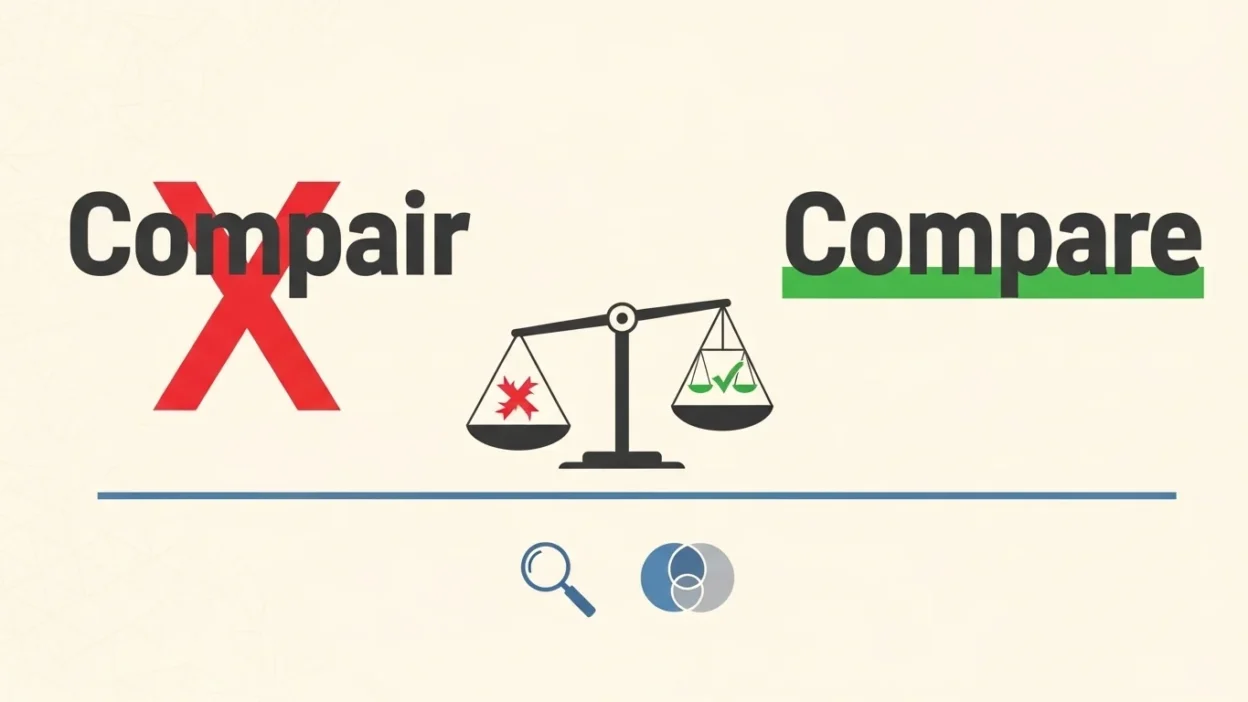
Quick Answer: Compair vs Compare
- ✅ Correct spelling: Compare
- ❌ Incorrect spelling: Compair
The word compare is the correct and widely accepted form. Compair is a misspelling and should not be used.
What Does “Compare” Mean?
The word compare is a verb that means to examine two or more things to identify similarities and differences.
Simple Definitions:
- To evaluate similarities and differences
- To analyze items side by side
- To assess or measure one thing against another
Examples in Sentences:
- Let’s compare these two products before buying.
- She likes to compare prices online.
- The report compares different strategies.
Why Do People Write “Compair”?
The incorrect spelling compair usually comes from confusion between similar-sounding vowel combinations.
Common Reasons:
- Mixing up “-pare” with “-pair”
- Phonetic spelling based on pronunciation
- Influence from words like “pair”
Key Point:
Even though “pair” is a real word, it does not apply in compare.
Understanding the Correct Spelling Pattern
The word compare comes from Latin comparare, meaning “to match or bring together.”
Key Insight:
👉 The correct ending is “-pare,” not “-pair.”
Break It Down:
- Com → together
- Pare → to match or equal
This explains why:
- Compare ✅
- Compair ❌
Compair vs Compare: Comparison Table
| Feature | Compare ✅ | Compair ❌ |
|---|---|---|
| Correct spelling | Yes | No |
| Meaning | Examine similarities/differences | No meaning |
| Dictionary status | Recognized | Not recognized |
| Usage | Formal & informal | Incorrect |
| Word ending | “-pare” | Incorrect “-pair” |
Common Mistakes to Avoid
Even simple spelling errors can affect clarity. Here are the most common ones:
1. Using “Pair” Instead of “Pare”
❌ Let’s compair the results.
✅ Let’s compare the results.
2. Relying Only on Sound
Both words sound similar, which can lead to confusion.
3. Typing Quickly Without Checking
Fast typing often leads to small spelling mistakes.
4. Confusing with Related Words
- Pair = two items
- Compare = analyze similarities/differences
More Examples of “Compare” in Context
In Everyday Life:
- Always compare options before making a decision.
- She compared different brands before buying.
In Academic Writing:
- The essay compares two historical events.
- Students are asked to compare theories.
In Business:
- Companies compare performance metrics regularly.
American vs British English Differences
There is no difference between American and British English for this word.
- 🇺🇸 American English: compare
- 🇬🇧 British English: compare
Both forms use the same spelling and meaning.
Why Correct Spelling Matters
Using the correct spelling of compare improves your writing quality and credibility.
Key Benefits:
- Enhances clarity and understanding
- Builds trust with readers
- Improves professionalism
- Supports effective communication
Even small mistakes like compair can distract readers.
Synonyms and Related Words
Using alternative words can make your writing more engaging.
Synonyms of “Compare”:
- Contrast
- Evaluate
- Analyze
- Examine
- Assess
Easy Memory Trick
Here’s a simple way to remember:
👉 “Compare has ‘pare’—like preparing to analyze.”
This helps reinforce the correct spelling.
FAQs About Compair vs Compare
Is “compair” ever correct?
No, compair is always incorrect and should not be used.
What is the correct spelling?
The correct spelling is compare.
What does “compare” mean?
It means to examine similarities and differences between things.
Why do people confuse these words?
Because of similar pronunciation and confusion with “pair.”
Is there a British vs American difference?
No, both use compare.
Can “compare” be used in formal writing?
Yes, it is widely used in academic and professional contexts.
How can I remember the correct spelling?
Remember that “compare” ends with “-pare,” not “-pair.”
Can spell-check tools catch this mistake?
Yes, most tools will flag compair as incorrect.
Summary: Compair vs Compare
The difference between compair vs compare is simple but important. Compare is the correct spelling and is used to analyze similarities and differences, while compair is a common misspelling that should always be avoided.
Understanding the correct structure and practicing it can help you avoid this mistake. Small details like this improve clarity and make your writing more professional.
Final Thoughts
Spelling accuracy plays a key role in effective communication. By consistently using compare and avoiding compair, you ensure your writing is clear, polished, and easy to understand.