Have you ever wondered whether you should use continuous or continuing in a sentence? Since both words come from the verb continue, they seem almost identical. However, they are not always interchangeable, and using the wrong one can subtly change the meaning of your sentence.
In this guide, you’ll learn the difference between continuous vs continuing, discover when each word is appropriate, see practical examples, avoid common grammar mistakes, and understand how native English speakers use these terms in everyday and professional communication.
Quick Answer
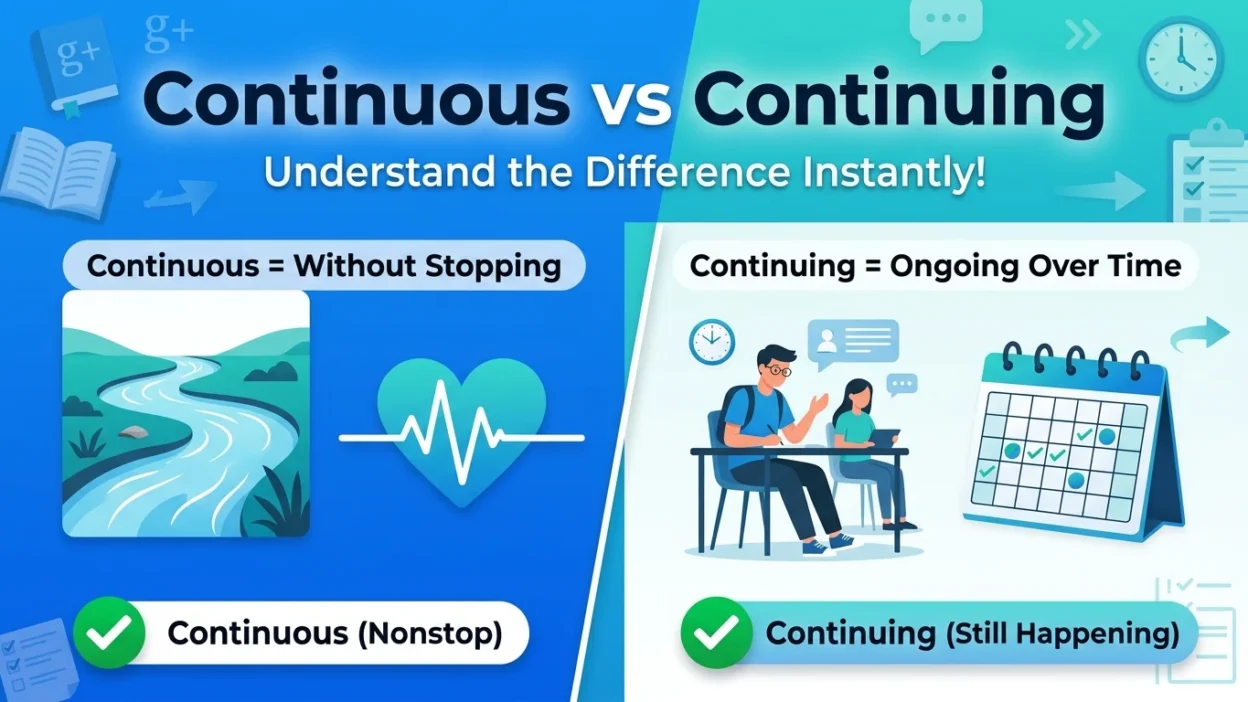
The difference between continuous and continuing is mainly about meaning and emphasis.
- Continuous describes something that happens without stopping or interruption.
- Continuing describes something that keeps happening over time, although there may be pauses or breaks.
Examples:
- The machine made a continuous noise all night. ✅
- She receives continuing support from her family. ✅
Think of it this way:
- Continuous = nonstop.
- Continuing = ongoing.
What Does “Continuous” Mean?
Continuous is an adjective that describes something happening without interruption.
If something is continuous, it does not stop, pause, or break.
Examples
- We heard continuous thunder throughout the storm.
- The alarm produced a continuous sound.
- The road has a continuous white line.
- There was continuous rainfall for several hours.
- The factory operates with continuous production.
In each example, the activity or condition remains uninterrupted.
What Does “Continuing” Mean?
Continuing is the present participle of the verb continue, but it is also commonly used as an adjective.
As an adjective, it means something that continues over a period of time, even if there are occasional pauses.
Examples
- The company offers continuing education programs.
- We appreciate your continuing support.
- The investigation is continuing.
- They face continuing challenges.
- The project requires continuing maintenance.
Here, the emphasis is on something lasting over time rather than happening without interruption.
Continuous vs Continuing: Comparison Table
| Feature | Continuous | Continuing |
|---|---|---|
| Part of Speech | Adjective | Adjective / Verb form |
| Meaning | Without interruption | Ongoing over time |
| Emphasis | Nonstop action | Lasting or recurring activity |
| Example | Continuous rain | Continuing education |
| Can Have Breaks? | No | Yes |
When Should You Use “Continuous”?
Use continuous when describing something that never stops during a specific period.
Examples
- The baby cried with continuous tears.
- We experienced continuous delays.
- The machine runs on continuous power.
- The river provides a continuous flow of water.
- There was continuous applause after the performance.
In each sentence, the activity is uninterrupted.
When Should You Use “Continuing”?
Use continuing when something remains active, ongoing, or repeated over time.
Examples
- Thank you for your continuing cooperation.
- The school offers continuing education classes.
- The organization provides continuing assistance.
- We expect continuing improvements.
- The patient needs continuing care.
These situations may include pauses but continue over an extended period.
The Key Difference
The easiest way to distinguish these words is by asking one question:
Does it stop?
If the answer is no, use continuous.
If the answer is yes, but it keeps happening over time, use continuing.
For example:
- Continuous rainfall means the rain never stopped.
- Continuing rainfall means it keeps occurring over several days, even if there are breaks.
Common Mistakes People Make
Because the words are closely related, they’re often confused.
Mistake 1: Using Continuous for Ongoing Support
❌ Thank you for your continuous support.
✅ Thank you for your continuing support.
Support usually continues over time rather than occurring every second without interruption.
Mistake 2: Using Continuing for Nonstop Noise
❌ The alarm made a continuing sound.
✅ The alarm made a continuous sound.
The alarm sounded without stopping.
Mistake 3: Assuming They’re Always Interchangeable
Although similar, these words emphasize different ideas.
Choosing the correct one makes your writing more accurate.
Easy Trick to Remember the Difference
Here’s a simple memory tip.
Think about these questions:
Does it happen nonstop?
Use continuous.
Does it keep happening over time?
Use continuing.
For example:
- Continuous music played throughout the ceremony.
- We appreciate your continuing friendship.
One is uninterrupted.
The other is ongoing.
Everyday Examples
Using “Continuous”
- The engine produced continuous vibrations.
- She worked for eight continuous hours.
- We experienced continuous sunshine.
- The speaker gave a continuous presentation.
- The phone rang with a continuous tone.
Using “Continuing”
- The team received continuing encouragement.
- We face continuing economic challenges.
- The museum offers continuing workshops.
- He has continuing responsibilities.
- The negotiations are continuing.
Common Expressions
You’ll often hear these phrases.
With “Continuous”
- Continuous improvement
- Continuous monitoring
- Continuous operation
- Continuous flow
- Continuous process
With “Continuing”
- Continuing education
- Continuing support
- Continuing care
- Continuing efforts
- Continuing development
These combinations are widely accepted in both formal and informal English.
Continuous vs Continual
Many learners also confuse continuous with continual.
Although they are similar, continual means something happens repeatedly with interruptions, while continuous means it happens without any interruption.
For example:
- Continuous rain fell for six hours without stopping.
- Continual interruptions made it difficult to finish the meeting.
This distinction is helpful when choosing the most accurate word.
American vs British English
There is no significant difference between American and British English in the use of continuous and continuing.
Both varieties use the words with the same meanings.
However, in professional settings, expressions such as continuing education, continuing professional development, and continuous improvement are widely recognized in both forms of English.
Practice Sentences
Choose the correct word.
- We appreciate your ______ support.
Answer: continuing
- The machine produced a ______ noise.
Answer: continuous
- The university offers ______ education programs.
Answer: continuing
- There was ______ traffic for two hours.
Answer: continuous
- The negotiations are ______.
Answer: continuing
Frequently Asked Questions (FAQs)
What is the difference between continuous and continuing?
Continuous means happening without interruption, while continuing means ongoing over time, even if there are occasional breaks.
Can continuous and continuing be used interchangeably?
Not always. They have similar meanings but emphasize different ideas.
Which is correct: continuous support or continuing support?
Continuing support is usually correct because support continues over time rather than occurring nonstop.
What does continuous mean?
It describes something that happens without stopping or interruption.
What does continuing mean?
It describes something that remains ongoing or continues over a period of time.
Is there a difference between American and British English?
No. Both American and British English use continuous and continuing in the same way.
What is the difference between continuous and continual?
Continuous means nonstop, while continual means repeated with interruptions.
Summary
Understanding continuous vs continuing is easier once you focus on whether something happens without interruption or simply continues over time. Continuous describes an activity or condition that never stops during a particular period, while continuing refers to something ongoing that may include pauses or repeated occurrences. Although the two words are closely related, they highlight different aspects of duration.
Choosing the correct word helps make your writing more precise and natural. Whether you’re describing continuous rainfall, a continuing education program, or ongoing support, recognizing the distinction between continuous and continuing allows you to communicate your ideas clearly and accurately in both everyday conversations and professional writing.

Dani Morrison is a dedicated language writer and spelling expert at Spelword.com, where she focuses on helping readers understand common English spelling mistakes and confusing word pairs. With a passion for clear communication, Dani creates easy-to-follow guides that simplify complex grammar and spelling rules for everyday use.