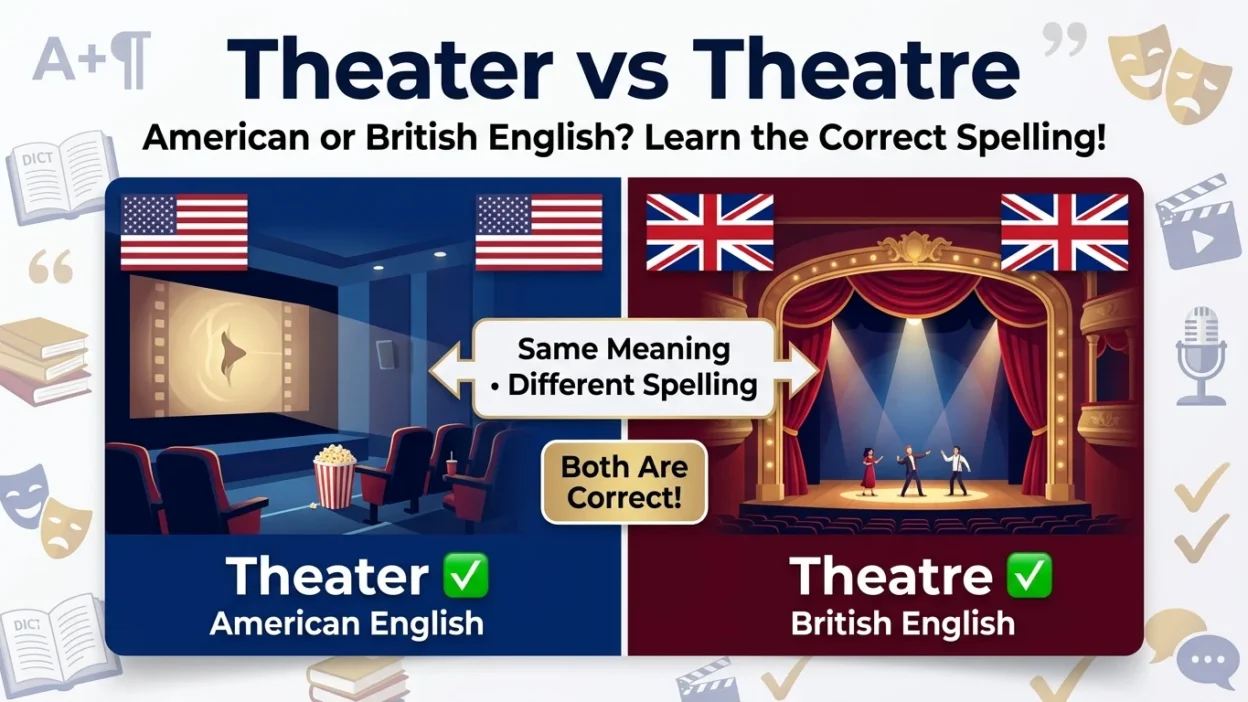
Have you ever noticed that some people write theater while others write theatre? If you’ve seen both spellings in books, movie websites, travel guides, or school materials, you may have wondered whether one of them is incorrect. The good news is that both spellings are correct they simply belong to different varieties of English.
In this guide, you’ll learn the difference between theater vs theatre, understand when each spelling should be used, explore practical examples, discover common mistakes, and find out how American and British English differ. By the end, you’ll know exactly which spelling fits your audience and writing style.
Quick Answer
Both theater and theatre are correct spellings.
- Theater is the preferred spelling in American English.
- Theatre is the standard spelling in British English and many Commonwealth countries.
They have the same pronunciation and meaning.
Examples:
- We watched a movie at the theater. ✅ (American English)
- We watched a play at the theatre. ✅ (British English)
The only difference is spelling preference based on regional English.
What Does “Theater” Mean?
Theater is a noun that refers to:
- A building where plays, musicals, concerts, or films are presented.
- The art or profession of acting and stage performance.
- A place designed for performances or entertainment.
In American English, theater is the preferred spelling.
Examples
- We went to the theater on Saturday.
- The new theater seats over 500 people.
- She studied theater in college.
- They bought tickets to the local theater.
- His passion for theater began at a young age.
What Does “Theatre” Mean?
Theatre has exactly the same meaning as theater.
It refers to:
- A venue for live performances.
- The performing arts.
- Dramatic productions and acting.
The spelling theatre is preferred in British English and many other English-speaking countries.
Examples
- The theatre hosts Shakespeare productions.
- She enjoys working in the theatre.
- The city’s historic theatre attracts thousands of visitors.
- We attended a musical at the theatre.
- He teaches theatre studies at the university.
The meaning does not change—only the spelling.
Theater vs Theatre: Comparison Table
| Feature | Theater | Theatre |
|---|---|---|
| Meaning | Building or art of performance | Building or art of performance |
| Correct? | Yes | Yes |
| Preferred In | American English | British English |
| Pronunciation | Same | Same |
| Grammar | Same | Same |
Why Are There Two Spellings?
The difference between theater and theatre comes from the historical development of English spelling.
American English simplified many spellings over time.
Examples include:
- Center → Centre
- Meter → Metre
- Theater → Theatre
American English generally favors -er, while British English often prefers -re.
Both spellings originated from the same historical root and remain correct today.
When Should You Use “Theater”?
Use theater if you’re writing for an American audience.
It is the standard spelling in:
- United States publications
- American schools
- U.S. businesses
- American newspapers
- U.S. entertainment websites
Examples
- We visited the movie theater.
- She teaches theater arts.
- They’re renovating the downtown theater.
- The theater was sold out.
- He dreams of working in theater.
When Should You Use “Theatre”?
Use theatre when writing for readers in:
- United Kingdom
- Australia
- New Zealand
- Ireland
- South Africa
- Many Commonwealth countries
Examples
- The theatre reopened after renovations.
- She studies theatre history.
- We enjoyed an evening at the theatre.
- The local theatre hosts community performances.
- They’re performing at the national theatre.
If your audience follows British English conventions, theatre is the preferred spelling.
Common Mistakes People Make
Although both spellings are correct, consistency is important.
Mistake 1: Mixing Spellings
Avoid writing:
- The local theater hosted a performance at the city theatre.
Unless you’re referring to official names, choose one spelling style and use it consistently.
Mistake 2: Thinking One Spelling Is Incorrect
Neither spelling is wrong.
The correct choice depends on your audience.
Mistake 3: Changing Styles Mid-Article
If you’re writing in American English, consistently use:
- Theater
- Center
- Meter
If you’re writing in British English, consistently use:
- Theatre
- Centre
- Metre
Consistency improves professionalism and readability.
Easy Trick to Remember the Difference
Here’s a simple memory tip.
Think about your audience.
- America → Theater (-er)
- Britain → Theatre (-re)
The meaning never changes.
Only the spelling does.
Everyday Examples
Using “Theater”
- We met outside the theater.
- She’s studying theater.
- The theater opens at 6 p.m.
- They’re building a new theater.
- The movie theater was crowded.
Using “Theatre”
- We visited the Royal Theatre.
- She enjoys theatre performances.
- The community theatre is popular.
- They work in professional theatre.
- The historic theatre was beautifully restored.
Common Expressions
These expressions are widely used.
With “Theater”
- Movie theater
- Theater performance
- Theater production
- Theater company
- Theater director
- Theater arts
With “Theatre”
- Theatre company
- Theatre production
- Theatre performance
- Theatre school
- Theatre actor
- Theatre studies
The phrases are identical except for spelling.
American vs British English
This is where the primary difference appears.
American English
Preferred spellings:
- Theater
- Center
- Meter
- Color
- Organize
British English
Preferred spellings:
- Theatre
- Centre
- Metre
- Colour
- Organise
Neither spelling is more correct than the other.
Simply match the spelling to your audience and remain consistent throughout your writing.
Practice Sentences
Choose the correct spelling based on the variety of English.
- We watched a movie at the ______ in New York.
Answer: theater
- She performs at a famous ______ in London.
Answer: theatre
- He’s studying ______ arts in California.
Answer: theater
- The community ______ hosts local productions.
Answer: theatre (British) or theater (American)
- They renovated the historic ______.
Answer: theater (American) or theatre (British)
Frequently Asked Questions (FAQs)
What is the difference between theater and theatre?
There is no difference in meaning. Theater is the American English spelling, while theatre is the British English spelling.
Which spelling is correct?
Both are correct. The choice depends on whether you’re using American or British English.
Is theatre used in the United States?
Yes. Some organizations and venues in the United States intentionally use theatre in their official names for stylistic or historical reasons, but theater is the standard American spelling.
Is theater wrong in British English?
No. It is understood, but theatre is the preferred spelling in British English.
Which spelling should I use for international readers?
Choose one spelling style and use it consistently throughout your article. Consistency is more important than choosing one variant over the other.
Why do American and British English have different spellings?
Over time, American English adopted simplified spelling conventions, while British English retained many traditional spellings inherited from earlier forms of English.
Do theater and theatre have different pronunciations?
No. They are pronounced the same way despite the spelling difference.
Summary
Understanding theater vs theatre is easy once you know that both spellings are correct. Theater is the standard spelling in American English, while theatre is preferred in British English and many Commonwealth countries. Their meanings, pronunciation, and grammatical usage are exactly the same, so the choice depends entirely on your intended audience.
The key to using these spellings correctly is consistency. If you’re writing for American readers, use theater throughout your content. If your audience follows British English conventions, choose theatre and use it consistently. Doing so will make your writing appear polished, professional, and appropriate for your readers.

William Harved is a passionate language enthusiast and digital writer specializing in English spelling, grammar clarity, and common writing mistakes. As the primary author of Spelword.com, he focuses on helping readers understand confusing word pairs, correct spelling errors, and improve everyday communication.