Have you ever written “sitted” and hesitated, wondering if it sounded right? You’re not alone. This is a very common confusion, especially for learners and even fluent speakers who rely on how words sound rather than their correct forms.
Understanding sitted vs seated is important for clear, natural English. Let’s explore the difference in a simple and friendly way so you can use the right word with confidence.
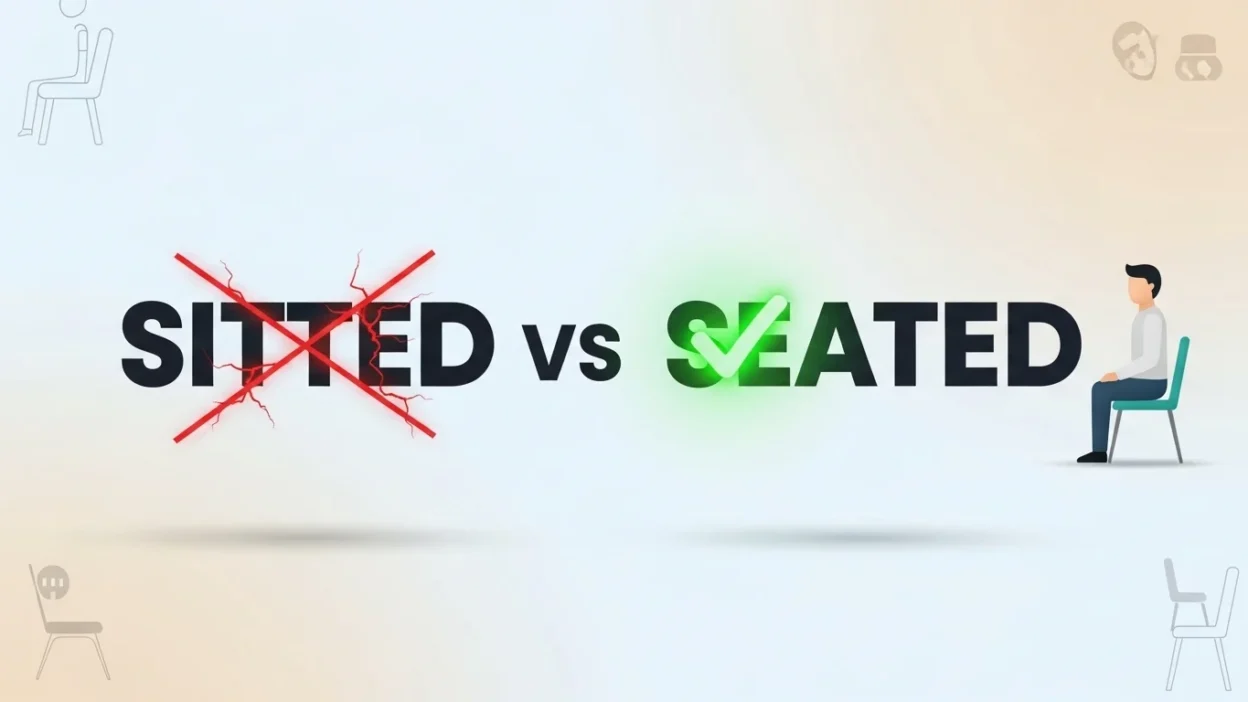
Quick Answer: Sitted vs Seated
- ❌ Sitted = Incorrect (nonstandard in modern English)
- ✅ Seated = Correct
What Does “Seated” Mean?
Seated is the correct past form or adjective related to sitting.
Core Meanings of Seated
- Sitting down
- Placed in a seat
- Positioned comfortably
Examples of “Seated” in Sentences
- He remained seated during the performance.
- Please stay seated until the ride stops.
Why Do People Say “Sitted”?
This mistake usually happens because:
- People try to form the past tense by adding “-ed”
- Confusion with regular verbs (like “walked” or “talked”)
- Lack of awareness that “sit” is an irregular verb
However, the correct past tense of “sit” is “sat,” not “sitted.”
Correct Forms of “Sit”
- Present: Sit
- Past: Sat
- Past participle: Sat
👉 Example:
- “I sat down after a long day.”
Sitted vs Seated: Key Differences
| Feature | Seated | Sitted |
|---|---|---|
| Correct spelling | ✅ Yes | ❌ No |
| Meaning | Sitting or placed in a seat | None (incorrect form) |
| Grammar | Adjective / past form usage | Invalid verb form |
| Usage | Formal & informal English | Should be avoided |
| Dictionary status | Recognized word | Not accepted in standard use |
When to Use “Seated” vs “Sat”
Understanding this distinction can improve your grammar even more.
Use “Seated” When:
- You describe a state or position
- You refer to arrangement or placement
Use “Sat” When:
- You describe the action of sitting
Examples:
- “She sat on the chair.”
- “He sat beside me.”
Common Mistakes to Avoid
When dealing with sitted vs seated, here are common errors:
1. Using “Sitted” as Past Tense
- ❌ I sitted there.
- ✅ I sat there.
2. Confusing “Sat” and “Seated”
- “Sat” = action
- “Seated” = position
3. Overgeneralizing Grammar Rules
Not all verbs follow the “-ed” pattern.
Easy Memory Trick
👉 “Sit becomes sat, and seated shows position.”
- Action → Sat
- Position → Seated
This makes it easy to choose the correct form.
Real-Life Usage of “Seated”
Using “seated” correctly makes your English sound more natural and polished.
In Formal Situations
- “The audience remained seated.”
- “Guests were seated according to their tickets.”
In Everyday Conversations
- “She was already seated when I arrived.”
In Instructions
- “Please remain seated during the flight.”
Synonyms and Related Words
To add variety to your writing, consider these alternatives:
- Sitting
- Positioned
- Placed
- Settled
Example:
- “She was sitting by the window.”
American vs British English
There is no difference between American and British English for these words.
- 🇺🇸 American English: Seated / Sat
- 🇬🇧 British English: Seated / Sat
Both forms follow the same rules.
Why Correct Usage Matters
- Improves grammar accuracy
- Enhances clarity and fluency
- Builds confidence in communication
- Reflects strong language skills
Using “sitted” can:
- Make your writing sound unnatural
- Signal grammar mistakes
- Reduce credibility
FAQs About Sitted vs Seated
Is “sitted” a correct word?
No, “sitted” is not correct in standard modern English.
What is the past tense of “sit”?
The past tense of “sit” is “sat.”
When should I use “seated”?
Use “seated” when describing someone in a sitting position.
Can “seated” replace “sat”?
Not always. “Seated” describes a state, while “sat” describes an action.
Why do people say “sitted”?
Because they assume “sit” follows regular verb patterns.
Is there a British vs American difference?
No, both use “sat” and “seated.”
What are synonyms for “seated”?
Words like sitting, placed, or positioned can be used.
How can I remember the correct forms?
Remember: sit → sat, not “sitted.”
Summary: Sitted vs Seated
The difference between sitted vs seated is clear once you understand basic grammar rules. “Seated” is the correct word used to describe someone who is sitting or placed in a sitting position. It is widely accepted in both formal and informal English.
“Sitted,” on the other hand, is incorrect and results from applying regular verb rules to an irregular verb. The correct past tense of “sit” is “sat,” which should be used when describing the action itself.
By learning these distinctions and practicing correct usage, you can improve your writing and speaking skills significantly. Small grammar corrections like this help your communication sound more natural, accurate, and professional.