Have you ever typed a sentence and wondered whether you meant vary or very? You’re not alone. These two words look similar, sound somewhat alike, and are among the most commonly confused words in English. A simple typo can completely change the meaning of a sentence, making your writing unclear or incorrect.
Whether you’re a student, professional, writer, or English learner, understanding the difference between vary vs very can help you communicate more accurately and confidently. In this guide, you’ll learn what each word means, how to use them correctly, common mistakes to avoid, and practical examples that make the distinction easy to remember.
Quick Answer
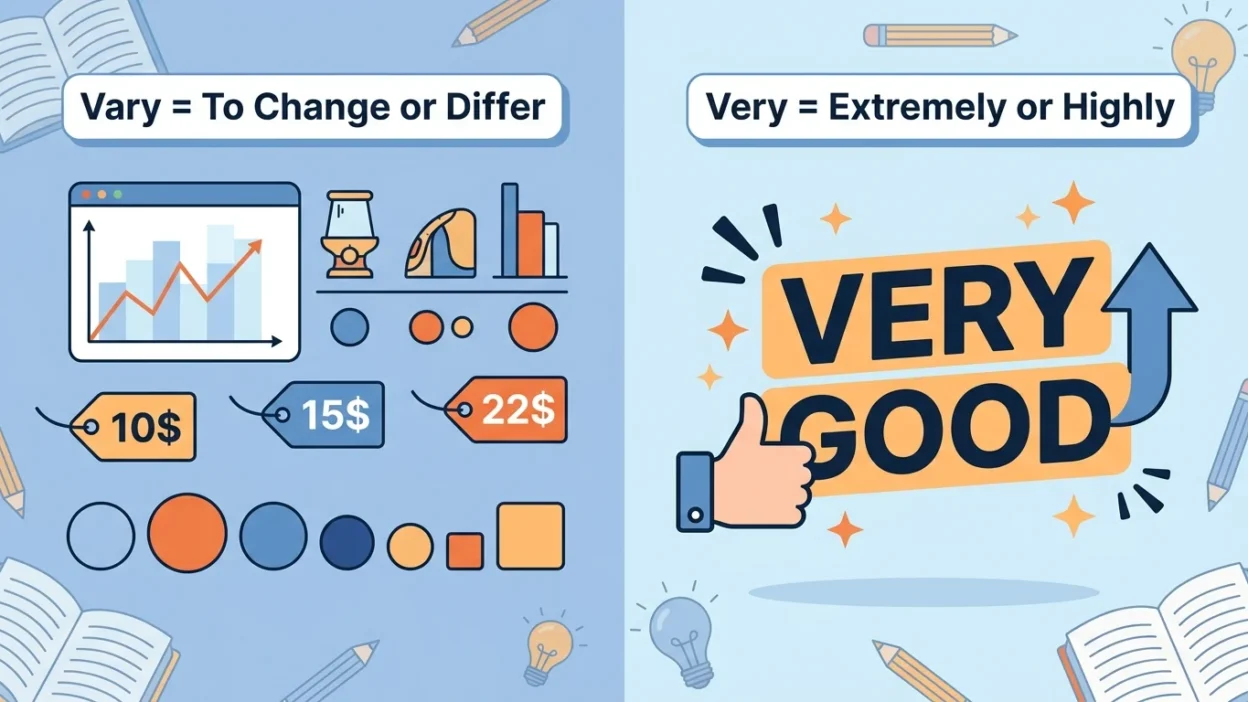
Vary is a verb that means to change, differ, or become different.
Very is an adverb that means extremely or to a high degree.
- ✅ Prices vary from store to store.
- ✅ The movie was very entertaining.
A simple rule is:
- Use vary when talking about differences or changes.
- Use very when emphasizing something.
What Does “Vary” Mean?
Vary is a verb. It describes something that changes, differs, or is not always the same.
When things vary, they are different from one another or change over time.
Examples of Vary
- Prices vary depending on location.
- Weather conditions vary throughout the year.
- Opinions vary among experts.
- Results may vary from person to person.
- The colors vary across the collection.
In each example, the focus is on differences or changes.
What Does “Very” Mean?
Very is an adverb that intensifies or emphasizes another word.
It usually modifies adjectives and adverbs to indicate a high degree.
Examples of Very
- She is very talented.
- The test was very difficult.
- They arrived very early.
- The meal was very delicious.
- He is very happy with the results.
In these sentences, very strengthens the meaning of the words that follow it.
Vary vs Very: The Main Difference
The key difference is that they belong to different parts of speech.
- Vary = verb (an action word)
- Very = adverb (a describing word)
Comparison Table
| Feature | Vary | Very |
|---|---|---|
| Part of Speech | Verb | Adverb |
| Meaning | To differ or change | Extremely or highly |
| Function | Shows change or difference | Adds emphasis |
| Example | Costs vary by region. | Costs are very high. |
| Can Replace Each Other? | No | No |
Although the words look similar, they serve completely different purposes in a sentence.
How to Use Vary Correctly
Use vary when discussing differences, changes, or variations.
Common Sentence Patterns
- Vary by
- Vary from
- Vary according to
- Vary depending on
Examples
- Salaries vary by industry.
- The symptoms vary from patient to patient.
- Travel costs vary according to season.
- Performance can vary depending on experience.
- Preferences vary among individuals.
These examples show that vary expresses change or difference.
How to Use Very Correctly
Use very when you want to strengthen an adjective or adverb.
Examples
- The book is very interesting.
- She spoke very clearly.
- The project was very successful.
- We are very grateful.
- The restaurant is very popular.
In each sentence, very increases the intensity of the description.
Why People Confuse Vary and Very
The confusion usually happens because:
- The words have similar spellings.
- Their pronunciations are somewhat alike.
- Typing errors are common.
- Spell-check tools may not catch the mistake because both are valid words.
For example:
Incorrect
- The results are vary impressive.
Correct
- The results are very impressive.
Here, very is needed because it emphasizes the adjective impressive.
Incorrect
- Prices very across different stores.
Correct
- Prices vary across different stores.
In this case, vary is required because the sentence discusses differences.
Common Mistakes to Avoid
Mistake 1: Using Very as a Verb
Incorrect:
- Prices very by location.
Correct:
- Prices vary by location.
Very cannot describe change.
Mistake 2: Using Vary as an Intensifier
Incorrect:
- She is vary talented.
Correct:
- She is very talented.
Vary cannot intensify adjectives.
Mistake 3: Typos in Professional Writing
Many writers accidentally type one word instead of the other because the letters are similar.
Examples:
- ❌ vary good
- ✅ very good
- ❌ very depending on
- ✅ vary depending on
Proofreading can help catch these errors.
Mistake 4: Assuming Pronunciation Determines Meaning
Even if the words sound somewhat similar, pronunciation alone does not determine usage. Focus on the sentence meaning instead.
Easy Trick to Remember the Difference
A simple memory trick can help.
Vary = Variation
Both words begin with var.
If you can replace the word with change or differ, use vary.
Example:
- Prices vary.
- Prices change.
The meaning remains similar.
Very = Emphasis
Think of very as a word that makes something stronger.
Example:
- very happy
- very large
- very expensive
If you are adding emphasis, choose very.
Examples in Everyday Situations
Workplace Examples
- Project timelines vary from department to department.
- The manager was very pleased with the team’s performance.
School Examples
- Learning styles vary among students.
- The exam was very challenging.
Travel Examples
- Hotel prices vary throughout the year.
- The destination was very beautiful.
Health Examples
- Symptoms vary from person to person.
- The treatment was very effective.
Shopping Examples
- Product availability may vary by location.
- The discount was very attractive.
These examples demonstrate how the two words serve entirely different functions.
Vary vs Very in Formal Writing
Using the correct word is especially important in professional and academic writing.
Correct Academic Example
- Research findings vary across populations.
Correct Business Example
- Customer satisfaction is very important to our company.
Using the wrong word can make your writing appear careless or confusing.
American vs British English Differences
There are no significant differences between American and British English regarding vary and very.
The meanings, spelling, pronunciation, and grammatical functions remain the same in both varieties of English.
Whether you are writing for a British audience or an American audience:
- Vary means to differ or change.
- Very means extremely or highly.
The usage rules are identical.
Frequently Asked Questions
What is the difference between vary and very?
Vary means to change or differ, while very means extremely or highly.
Is vary a verb?
Yes. Vary is a verb that describes differences or changes.
Is very an adverb?
Yes. Very is an adverb used to strengthen adjectives and other adverbs.
Can vary and very be used interchangeably?
No. They have completely different meanings and grammatical functions.
Why do people confuse vary and very?
They look similar, sound somewhat alike, and are often mistyped.
Which sentence is correct: “Prices vary” or “Prices very”?
Prices vary is correct because the sentence discusses differences.
Which sentence is correct: “very good” or “vary good”?
Very good is correct because very intensifies the adjective good.
How can I remember the difference quickly?
Think of vary as related to variation and very as related to emphasis.
Summary
Understanding vary vs very is easier once you recognize that they belong to different parts of speech. Vary is a verb that means to change, differ, or be different, while very is an adverb used to add emphasis or intensity. Although the words look similar, they cannot replace each other.
Using the correct word improves clarity, professionalism, and accuracy in writing. Whenever you’re unsure, ask yourself whether the sentence involves a change or difference. If it does, choose vary. If you’re strengthening a description or adding emphasis, choose very.

William Harved is a passionate language enthusiast and digital writer specializing in English spelling, grammar clarity, and common writing mistakes. As the primary author of Spelword.com, he focuses on helping readers understand confusing word pairs, correct spelling errors, and improve everyday communication.