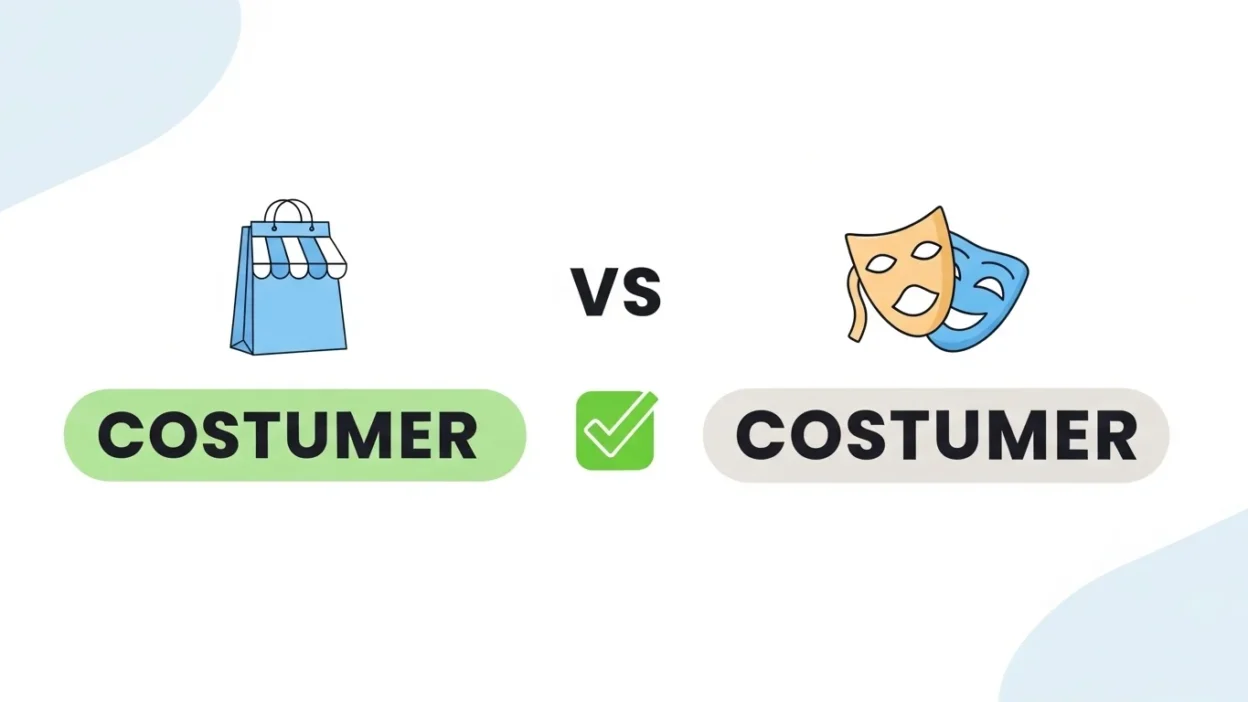
It’s surprisingly easy to confuse costumer and customer. They look almost identical, sound similar, and can slip past you when typing quickly. But here’s the catch they have completely different meanings, and using the wrong one can change your message entirely.
If you’ve ever wondered whether you meant someone buying a product or someone designing outfits, you’re in the right place. This guide will clearly explain costumer vs customer, helping you understand the difference, use each word correctly, and avoid common mistakes in everyday writing.
Quick Answer: Costumer vs Customer
- Customer: A person who buys goods or services.
- Costumer: A person who makes, designs, or supplies costumes.
Both are real words—but they are not interchangeable.
What Does “Customer” Mean?
The word customer refers to someone who purchases products or services from a business.
Definition:
A person who buys goods or services from a shop, company, or provider.
Examples:
- The store values every customer.
- She is a loyal customer of that brand.
- Good service keeps customers coming back.
This is one of the most commonly used words in business, marketing, and everyday conversation.
What Does “Costumer” Mean?
The word costumer is much less common and has a very specific meaning.
Definition:
A person who designs, makes, or supplies costumes, especially for theater, film, or events.
Examples:
- The costumer created outfits for the movie cast.
- She works as a costumer in a theater company.
- The costumer prepared costumes for the festival.
It’s mainly used in creative industries like film, fashion, and performing arts.
Costumer vs Customer: Key Differences
| Feature | Customer | Costumer |
|---|---|---|
| Meaning | Buys goods or services | Designs or supplies costumes |
| Usage frequency | Very common | Less common |
| Context | Business, shopping, services | Theater, film, fashion |
| Correct usage | Everyday communication | Specific professional context |
Why People Confuse Costumer and Customer
This mix-up happens more often than you might think. Here’s why:
1. Similar spelling
Only one letter separates the two words, making them easy to mix up.
2. Similar pronunciation
They sound nearly identical in fast speech.
3. Typing errors
Quick typing or autocorrect mistakes can swap one for the other.
4. Lack of familiarity
Most people use customer frequently but rarely encounter costumer.
Examples to Show the Difference Clearly
Using “customer” correctly:
- The customer asked for a refund.
- Every customer deserves respect.
Using “costumer” correctly:
- The costumer designed historical outfits for the play.
- A skilled costumer pays attention to detail.
Incorrect usage example:
- The costumer bought a new phone. ❌
- The customer bought a new phone. ✅
Common Mistakes to Avoid
Even though the difference is simple, these errors are common:
1. Using “costumer” when you mean “customer”
Incorrect: The costumer is always right.
Correct: The customer is always right.
2. Assuming both words mean the same
They are completely different and should not be swapped.
3. Ignoring context
If the sentence is about buying or selling, the correct word is almost always customer.
4. Not proofreading
Small spelling errors can change meaning and confuse readers.
Easy Ways to Remember the Difference
Here are a few simple memory tricks:
- Customer → contains “custom” → relates to buying habits or regular clients.
- Costumer → contains “costume” → relates to clothing or outfits.
- Think:
- Shopping = customer
- Costumes = costumer
These associations make it much easier to recall the correct word.
American vs British English Differences
There is no difference between American and British English for these words:
- Both use customer for buyers.
- Both use costumer for costume professionals.
The meanings and spellings remain the same in all regions.
Why Using the Correct Word Matters
Choosing between costumer and customer may seem minor, but it can have a big impact.
- Clarity: Your message becomes instantly understandable.
- Professionalism: Correct usage builds trust with readers.
- Credibility: Especially important in business or academic writing.
- Engagement: Readers stay focused without confusion.
Using the wrong word can make your writing seem careless, even if your idea is strong.
Frequently Asked Questions (FAQs)
What is the main difference between costumer and customer?
A customer buys goods or services, while a costumer designs or supplies costumes.
Is costumer a correct word?
Yes, costumer is correct, but it is used only in specific contexts related to costumes.
Which word is more commonly used?
Customer is far more common in everyday language.
Can costumer and customer be used interchangeably?
No, they have completely different meanings and should not be swapped.
How can I remember the difference easily?
Think: costume → costumer and shopping → customer.
Is there any difference in American and British English?
No, both words have the same meaning and spelling in both versions.
Why is this mistake so common?
Because the words look and sound very similar, especially when typing quickly.
Summary
The difference between costumer vs customer comes down to meaning and context. A customer is someone who buys products or services, while a costumer is someone who creates or supplies costumes. Although the words look similar, using the wrong one can completely change your sentence.
Understanding this distinction helps you communicate more clearly and professionally. By paying attention to context and remembering simple associations, you can avoid this common mistake and improve your writing with confidence.