
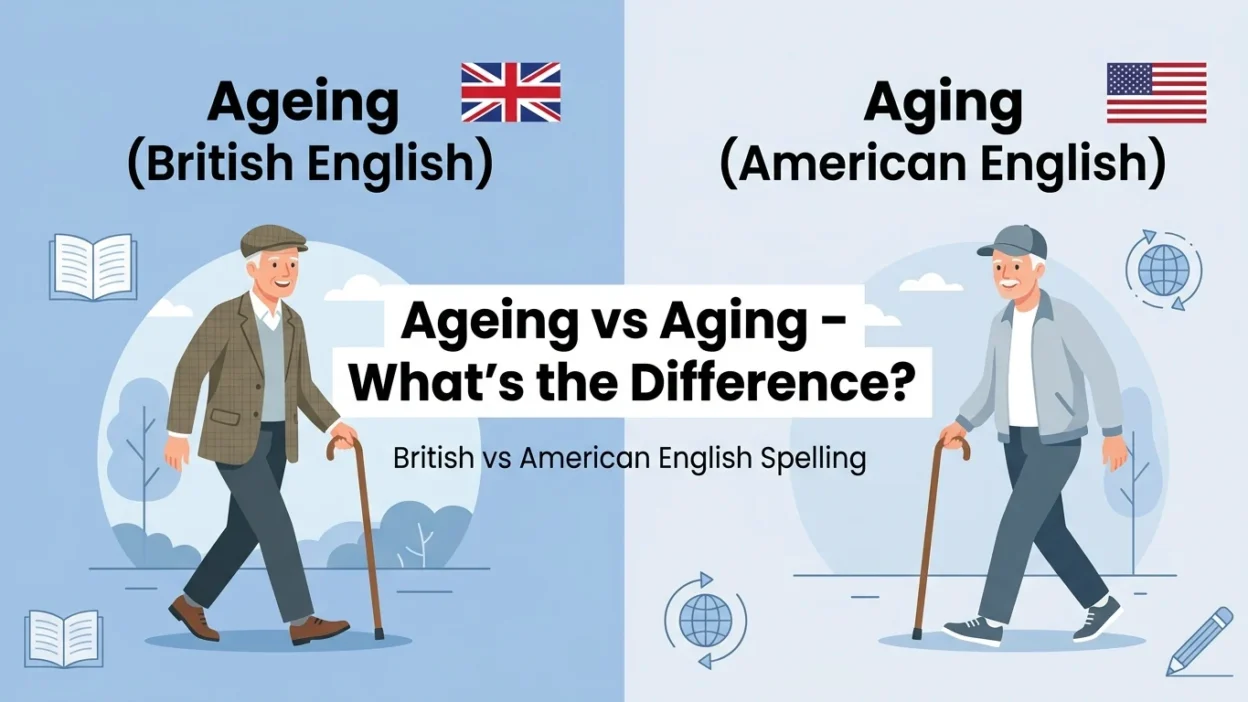
If you’ve ever wondered whether ageing or aging is the correct spelling, you’re not alone. These two words often confuse writers, students, bloggers, and professionals because both appear in books, websites, and dictionaries. The good news is that both spellings are correct they simply belong to different varieties of English.
Understanding the difference between ageing vs aging will help you write more confidently and choose the spelling that matches your audience. In this guide, you’ll learn when to use each spelling, see real life examples, discover common mistakes to avoid, and understand the American and British English differences.
Quick Answer
The difference between ageing and aging is based on the type of English you use.
- Aging is the preferred spelling in American English.
- Ageing is the preferred spelling in British English and many other English-speaking countries, including Australia and New Zealand.
Both words have exactly the same meaning. They describe the natural process of growing older or becoming older over time.
What Does “Aging” or “Ageing” Mean?
Both aging and ageing refer to the process of becoming older. The word can describe:
- People growing older
- Animals becoming older
- Plants maturing
- Objects wearing out over time
- Wine or cheese improving with age
- Scientific studies related to growing old
The meaning never changes between the two spellings. Only the regional spelling differs.
Examples
- My grandparents are aging gracefully. (American English)
- My grandparents are ageing gracefully. (British English)
- Scientists are studying the aging process.
- Researchers are exploring the ageing process.
Ageing vs Aging: Comparison Table
| Feature | Ageing | Aging |
|---|---|---|
| Meaning | Growing older | Growing older |
| Correct? | Yes | Yes |
| Preferred in | British English | American English |
| Used in UK | Yes | Rarely |
| Used in USA | Rarely | Yes |
| Meaning Changes? | No | No |
Why Are There Two Spellings?
The difference comes from regional spelling conventions rather than grammar.
British English often keeps spellings that have evolved differently over time, while American English simplified many spellings for consistency.
Because English is spoken worldwide, both spellings are accepted. The important thing is to stay consistent throughout your writing.
For example:
- A UK health website will usually write ageing population.
- A US medical journal will typically write aging population.
Neither is incorrect.
American vs British English
This is one of the clearest examples of spelling differences between American and British English.
American English
Use aging.
Examples:
- Healthy aging starts with good nutrition.
- The aging workforce needs updated training.
- Aging affects every part of the human body.
British English
Use ageing.
Examples:
- Healthy ageing begins with regular exercise.
- The ageing population continues to increase.
- Ageing is a natural biological process.
If you’re writing for an international audience, choose one spelling and use it consistently throughout your content.
Examples of Aging in Sentences
Here are some American English examples:
- The doctor specializes in aging research.
- Proper sleep can support healthy aging.
- Many people worry about aging skin.
- The aging bridge needs repairs.
- Scientists continue studying the biology of aging.
Examples of Ageing in Sentences
Here are British English examples:
- Regular exercise promotes healthy ageing.
- The government is planning for an ageing population.
- Experts study the effects of ageing on memory.
- The museum protects ageing historical documents.
- Good nutrition supports healthy ageing.
Common Phrases Using Aging and Ageing
American English:
- Aging population
- Aging process
- Healthy aging
- Aging parents
- Anti-aging products
British English:
- Ageing population
- Ageing process
- Healthy ageing
- Ageing parents
- Anti-ageing products
The phrases are identical except for spelling.
Common Mistakes to Avoid
Many learners make small spelling mistakes when using these words.
Mixing Both Spellings
Incorrect:
- The aging process affects everyone, and healthy ageing habits help.
Correct:
- Use aging throughout American English writing.
- Use ageing throughout British English writing.
Thinking One Is Wrong
Some people assume only one spelling is correct.
In reality:
- Ageing is correct.
- Aging is also correct.
Choose the version that matches your audience.
Switching English Styles
If your article uses American spellings like:
- color
- organize
- favorite
Then use aging.
If your writing uses British spellings like:
- colour
- organise
- favourite
Then use ageing.
Consistency makes your writing look professional.
Tips for Remembering the Difference
Here are a few easy ways to remember:
- Aging = American English
- Ageing = British English
- The meaning stays exactly the same.
- Match the spelling with your audience.
- Never switch between the two in the same document.
When Should You Use Aging?
Choose aging if you’re writing:
- For American readers
- US academic papers
- American businesses
- US healthcare content
- American websites
Example:
“The clinic offers programs that support healthy aging.”
When Should You Use Ageing?
Choose ageing if you’re writing:
- For UK readers
- British schools
- UK government documents
- Australian publications
- New Zealand audiences
Example:
“The charity provides services for the ageing community.”
Is One More Formal Than the Other?
No.
Both spellings are equally formal and accepted by dictionaries, universities, publishers, and style guides.
Professional writers simply choose the spelling that matches their target audience.
Whether you’re writing an academic paper, blog post, medical article, or business report, either spelling is appropriate when used consistently.
Frequently Confused Words
Many regional spelling differences follow the same pattern.
Examples include:
- Color vs Colour
- Favor vs Favour
- Organize vs Organise
- Realize vs Realise
- Traveling vs Travelling
- Aging vs Ageing
Understanding these differences makes it easier to write for different English-speaking audiences.
FAQs
Is ageing or aging correct?
Both are correct. Aging is preferred in American English, while ageing is preferred in British English.
Why do Americans spell it aging?
American English simplified many spellings over time. As a result, aging became the standard spelling in the United States.
Why does British English use ageing?
British English follows traditional spelling conventions, making ageing the standard form in the UK and many Commonwealth countries.
Can I use both spellings in one article?
No. It’s best to choose one spelling style and use it consistently throughout your writing.
Is there a difference in meaning between ageing and aging?
No. Both words describe the process of growing older and have exactly the same meaning.
Which spelling should I use in academic writing?
Use the spelling required by your institution, publisher, or style guide. American publications generally use aging, while British publications usually use ageing.
Is anti-aging different from anti-ageing?
No. The meaning is identical. The spelling simply depends on whether you’re using American or British English.
Summary
The difference between ageing vs aging comes down to regional spelling rather than meaning. Aging is the standard spelling in American English, while ageing is preferred in British English. Both describe the same natural process of growing older and are equally correct within their respective language varieties.
When writing, think about who will read your content. If your audience is mainly in the United States, use aging. If you’re writing for readers in the United Kingdom or other countries that follow British English, use ageing. Staying consistent throughout your document will make your writing clearer, more professional, and easier for your audience to follow.