
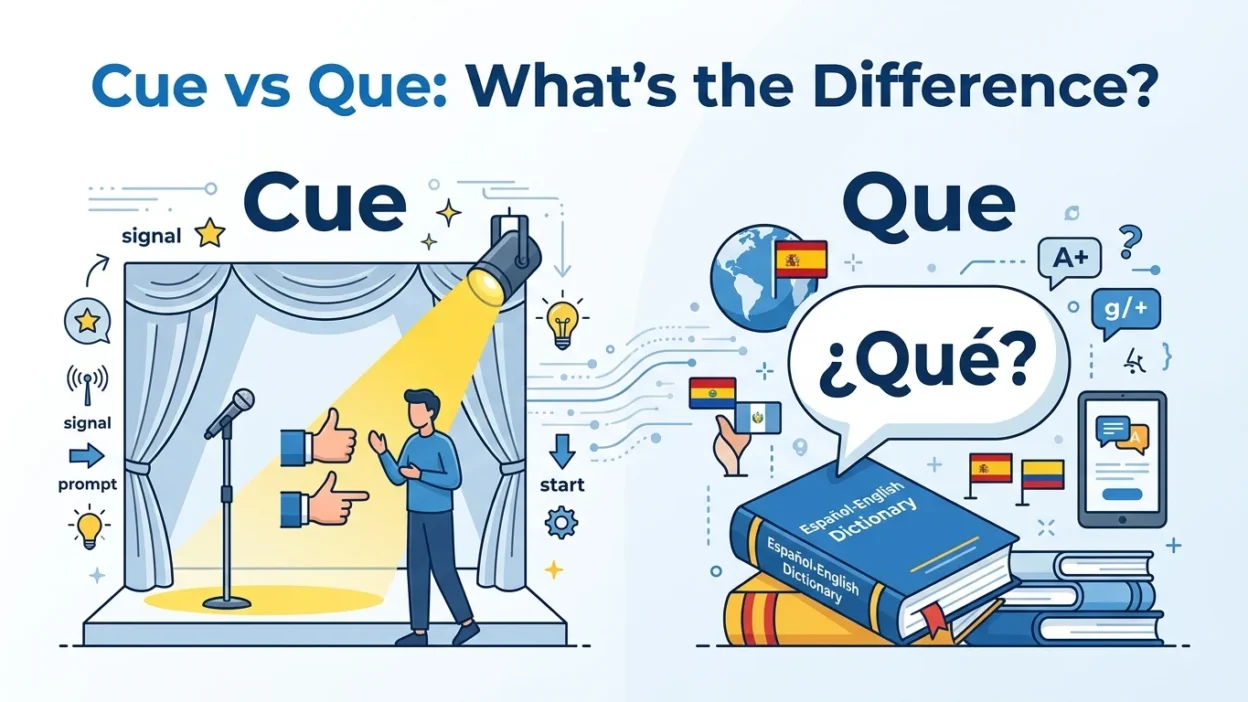
Have you ever stopped while writing and wondered whether you should use cue or que? You’re not alone. These two words look similar and sound alike to many English learners, but they have very different meanings and uses.
Understanding the difference between cue vs que can help you avoid common spelling mistakes and communicate more clearly. In this guide, you’ll learn what each word means, when to use it, examples in context, and simple tricks to remember the difference.
Quick Answer
Cue is an English word that means a signal, prompt, or indication to act or speak.
Que is generally not an English word. It is a word used in Spanish, Portuguese, and some other languages, where it usually means “what,” “that,” or “which” depending on the context.
Example:
- Correct: That was my cue to leave the meeting.
- Incorrect: That was my que to leave the meeting.
If you’re writing in English and mean a signal or prompt, cue is almost always the correct choice.
What Does Cue Mean?
The word cue is commonly used in English to describe a signal, prompt, or indication that tells someone to do something.
It can be used as both a noun and a verb.
Cue as a Noun
As a noun, cue refers to a signal that prompts an action.
Examples:
- The actor waited for her cue before entering the stage.
- The music was my cue to start dancing.
- His smile was a cue that everything was okay.
Cue as a Verb
As a verb, cue means to give a signal or prompt.
Examples:
- The director cued the performers.
- She cued the presentation slides.
- The teacher cued the students to begin.
What Does Que Mean?
Que is generally not considered a standard English word. It comes from languages such as Spanish and Portuguese.
In Spanish, que often means:
- What
- That
- Which
Examples in Spanish:
- ¿Qué hora es? (What time is it?)
- Creo que sí. (I think that yes.)
Because many people see the word online, in songs, or in multilingual content, they sometimes mistakenly use que when they actually mean cue.
Cue vs Que: Side-by-Side Comparison
| Feature | Cue | Que |
|---|---|---|
| Language | English | Spanish, Portuguese, and others |
| Meaning | Signal, prompt, indication | What, that, which |
| Part of Speech | Noun or verb | Conjunction, pronoun, or interrogative word |
| Common in English Writing | Yes | Usually no |
| Example | That’s my cue to speak. | ¿Qué pasa? |
| Frequently Confused? | Yes | Yes |
When to Use Cue
Use cue whenever you’re referring to a signal, hint, prompt, or indication.
Common Situations
- Theater performances
- Public speaking
- Body language
- Music and entertainment
- Everyday conversations
Examples:
- The applause was her cue to come on stage.
- He took the phone call as a cue to leave.
- The green light is your cue to go.
When to Use Que
Use que only when writing in Spanish, Portuguese, or another language where the word belongs.
Examples:
- Que tengas un buen día.
- No sé que decir.
In standard English writing, que is rarely correct unless you are quoting or using a foreign-language expression.
Common Mistakes with Cue and Que
Many writers accidentally replace cue with que because the words look similar.
Mistake #1: Using Que Instead of Cue
❌ That was my que to start talking.
✅ That was my cue to start talking.
Mistake #2: Assuming Que Is an English Alternative
❌ The teacher gave us a que.
✅ The teacher gave us a cue.
There is no English grammar rule that makes que a substitute for cue.
Mistake #3: Confusing Foreign Language Usage
If you’re writing entirely in English, using que may appear as a spelling error unless you’re intentionally using another language.
Easy Trick to Remember the Difference
A simple memory trick can help.
Cue = Clue
Both words contain the letter u and are related to signals or hints.
Think:
- Cue gives a clue.
Que = Question Word in Spanish
Many Spanish questions use que or qué, making it easier to remember that it belongs primarily to Spanish rather than English.
Examples of Cue in Sentences
Here are some everyday examples:
- The bell was our cue to return to class.
- Her raised eyebrow was a cue that she disagreed.
- The announcer gave the cue for the race to begin.
- He waited for the cue before speaking.
- The change in weather was a cue to bring a jacket.
Examples of Que in Sentences
Examples from Spanish include:
- Que tengas suerte.
- No entiendo que pasó.
- Dime que quieres.
These examples demonstrate that que functions differently from the English word cue.
Why Do People Confuse Cue and Que?
Several factors contribute to the confusion:
- Similar spelling
- Similar pronunciation for some speakers
- Exposure to Spanish-language content
- Autocorrect errors
- Lack of familiarity with the word cue
Because both words are short and visually similar, it’s easy to mistype one for the other.
American vs British English Differences
There is no significant difference between American and British English regarding cue and que.
In both varieties:
- Cue means a signal, prompt, or indication.
- Que remains primarily a foreign-language word.
Whether you’re writing for a British or American audience, the usage rules stay the same.
Related Words to Cue
Understanding related words can strengthen your vocabulary.
Words similar to cue include:
- Signal
- Prompt
- Hint
- Indication
- Trigger
- Reminder
- Sign
These words often appear in similar contexts and can sometimes be used interchangeably depending on the sentence.
How to Avoid Mixing Up Cue and Que
Follow these simple tips:
- Ask yourself if you’re writing in English or Spanish.
- If you mean a signal or prompt, choose cue.
- Proofread short words carefully.
- Use grammar-checking tools when possible.
- Remember the phrase: Cue gives a clue.
These habits can eliminate most errors involving cue and que.
FAQs
Is cue or que correct in English?
Cue is correct in English when referring to a signal, prompt, or indication. Que is generally used in Spanish and other languages.
What does cue mean?
Cue means a signal, hint, prompt, or indication that tells someone when to act, speak, or respond.
Is que an English word?
Que is not commonly used as a standard English word. It primarily belongs to Spanish, Portuguese, and certain other languages.
Why do people write que instead of cue?
People often confuse them because of their similar spelling and pronunciation, especially when exposed to multilingual content.
Can cue be used as a verb?
Yes. As a verb, cue means to signal or prompt someone to do something.
What is an example of cue in a sentence?
An example is: The music was my cue to walk onto the stage.
Is there a difference between American and British English usage?
No. Both American and British English use cue the same way and do not use que as a replacement.
How can I remember the difference between cue and que?
Remember the phrase “Cue gives a clue.” If you mean a signal or prompt, use cue.
Summary
Understanding cue vs que is simpler than it may first appear. Cue is an English word that refers to a signal, prompt, clue, or indication. It is commonly used in everyday communication, theater, music, public speaking, and many other situations. Que, on the other hand, is primarily a word from Spanish and Portuguese and is not normally used as an English substitute for cue.
The confusion usually happens because the words look alike and may sound similar to some speakers. However, their meanings are completely different. When writing in English, choose cue whenever you’re talking about a signal or prompt. Reserve que for foreign language contexts where it is grammatically appropriate.

William Harved is a passionate language enthusiast and digital writer specializing in English spelling, grammar clarity, and common writing mistakes. As the primary author of Spelword.com, he focuses on helping readers understand confusing word pairs, correct spelling errors, and improve everyday communication.