Choosing between immigrated vs migrated can be confusing because both words describe moving from one place to another. However, they are not interchangeable in every situation. Understanding the difference helps you communicate more accurately, whether you’re writing an essay, preparing for an English exam, or simply improving your grammar.
In this guide, you’ll learn the meanings of immigrated and migrated, see practical examples, understand common mistakes, and discover when each word is appropriate. By the end, you’ll be able to use both terms confidently in everyday English.
Quick Answer
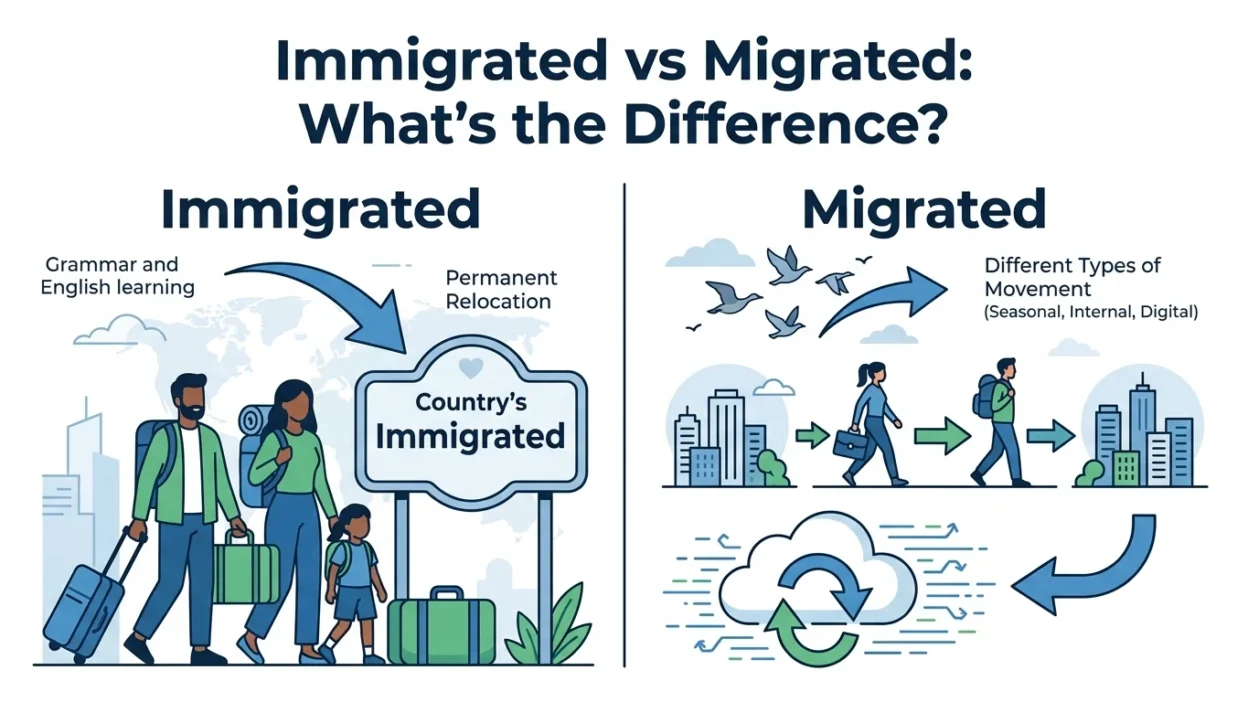
The main difference between immigrated and migrated is perspective and purpose.
- Immigrated means moving into another country to live permanently.
- Migrated means moving from one place to another, either temporarily or permanently, and it applies to people, animals, and even technology or data.
For example:
- ✅ My family immigrated to Canada in 2015.
- ✅ Many birds migrated south for the winter.
What Does “Immigrated” Mean?
Immigrated is the past tense of immigrate, which means entering a foreign country with the intention of living there permanently.
The focus is always on the destination country. If someone immigrates, they are arriving in a new country to settle there.
Examples
- She immigrated to Australia after finishing college.
- My grandparents immigrated to the United States in the 1980s.
- Thousands of skilled workers immigrated to Germany last year.
- They immigrated to New Zealand to build a better future.
A useful tip is to remember that immigrate is usually followed by to.
Pattern:
- Immigrate to a country
Correct:
- They immigrated to Canada.
Incorrect:
- They migrated to Canada permanently. (Possible, but less specific when discussing permanent settlement.)
What Does “Migrated” Mean?
Migrated is the past tense of migrate, meaning to move from one place to another.
Unlike immigrate, migrate is much broader. It can describe movement within a country, between countries, or seasonal movement by animals. It is also commonly used in technology and business.
Examples
- Many workers migrated from rural areas to cities.
- Birds migrated south before winter.
- The company migrated its database to a cloud server.
- Early humans migrated across continents thousands of years ago.
Notice that migration does not always mean someone is changing citizenship or settling permanently.
Immigrated vs Migrated: Key Difference
| Feature | Immigrated | Migrated |
|---|---|---|
| Meaning | Moved into another country to live | Moved from one place to another |
| Permanent move | Usually yes | May be temporary or permanent |
| Used for people | Yes | Yes |
| Used for animals | No | Yes |
| Used for technology | No | Yes |
| Focus | Arrival in a new country | Movement from one place to another |
Immigrated vs Migrated in Sentences
Here are examples showing how each word is used naturally.
Using “Immigrated”
- My parents immigrated to Canada twenty years ago.
- She immigrated to the UK for better career opportunities.
- He immigrated after receiving permanent residency.
- Thousands of families immigrated during the last decade.
Using “Migrated”
- Farmers migrated to cities looking for work.
- Whales migrated to warmer waters.
- Ancient civilizations migrated across Asia.
- Our company migrated all customer files to a new system.
Immigrate vs Emigrate vs Migrate
Many learners also confuse immigrate, emigrate, and migrate.
Here’s an easy comparison.
| Word | Focus | Example |
|---|---|---|
| Immigrate | Moving into a country | They immigrated to Canada. |
| Emigrate | Leaving a country | They emigrated from India. |
| Migrate | Moving from one place to another | Birds migrated south. |
A simple way to remember:
- Immigrate = move into
- Emigrate = move out of
- Migrate = simply move
When Should You Use “Immigrated”?
Use immigrated when discussing permanent relocation into another country.
Examples include:
- Citizenship applications
- Permanent residency
- Family relocation
- International settlement
- Immigration history
Examples:
- She immigrated to the United States after graduation.
- His family immigrated for economic opportunities.
- They immigrated legally under a skilled worker program.
When Should You Use “Migrated”?
Use migrated whenever you’re talking about movement without specifically emphasizing immigration.
This includes:
- Seasonal animal movement
- Internal movement within a country
- Historical population shifts
- Workers moving between regions
- Digital systems moving data
- Business transitions
Examples:
- Millions migrated from villages to cities.
- Monarch butterflies migrated every autumn.
- The website migrated to a faster server.
Common Mistakes to Avoid
Many English learners mix these words because both involve moving. Here are some frequent mistakes.
Mistake 1: Using “immigrated” for animals
❌ Birds immigrated south.
✅ Birds migrated south.
Animals migrate, not immigrate.
Mistake 2: Using “migrated” when discussing legal immigration
❌ She migrated to Canada and became a citizen.
✅ She immigrated to Canada and became a citizen.
When permanent settlement is the focus, immigrated is more accurate.
Mistake 3: Confusing immigrate and emigrate
❌ They immigrated from France.
Better:
- They emigrated from France.
- They immigrated to Canada.
Remember:
- from = emigrate
- to = immigrate
Easy Memory Trick
Think about the direction.
- Immigrate = moving into a new country.
- Migrate = moving anywhere.
If the sentence is about becoming part of another country’s population, choose immigrated.
If it’s simply about movement, choose migrated.
American vs British English
There is no significant difference between American and British English when using immigrated and migrated. Both varieties follow the same grammar and meanings.
The only noticeable differences are usually in writing style or preferred vocabulary surrounding immigration policies, not in the meanings of these verbs.
Examples in both American and British English:
- She immigrated to Canada.
- Workers migrated from rural communities to urban areas.
These sentences are correct in both forms of English.
Tips for Remembering the Difference
- Think of immigrate as entering a new country permanently.
- Use migrate for general movement.
- Animals always migrate.
- Data and computer systems migrate.
- Immigration usually involves legal residence or citizenship.
- Migration may be temporary or permanent.
FAQs
Is immigrated the same as migrated?
No. Immigrated refers to moving into another country to live permanently, while migrated refers to moving from one place to another for various reasons.
Can people migrate without immigrating?
Yes. People can migrate within the same country or temporarily move to another location without becoming immigrants.
Do animals immigrate or migrate?
Animals migrate, not immigrate. Their movement is usually seasonal and does not involve settling in another country.
Which word is correct for moving to another country permanently?
Immigrated is the correct choice when someone moves to another country intending to live there permanently.
Can migrated be used for computers?
Yes. In technology, migrated commonly describes moving data, software, websites, or systems from one platform to another.
Is immigrated always followed by “to”?
Most of the time, yes. The standard pattern is immigrated to a country.
What is the difference between immigrated and emigrated?
Immigrated focuses on entering a country, while emigrated focuses on leaving a country.
Summary
Understanding immigrated vs migrated is easier once you focus on the purpose of the movement. Immigrated is used when someone enters another country to live there permanently, while migrated is a broader term that refers to movement from one place to another, whether temporary or permanent. It also applies to animals, historical populations, workers, and even digital systems.
Choosing the correct word improves both spoken and written English. Whenever you’re discussing permanent relocation into a new country, immigrated is the precise choice. For general movement, seasonal travel, or non human contexts, migrated is the appropriate word. Keeping this distinction in mind will help you write with greater clarity and confidence.