Many English learners and even native speakers sometimes confuse wore and worn because both come from the same verb, wear. While they look similar, they are used in different grammatical situations. Choosing the correct one makes your writing sound natural and grammatically correct.
If you’ve ever wondered whether to say “I have wore” or “I have worn,” you’re not alone. This guide explains the difference between wore or worn in simple language, with clear examples, common mistakes, and practical tips to help you remember the correct usage every time.
Quick Answer
The difference between wore and worn is simple:
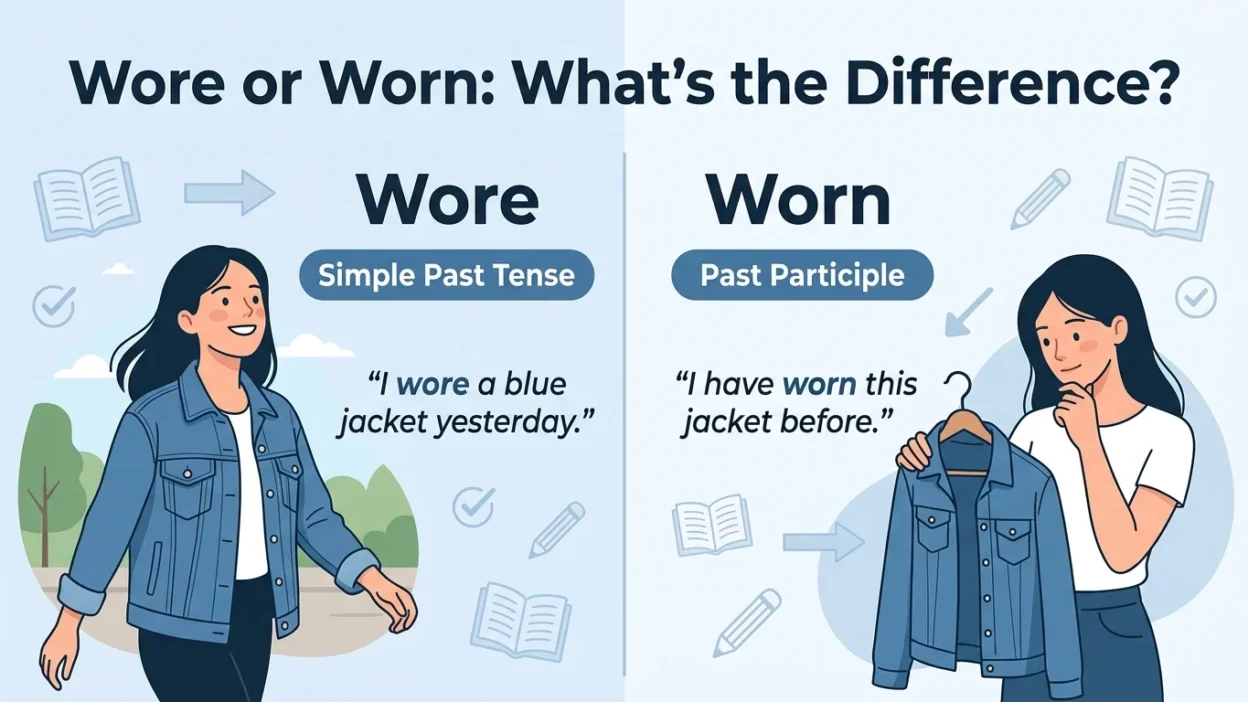
- Wore is the simple past tense of the verb wear.
- Worn is the past participle of wear and must be used with helping verbs such as has, have, had, is, was, were, or been.
Correct Examples:
- I wore a blue jacket yesterday. ✅
- She has worn that dress many times. ✅
Incorrect Examples:
- I have wore a blue jacket. ❌
- She worn a red dress yesterday. ❌
What Do “Wore” and “Worn” Mean?
Both wore and worn come from the verb wear, which means:
- To have clothing, shoes, or accessories on your body.
- To use something regularly until it becomes damaged or old.
- To show a facial expression.
- To gradually become damaged through use.
Although they share the same meaning, they are used in different verb forms.
When to Use “Wore”
Wore is the simple past tense of wear. Use it when talking about something someone wore at a specific time in the past.
Formula
Subject + wore + object
Examples
- I wore my favorite shoes yesterday.
- She wore a beautiful necklace to the wedding.
- They wore uniforms during the ceremony.
- We wore raincoats because it was raining.
- He wore glasses throughout college.
In each sentence, the action happened in the past and is complete.
When to Use “Worn”
Worn is the past participle of wear. It cannot stand alone as the main verb. It must be used with an auxiliary (helping) verb.
Formula
Subject + has/have/had + worn
or
Subject + is/was/were + worn
Examples
- I have worn these boots for years.
- She has worn that jacket before.
- They had worn masks before entering.
- The carpet is worn after many years of use.
- His favorite hat has been worn almost every day.
Notice that every sentence includes a helping verb.
Wore vs Worn: Comparison Table
| Feature | Wore | Worn |
|---|---|---|
| Verb form | Simple past | Past participle |
| Can stand alone? | Yes | No |
| Needs a helping verb? | No | Yes |
| Time reference | Completed past action | Perfect tenses or passive voice |
| Example | I wore a coat yesterday. | I have worn this coat before. |
Verb Forms of “Wear”
Understanding all forms of the verb makes the difference much easier.
| Verb Form | Word |
|---|---|
| Base Form | Wear |
| Present | Wear / Wears |
| Past | Wore |
| Past Participle | Worn |
| Present Participle | Wearing |
Example:
- I wear a uniform every day.
- Yesterday I wore a uniform.
- I have worn a uniform for five years.
- I am wearing a uniform now.
Examples of “Wore” in Sentences
Here are more examples showing how wore is correctly used.
- Emma wore a green sweater yesterday.
- My grandfather wore a watch every day.
- We wore comfortable clothes during the trip.
- The actor wore a black suit at the event.
- The children wore costumes for Halloween.
- He wore running shoes during the race.
- I wore my lucky shirt to the interview.
- She wore sunglasses all afternoon.
Each sentence refers to a completed action in the past.
Examples of “Worn” in Sentences
Now look at examples using worn correctly.
- I have worn this jacket for three winters.
- She has worn glasses since childhood.
- We had worn safety equipment before entering.
- These shoes have been worn for several years.
- The sofa is worn from everyday use.
- He had worn the same hat for months.
- They have worn matching uniforms before.
- The paint was worn away by the weather.
Common Mistakes with Wore and Worn
Many learners accidentally mix these forms.
Mistake 1: Using “wore” after “have”
❌ I have wore this shirt before.
✅ I have worn this shirt before.
Mistake 2: Using “worn” without a helping verb
❌ She worn a beautiful dress yesterday.
✅ She wore a beautiful dress yesterday.
Mistake 3: Mixing up tense
❌ They have wore uniforms for years.
✅ They have worn uniforms for years.
Mistake 4: Forgetting the helping verb
❌ I worn those boots already.
✅ I have worn those boots already.
Easy Trick to Remember
A simple memory trick can help.
Think of it this way:
- Yesterday = Wore
- Have/Has/Had = Worn
For example:
- Yesterday I wore a red shirt.
- I have worn that shirt many times.
Whenever you see has, have, or had, your brain should automatically choose worn.
American vs British English
There is no difference between American English and British English when it comes to wore and worn.
Both varieties use the same verb forms and grammar.
| American English | British English |
|---|---|
| I wore a jacket yesterday. | I wore a jacket yesterday. |
| I have worn that coat before. | I have worn that coat before. |
The spelling, pronunciation, and grammatical rules remain the same in both versions of English.
Tips to Avoid Confusion
Keep these simple tips in mind.
- Use wore for completed actions in the past.
- Use worn only with helping verbs.
- Learn all forms of the verb wear together.
- Practice writing sentences using each form.
- Read English books and articles to see both words used naturally.
Practice Sentences
Choose the correct word.
- I _____ my new shoes yesterday.
- Answer: wore
- She has _____ that scarf many times.
- Answer: worn
- They _____ uniforms during the event.
- Answer: wore
- He had _____ the same coat for years.
- Answer: worn
- We _____ jackets because it was cold.
- Answer: wore
FAQs
What is the difference between wore and worn?
Wore is the simple past tense of wear, while worn is the past participle and must be used with a helping verb like has, have, or had.
Is “I have wore” correct?
No. The correct sentence is I have worn because worn is the past participle used after have.
Can worn be used without a helping verb?
Generally, no. As a verb, worn requires a helping verb. However, it can also be used as an adjective, as in “a worn jacket.”
When should I use wore?
Use wore when describing a completed action in the past, such as “She wore a red dress yesterday.”
Why do people confuse wore and worn?
They are different forms of the same verb, so learners often mix the simple past tense with the past participle.
Is worn only used for clothing?
No. Worn can also describe something that has become old or damaged through use, such as “a worn path” or “worn furniture.”
Are wore and worn used differently in American and British English?
No. Both American and British English follow the same grammar rules for wore and worn.
Summary
Understanding the difference between wore or worn becomes much easier once you remember their grammatical roles. Wore is the simple past tense used for actions completed in the past, while worn is the past participle that always works with a helping verb or appears as an adjective. Choosing the correct form improves both spoken and written English and helps your sentences sound natural.
The easiest way to remember is this: if your sentence includes has, have, or had, use worn. If you are simply describing something that happened yesterday or at another specific time in the past, use wore. With regular practice and careful attention to sentence structure, you’ll be able to use both words confidently and accurately.

Dani Morrison is a dedicated language writer and spelling expert at Spelword.com, where she focuses on helping readers understand common English spelling mistakes and confusing word pairs. With a passion for clear communication, Dani creates easy-to-follow guides that simplify complex grammar and spelling rules for everyday use.