Have you ever paused while writing and wondered whether to use either or whether? You’re not alone. These two words often appear in similar situations, which makes them easy to confuse. However, they serve different grammatical purposes and cannot always be used interchangeably.
Understanding the difference between either vs whether can improve your writing, make your sentences clearer, and help you communicate more confidently. In this guide, you’ll learn the meaning of each word, when to use them, common mistakes to avoid, and practical examples that make the distinction easy to remember.
Quick Answer
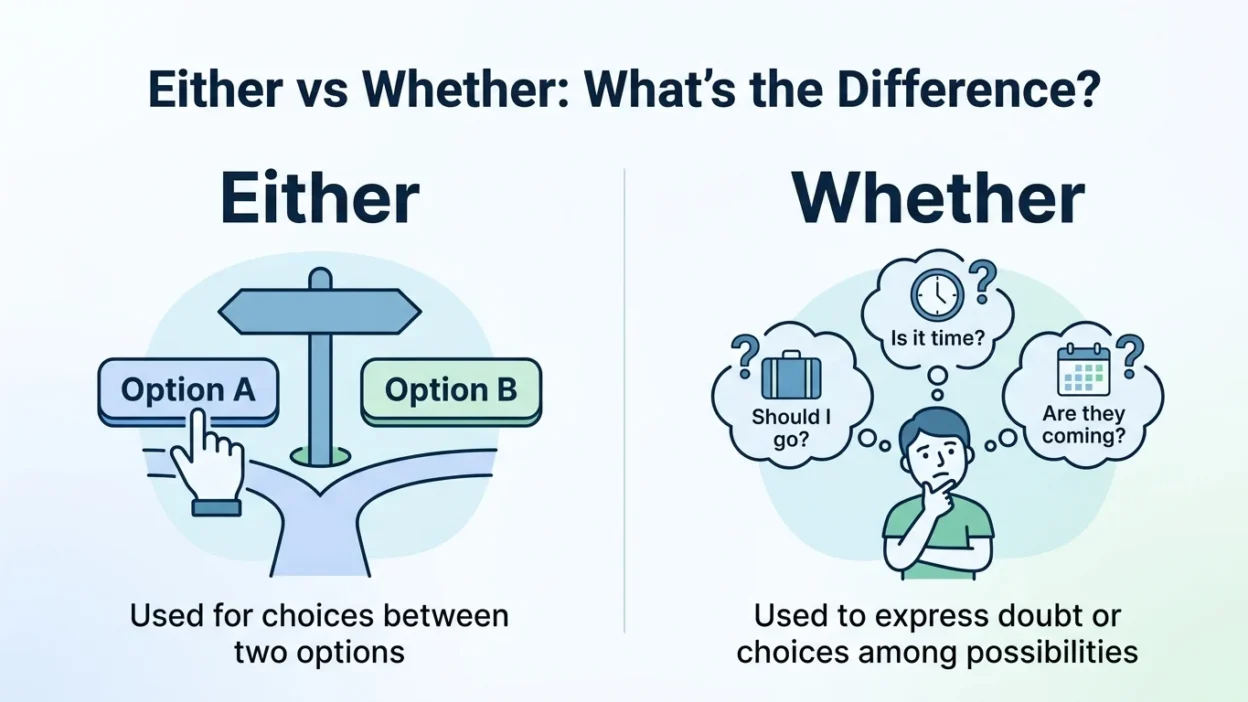
The main difference between either and whether is that:
- Whether introduces a choice, possibility, or uncertainty.
- Either refers to one of two choices or alternatives.
Correct: I don’t know whether he will come.
Correct: You can choose either option.
When discussing uncertainty, use whether. When referring to one of two options, use either.
What Does “Whether” Mean?
Whether is a conjunction used to introduce alternatives, possibilities, or uncertainty. It often means “if” when there are two possible outcomes.
Examples of Whether
- I don’t know whether she is available.
- We need to decide whether to travel now or later.
- He asked whether the meeting was canceled.
- She wasn’t sure whether she should apply for the job.
In these examples, the speaker is expressing uncertainty between possible outcomes.
Common Patterns with Whether
- Whether or not
- Whether…or
- Unsure whether
- Decide whether
- Know whether
Examples:
- I’ll attend whether or not it rains.
- We must determine whether the information is accurate.
- She couldn’t decide whether to stay or leave.
What Does “Either” Mean?
Either is a determiner, pronoun, adverb, or conjunction that refers to one of two people, things, or choices.
It emphasizes that one choice from two possibilities is acceptable or available.
Examples of Either
- You may choose either dress.
- Either answer is correct.
- We can leave on either Friday or Saturday.
- There are two entrances; use either one.
In these sentences, either refers directly to two alternatives.
Either vs Whether: Key Difference
Although both words can appear in sentences involving choices, their roles are different.
| Feature | Either | Whether |
|---|---|---|
| Part of Speech | Determiner, pronoun, adverb, conjunction | Conjunction |
| Main Function | Refers to one of two options | Introduces uncertainty or alternatives |
| Focus | Choice between two things | Question of possibility |
| Can Start a Clause? | Usually no | Yes |
| Example | Choose either route. | I don’t know whether to go. |
Compare These Sentences
Correct: I don’t know whether to go.
Incorrect: I don’t know either to go.
Correct: You may choose either option.
Incorrect: You may choose whether option.
The first sentence requires a word expressing uncertainty, so whether is correct. The second sentence requires a word referring to two available choices, so either is correct.
When Can Either and Whether Appear Together?
Sometimes both words can appear in the same sentence because they perform different jobs.
Examples
- I don’t know whether either candidate will attend.
- We are unsure whether either solution will work.
- She asked whether either restaurant was open.
Here, whether introduces uncertainty, while either refers to one of two candidates, solutions, or restaurants.
Common Mistakes with Either and Whether
Many writers use these words incorrectly because both involve alternatives.
Mistake 1: Using Either Instead of Whether
Incorrect: I don’t know either he called.
Correct: I don’t know whether he called.
The sentence expresses uncertainty, so whether is needed.
Mistake 2: Using Whether Before a Noun Choice
Incorrect: You can choose whether book.
Correct: You can choose either book.
The sentence refers to two books, making either the correct choice.
Mistake 3: Confusing Whether and If
Many people use if and whether interchangeably, but whether is often more accurate when discussing alternatives.
Less Precise: I don’t know if I should stay or leave.
More Precise: I don’t know whether I should stay or leave.
Examples in Everyday Conversations
Understanding real-life usage helps make the difference clear.
Using Whether
- Are you sure whether the store is open?
- We haven’t decided whether to move.
- She wondered whether the package arrived.
- They debated whether the project should continue.
Using Either
- Either route will get you there.
- You can sit in either chair.
- Either solution seems reasonable.
- Either team could win the match.
Either vs Whether in Questions
Questions often reveal the difference clearly.
Whether in Indirect Questions
- Do you know whether he is home?
- She asked whether the report was finished.
- We need to find out whether the flight is delayed.
Either in Choice Situations
- Would either option work for you?
- Is either restaurant still open?
- Did either player score?
Notice that whether introduces the question itself, while either refers to one of two possible things.
Grammar Tips to Remember
Use these simple rules whenever you’re unsure.
Use Whether When:
- Expressing uncertainty
- Presenting alternatives
- Introducing indirect questions
- Using “whether or not”
Examples:
- I wonder whether it’s true.
- We must decide whether to proceed.
Use Either When:
- Referring to one of two choices
- Talking about two people or things
- Indicating that both options are acceptable
Examples:
- Choose either seat.
- Either answer will work.
American vs British English
There is very little difference between American and British English regarding either and whether.
Both varieties use these words according to the same grammatical rules.
One minor difference involves pronunciation of either:
American English
- Often pronounced as “EE-ther”
- Sometimes pronounced as “EYE-ther”
British English
- Frequently pronounced as “EYE-ther”
- “EE-ther” is also accepted
Regardless of pronunciation, the meaning and usage remain the same.
Easy Trick to Remember the Difference
A simple memory trick can help:
- Whether = uncertainty or possibility.
- Either = one of two choices.
Ask yourself:
“Am I talking about uncertainty?”
If yes, use whether.
“Am I referring to one of two options?”
If yes, use either.
Frequently Asked Questions
Can either and whether mean the same thing?
No. They have different grammatical functions. Whether expresses uncertainty, while either refers to one of two choices.
Is it correct to say “either or whether”?
Usually not. They serve different purposes and are generally not interchangeable in the same grammatical position.
Should I use whether or if?
Use whether when discussing alternatives or choices. If is often acceptable in casual contexts but may not always be grammatically precise.
Can either be used for more than two options?
Traditionally, either refers to two options only. For more than two choices, other words are usually more appropriate.
What does “whether or not” mean?
It means regardless of the outcome or possibility being discussed.
Example: “I’ll go whether or not it rains.”
Can a sentence start with whether?
Yes. A sentence can begin with whether.
Example: “Whether we agree or disagree, we must respect each other.”
Can either be a pronoun?
Yes. It can replace a noun when referring to one of two things.
Example: “Either is acceptable.”
Why do people confuse either and whether?
People often associate both words with alternatives and choices, but they play different grammatical roles in a sentence.
Summary
Understanding the difference between either vs whether is easier once you recognize their specific functions. Whether is used when discussing uncertainty, possibilities, or alternatives, while either refers to one of two available choices. Although they may appear in similar contexts, they are not interchangeable in most sentences.
When in doubt, remember this simple rule: use whether when you’re unsure about an outcome, and use either when selecting between two options. Mastering this distinction will make your writing clearer, more professional, and grammatically accurate in both everyday communication and formal writing.

Dani Morrison is a dedicated language writer and spelling expert at Spelword.com, where she focuses on helping readers understand common English spelling mistakes and confusing word pairs. With a passion for clear communication, Dani creates easy-to-follow guides that simplify complex grammar and spelling rules for everyday use.