
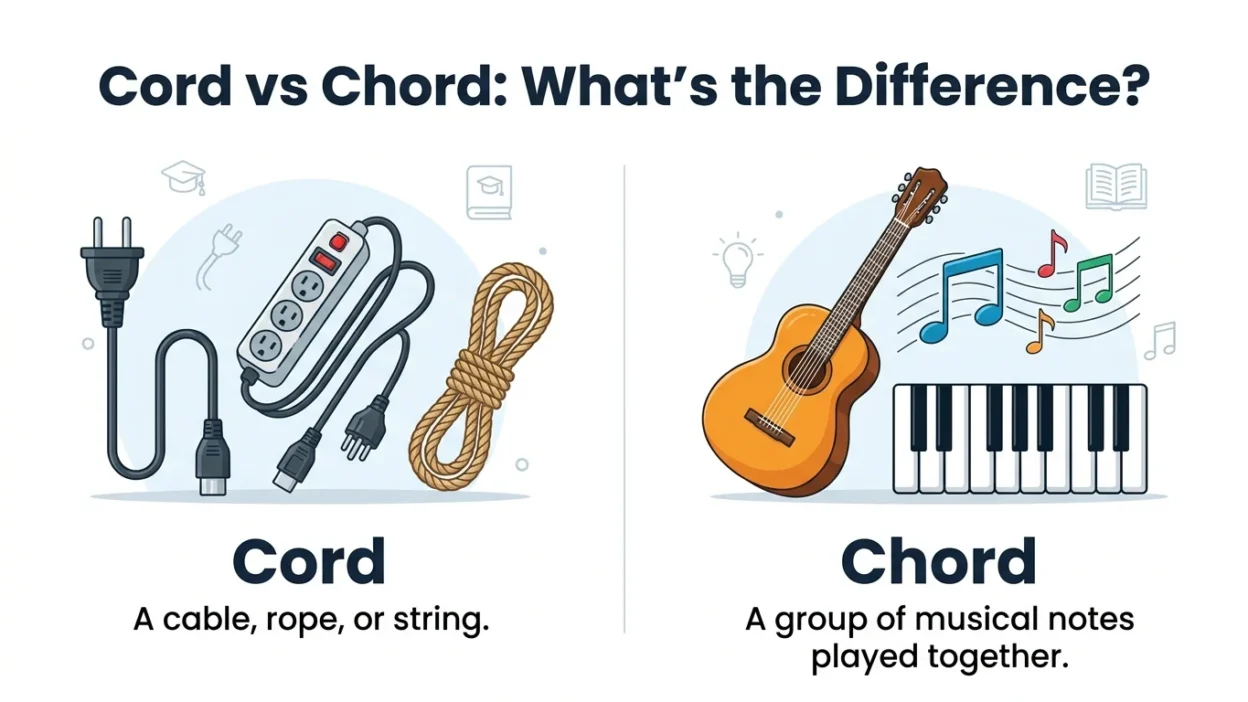
Have you ever written cord when you meant chord or vice versa? You’re not alone. These two words sound exactly alike, making them a common source of confusion in English. Although they share the same pronunciation, they have completely different meanings and are used in different contexts.
Understanding the difference between cord vs chord can help you write more accurately and avoid embarrassing mistakes. Whether you’re talking about music, anatomy, electricity, or simple ropes, knowing which word to choose makes your communication clearer and more professional.
Quick Answer
The difference between cord and chord is simple:
- Cord refers to a rope, cable, string, or a structure resembling one.
- Chord refers to a group of musical notes played together or a straight line connecting two points on a curve.
Example:
- I plugged the lamp into the power cord.
- The guitarist played a beautiful chord.
Even though they sound the same, their meanings are entirely different.
What Does “Cord” Mean?
The word cord typically refers to a long, thin, flexible material such as a rope, string, cable, or wire. It can also describe certain structures in anatomy that resemble a rope.
Examples of Cord in Sentences
- The power cord needs to be replaced.
- She tied the package with a decorative cord.
- The curtain hangs from a thick cord.
- The doctor examined the patient’s spinal cord.
- He pulled the starter cord to start the engine.
In everyday English, you’ll most often encounter cord when discussing electrical cables, ropes, or wires.
Common Uses of Cord
- Power cord
- Extension cord
- Spinal cord
- Rope cord
- Decorative cord
What Does “Chord” Mean?
The word chord has two primary meanings. It is most commonly used in music, where it refers to a combination of notes played simultaneously. In mathematics and geometry, it refers to a straight line connecting two points on a curve.
Examples of Chord in Sentences
- She learned a new guitar chord today.
- The piano chord sounded rich and powerful.
- That song uses only three basic chords.
- The geometry lesson focused on finding the length of a chord in a circle.
- The musician played the final chord before leaving the stage.
For most people, chord is associated with music.
Common Uses of Chord
- Guitar chord
- Piano chord
- Musical chord progression
- Major chord
- Minor chord
- Chord of a circle
Cord vs Chord: Side-by-Side Comparison
| Feature | Cord | Chord |
|---|---|---|
| Meaning | Rope, wire, cable, or string | Group of musical notes or a geometric line |
| Field of Use | Everyday objects, anatomy, electronics | Music and mathematics |
| Pronunciation | Kord | Kord |
| Part of Speech | Noun | Noun |
| Example | Power cord | Guitar chord |
This comparison makes it easier to remember which word belongs in which situation.
Why Are Cord and Chord Confused?
The main reason people mix up cord and chord is that they are homophones. Homophones are words that sound the same but have different meanings and spellings.
When speaking, there is no audible difference between the two words. The distinction only becomes clear in writing and context.
For example:
- “I broke a guitar cord” could mean a cable connected to a guitar.
- “I played a guitar chord” refers to a musical sound created by multiple notes.
Because both words may appear in discussions about music equipment, confusion is common.
Memory Trick to Remember the Difference
A simple memory trick can help you choose the correct word.
Cord = Cable
Both cord and cable relate to wires and physical connections.
Cord → Think of cords, cables, ropes, and strings.
Chord = Harmony
The letter H in chord can remind you of harmony, which is closely related to music.
Chord → Think of harmony and musical notes.
Using these associations makes it easier to remember the correct spelling.
Examples of Cord and Chord in Everyday Sentences
Here are examples showing both words in context.
Using Cord
- The phone charger cord was tangled.
- She replaced the damaged extension cord.
- The climber relied on a strong safety cord.
- The spinal cord carries signals between the brain and body.
- The package was wrapped with a gold cord.
Using Chord
- The beginner practiced a simple guitar chord.
- The singer ended on a beautiful chord.
- Learning piano chords takes patience.
- The orchestra struck a dramatic chord.
- The math teacher explained how to calculate a circle’s chord length.
Common Mistakes with Cord and Chord
Many writers accidentally substitute one word for the other.
Incorrect
- I learned a new guitar cord today.
- The pianist played a powerful cord.
- Plug the lamp into the chord.
Correct
- I learned a new guitar chord today.
- The pianist played a powerful chord.
- Plug the lamp into the cord.
Checking whether you’re talking about music or a physical cable usually reveals the correct choice immediately.
Cord vs Chord in Music
Music learners frequently encounter both words.
A chord is a combination of notes played together. Examples include:
- C major chord
- G major chord
- D minor chord
- A minor chord
A cord, on the other hand, might refer to:
- A microphone cord
- A guitar cable
- A power cord for an amplifier
If the discussion involves sound, harmony, or musical notes, the correct word is usually chord.
Cord vs Chord in Science and Anatomy
The word cord appears frequently in science and medicine.
Examples include:
- Spinal cord
- Umbilical cord
- Vocal cords
These uses describe structures that resemble ropes, strings, or connected bundles.
The word chord appears more often in geometry and mathematics.
For example:
- A chord of a circle connects two points on the circumference.
Because the fields are different, context usually makes the intended meaning obvious.
American vs British English
There is no significant difference between American and British English regarding cord and chord.
Both varieties use the same spellings and meanings:
- Power cord
- Extension cord
- Guitar chord
- Musical chord
Writers in both countries follow the same rules, so there is no regional variation to remember.
Tips for Using Cord and Chord Correctly
Keep these simple tips in mind:
- Use cord for ropes, strings, wires, cables, and anatomical structures.
- Use chord for music and geometry.
- Think of the H in chord as standing for harmony.
- If you can replace the word with “cable,” choose cord.
- If the discussion involves musical notes, choose chord.
These quick checks can prevent most mistakes.
FAQs
What is the difference between cord and chord?
Cord refers to a rope, cable, wire, or similar structure. Chord refers to a group of musical notes played together or a line connecting two points on a curve.
Is a guitar chord or cord?
A guitar chord is correct when referring to musical notes played together. A guitar cord may refer to a cable connected to the instrument.
Why do cord and chord sound the same?
They are homophones, meaning they have identical pronunciations but different spellings and meanings.
What is an example of a cord?
A power cord, extension cord, or spinal cord are common examples of the word cord.
What is an example of a chord?
A C major chord on a guitar or piano is a common example of a chord.
Is spinal chord correct?
No. The correct term is spinal cord because it refers to the bundle of nerves running through the spine.
Is chord only used in music?
No. Chord is also used in geometry to describe a straight line connecting two points on a curve.
How can I remember cord vs chord?
Remember that chord contains the letter H, which can remind you of harmony and music. Use cord for cables, ropes, and wires.
Summary
The distinction between cord vs chord is straightforward once you understand their meanings. Cord refers to ropes, strings, cables, wires, and certain anatomical structures, while chord refers primarily to musical notes played together and, in geometry, a line connecting two points on a curve. Although they sound identical, their uses are completely different.
When deciding which word to use, consider the context. If you’re discussing electronics, ropes, or anatomy, choose cord. If you’re talking about music or geometry, choose chord. Keeping this simple rule in mind will help you write with confidence and avoid one of English’s most common homophone mistakes.

Dani Morrison is a dedicated language writer and spelling expert at Spelword.com, where she focuses on helping readers understand common English spelling mistakes and confusing word pairs. With a passion for clear communication, Dani creates easy-to-follow guides that simplify complex grammar and spelling rules for everyday use.