Choosing between sole or soul can be confusing because both words sound exactly the same. However, despite their identical pronunciation, they have completely different meanings and are used in different situations. If you’ve ever wondered whether to write sole responsibility or soul responsibility, you’re not alone.
This guide explains the difference between sole or soul in simple language, with clear definitions, practical examples, common mistakes, and easy memory tips. By the end, you’ll know exactly which word to use and when.
Quick Answer
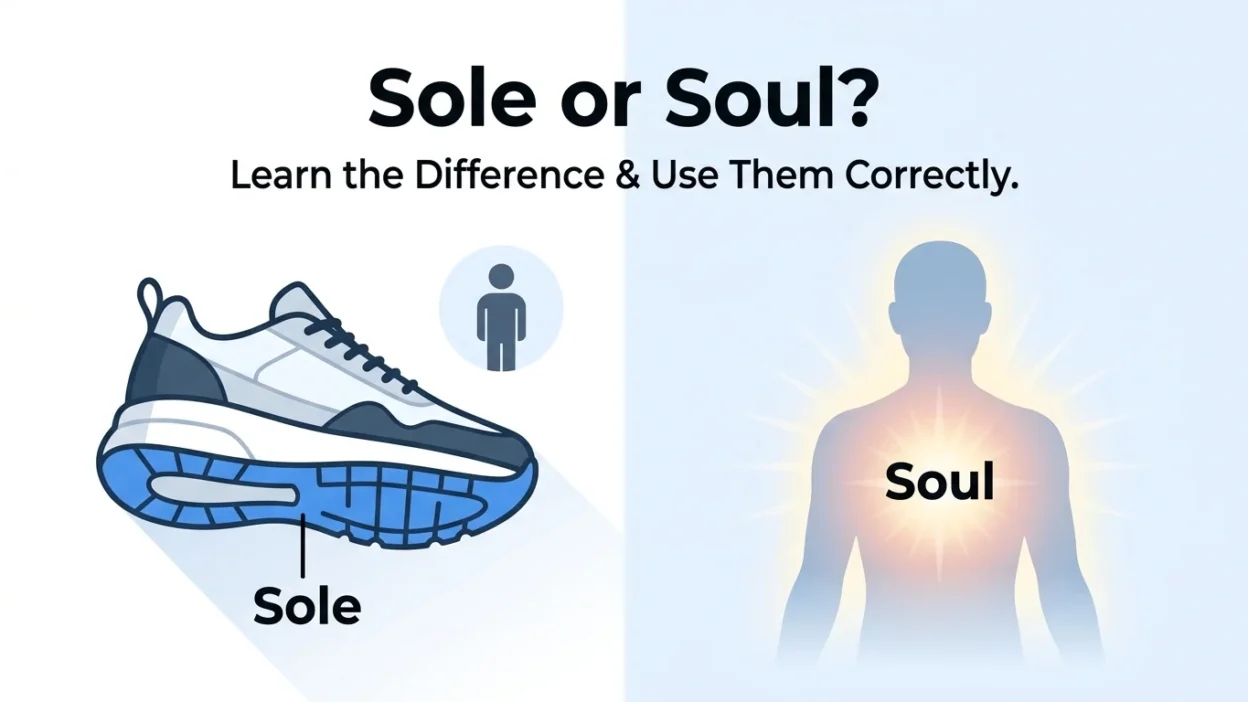
Sole refers to something that is only, single, exclusive, or the bottom of a foot or shoe.
Soul refers to the spiritual part of a person, emotions, character, or deep inner self.
Examples:
- ✅ She was the sole owner of the company.
- ✅ Music touched his soul.
- ✅ The sole of my shoe is worn out.
- ❌ Music touched his sole.
- ❌ She was the soul owner of the company.
Sole Meaning
The word sole has more than one meaning, but each relates to the idea of being unique, single, or exclusive.
Sole as “Only” or “Single”
When sole means only or exclusive, it describes one person or one thing without others.
Examples:
- He is the sole survivor of the accident.
- She has sole responsibility for the project.
- This is my sole reason for attending the meeting.
- They are the sole distributor in the region.
Sole as the Bottom of a Foot or Shoe
Sole also refers to the underside of a foot or a shoe.
Examples:
- The sole of my shoe needs replacing.
- I stepped on a nail with the sole of my foot.
- Thick rubber soles provide better grip.
Soul Meaning
The word soul refers to a person’s spiritual nature, emotions, personality, or deepest feelings. It is commonly used in religion, literature, music, and everyday expressions.
Soul as the Spiritual Self
Many religions describe the soul as the eternal or spiritual part of a human being.
Examples:
- Many people believe the soul lives forever.
- The story explores the journey of the human soul.
Soul as Deep Feelings or Character
In everyday English, soul often describes someone’s inner emotions, passion, or personality.
Examples:
- She poured her soul into the performance.
- His words touched my soul.
- She has a kind soul.
- That painting has real soul.
Sole or Soul: Comparison Table
| Feature | Sole | Soul |
|---|---|---|
| Meaning | Only, single, exclusive, or bottom of a foot/shoe | Spiritual self, emotions, inner character |
| Part of Speech | Noun and adjective | Noun |
| Related Ideas | Exclusive, unique, only | Spirit, heart, inner self |
| Common Contexts | Ownership, responsibility, footwear | Feelings, religion, music, personality |
| Example | She is the sole owner. | Music touched my soul. |
Examples of Sole in Sentences
Here are some everyday examples showing the correct use of sole.
- She was the sole applicant for the position.
- The judge awarded her sole custody of the child.
- This was my sole concern during the interview.
- The sole of these boots is waterproof.
- He became the sole owner after buying the remaining shares.
- The leather sole makes these shoes more comfortable.
Examples of Soul in Sentences
These examples demonstrate the proper use of soul.
- The singer’s voice touched everyone’s soul.
- He is a generous soul who helps everyone.
- She expressed her soul through art.
- Meditation helps calm the soul.
- The novel explores the human soul.
- They danced with heart and soul.
Common Expressions Using Sole
Many English expressions include sole.
- Sole owner
- Sole responsibility
- Sole survivor
- Sole purpose
- Sole provider
- Sole authority
- Sole custody
Examples:
- She has sole responsibility for the budget.
- He is the sole provider for his family.
Common Expressions Using Soul
The word soul appears in many popular expressions.
- Heart and soul
- Soul mate
- Lost soul
- Old soul
- Food for the soul
- Bare your soul
- Soul-searching
Examples:
- They are true soul mates.
- She put her heart and soul into the project.
- Traveling inspired some deep soul-searching.
Common Mistakes to Avoid
Because sole and soul sound identical, writers often confuse them.
Incorrect: Soul owner
Wrong: She is the soul owner of the company.
Correct: She is the sole owner of the company.
Why? Sole means only one.
Incorrect: Sole mate
Wrong: He found his sole mate.
Correct: He found his soul mate.
Why? A soulmate is someone with whom you share a deep emotional or spiritual connection.
Incorrect: My soul hurts after walking
Wrong: My soul hurts after walking all day.
Correct: The sole of my foot hurts after walking all day.
Why? Here you’re talking about the bottom of your foot.
Easy Memory Trick
A simple trick can help you remember the difference.
- Sole has the word “sol”, reminding you of single or only one.
- Soul contains “ou”, which can remind you of your inner self or emotions.
Another helpful reminder:
- Shoes have soles.
- People have souls.
American vs British English
There is no difference between American and British English in the spelling, pronunciation, or meaning of sole and soul.
Both varieties use:
- Sole owner
- Sole responsibility
- Sole of a shoe
- Human soul
- Soul music
- Soul mate (also commonly written as soulmate)
The only minor variation is stylistic. Some publishers prefer soulmate as one word, while others write soul mate as two words. Both forms are widely accepted.
When Should You Use Sole?
Use sole when talking about:
- One person or one thing
- Exclusive ownership
- Responsibility
- The bottom of a foot
- The bottom of a shoe
Examples:
- She is the sole beneficiary.
- He accepted sole responsibility.
- The sole of my shoe is damaged.
When Should You Use Soul?
Use soul when discussing:
- Spiritual beliefs
- Human emotions
- Inner character
- Passion
- Kindness
- Music or art
Examples:
- Music feeds the soul.
- She has a beautiful soul.
- The experience changed my soul.
How to Remember the Difference in Everyday Writing
Before choosing between sole and soul, ask yourself one question:
Are you talking about something that is only one or about footwear?
If yes, use sole.
Are you talking about feelings, spirit, personality, or emotions?
If yes, use soul.
This quick check helps eliminate almost every mistake.
FAQs
What is the difference between sole and soul?
Sole means only one or the bottom of a foot or shoe, while soul refers to a person’s spirit, inner self, or emotions.
Is it sole owner or soul owner?
The correct phrase is sole owner because sole means the only owner.
Is it soul mate or sole mate?
The correct expression is soul mate because it describes a deep emotional or spiritual connection.
Can sole be used as a noun?
Yes. Sole is a noun when referring to the bottom of a foot or shoe. It can also be an adjective meaning only or exclusive.
Can soul refer to personality?
Yes. Soul often describes a person’s inner character, kindness, emotions, or true nature.
Why do people confuse sole and soul?
They are homophones, meaning they sound the same but have different meanings and spellings.
Is there any spelling difference in British and American English?
No. Both American and British English spell and use sole and soul in the same way.
Summary
Understanding the difference between sole or soul is easier once you remember their meanings. Sole refers to something that is only one, exclusive, or the bottom of a foot or shoe. Soul, on the other hand, relates to the spirit, emotions, inner character, and deepest part of a person. Although they sound identical, they are never interchangeable because their meanings are entirely different.
Whenever you’re unsure, think about the context. If you’re discussing ownership, responsibility, or footwear, choose sole. If you’re talking about emotions, spirituality, personality, or heartfelt experiences, choose soul. Keeping this simple distinction in mind will help you write with greater confidence and accuracy.

Dani Morrison is a dedicated language writer and spelling expert at Spelword.com, where she focuses on helping readers understand common English spelling mistakes and confusing word pairs. With a passion for clear communication, Dani creates easy-to-follow guides that simplify complex grammar and spelling rules for everyday use.