If you’ve ever wondered whether to write saw or seen, you’re not alone. These two words are among the most commonly confused verbs in English because they both relate to the act of seeing. However, they are not interchangeable, and using the wrong one can make a sentence sound grammatically incorrect.
The good news is that the difference between saw vs seen is actually quite simple once you understand how English verb tenses work. In this guide, you’ll learn the meaning of each word, when to use it, common mistakes to avoid, helpful examples, and easy tricks to remember the difference.
Quick Answer
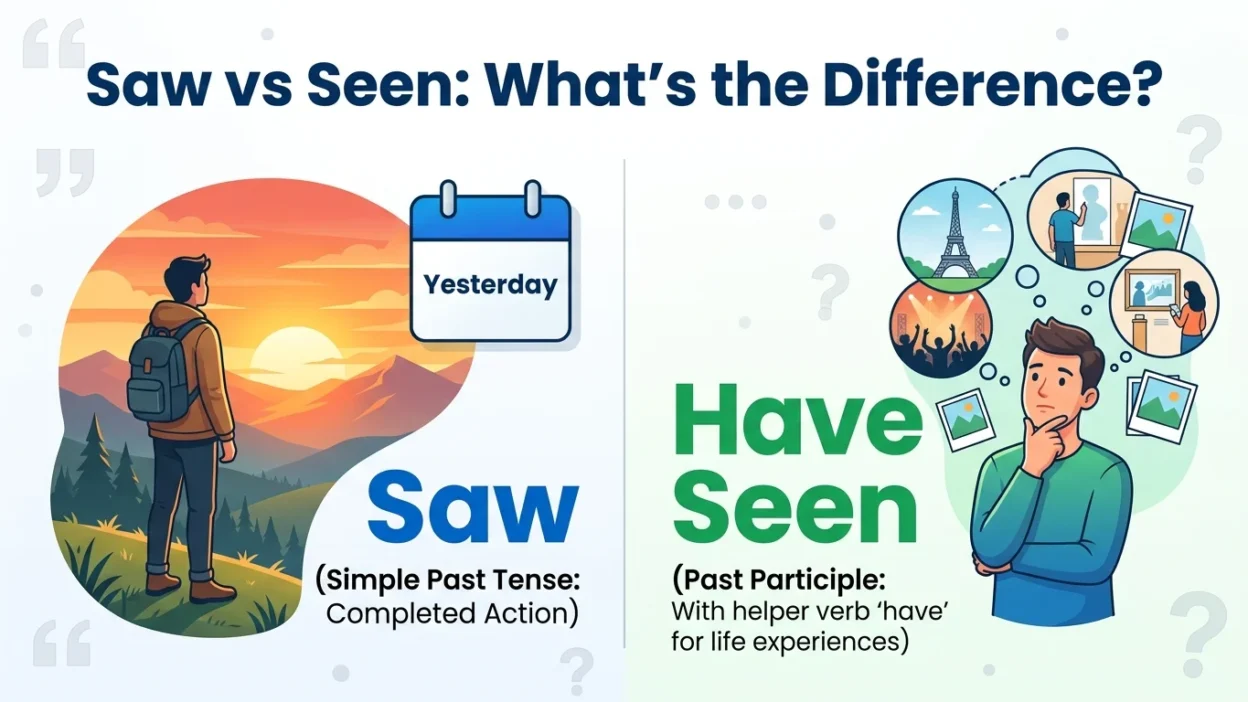
Saw is the simple past tense of the verb see.
Seen is the past participle of see and must usually be used with a helping verb such as have, has, had, was, or were.
Examples:
- Correct: I saw a beautiful sunset yesterday.
- Correct: I have seen that movie before.
A simple rule to remember is:
- Saw can stand alone.
- Seen usually needs a helping verb.
Understanding the Verb “See”
To understand saw vs seen, it helps to look at the different forms of the verb see.
| Verb Form | Word |
|---|---|
| Base Form | See |
| Past Tense | Saw |
| Past Participle | Seen |
| Present Participle | Seeing |
Examples:
- I see the mountains.
- I saw the mountains yesterday.
- I have seen the mountains before.
- I am seeing the mountains now.
Understanding these verb forms makes it much easier to choose the correct word.
What Does Saw Mean?
Saw is the simple past tense of see.
It describes something that happened and was completed in the past.
Examples of Saw in Sentences
- I saw a deer in the forest.
- She saw her friend at the mall.
- We saw a great movie last night.
- They saw the fireworks from their balcony.
- He saw the accident on his way home.
In each example, the action happened in the past and does not require a helping verb.
What Does Seen Mean?
Seen is the past participle form of see.
Unlike saw, it cannot usually stand alone as the main verb. It needs a helping verb to create a complete grammatical structure.
Examples of Seen in Sentences
- I have seen that movie three times.
- She has seen the new restaurant.
- We had seen the warning signs.
- They have seen better days.
- He was seen leaving the building.
Notice that every sentence includes a helping verb such as have, has, had, or was.
Saw vs Seen: Comparison Table
| Feature | Saw | Seen |
|---|---|---|
| Verb Form | Past tense | Past participle |
| Can Stand Alone? | Yes | Usually no |
| Needs a Helping Verb? | No | Yes |
| Example | I saw the bird. | I have seen the bird. |
| Time Reference | Simple past | Perfect or passive constructions |
| Common Mistake | Less common | Often used without a helper verb |
When to Use Saw
Use saw when talking about something that happened at a specific time in the past.
Examples
- I saw him yesterday.
- We saw the concert last week.
- She saw the email this morning.
- They saw a rainbow after the storm.
- He saw the doctor on Monday.
Keywords Often Used with Saw
You often see saw with time expressions such as:
- Yesterday
- Last week
- Last month
- Earlier
- This morning
- In 2024
Example:
- I saw her yesterday.
Because the action occurred at a specific point in the past, saw is the correct choice.
When to Use Seen
Use seen when it follows a helping verb.
Examples
- I have seen this show before.
- She has seen the results.
- We had seen enough.
- They have seen remarkable progress.
- The suspect was seen near the building.
Common Helping Verbs Used with Seen
- Have
- Has
- Had
- Was
- Were
- Being
- Been
Examples:
- I have seen it.
- She has seen it.
- They had seen it.
- He was seen there.
If there is no helping verb, seen is usually incorrect.
Common Mistakes with Saw and Seen
Many English learners and native speakers occasionally mix up these words.
Mistake #1: Using Seen Without a Helping Verb
❌ I seen that movie.
✅ I saw that movie.
✅ I have seen that movie.
This is one of the most common grammar mistakes in spoken English.
Mistake #2: Using Saw with Have
❌ I have saw the movie.
✅ I have seen the movie.
After have, has, or had, use seen, not saw.
Mistake #3: Mixing Up Past Tense and Past Participle
❌ She had saw the report.
✅ She had seen the report.
Past participles require helping verbs.
Easy Trick to Remember the Difference
Here’s a simple memory trick.
Saw Works Alone
Think:
I saw it.
The sentence is complete by itself.
Seen Needs a Friend
Think:
Seen needs a helping verb friend.
Examples:
- Have seen
- Has seen
- Had seen
- Was seen
If there is no helping verb, check whether saw is the better choice.
Examples of Saw and Seen Side by Side
Comparing the words can make the difference clearer.
Saw
- I saw the mountain yesterday.
- We saw the game last night.
- She saw the message earlier.
Seen
- I have seen the mountain before.
- We have seen that game already.
- She has seen the message.
Notice how seen always appears with a helper.
Saw and Seen in Everyday Conversation
These verbs appear frequently in daily communication.
Examples
- Have you seen my keys?
- Yes, I saw them on the table.
- Have you seen that new movie?
- No, but my brother saw it last week.
- Have you ever seen snow?
- Yes, I saw snow when I visited Canada.
Learning these patterns will help you sound more natural and confident.
Passive Voice and Seen
Another common use of seen is in passive voice.
Examples
- He was seen entering the building.
- The animal was seen near the river.
- The stars can be seen at night.
- The suspect was seen by witnesses.
In passive constructions, seen is the correct form because it functions as a past participle.
American vs British English Differences
There is no significant difference between American and British English when it comes to saw and seen.
Both varieties follow the same grammar rules:
- Saw is the simple past tense.
- Seen is the past participle.
Examples are used identically in both forms of English.
Practice Examples
Choose the correct word.
- I ___ a fox yesterday.
- Answer: saw
- Have you ever ___ a whale?
- Answer: seen
- She ___ the package arrive.
- Answer: saw
- We have ___ that restaurant before.
- Answer: seen
- They ___ the parade last weekend.
- Answer: saw
These examples highlight the difference between simple past and past participle forms.
FAQs
What is the difference between saw and seen?
Saw is the simple past tense of see, while seen is the past participle and usually requires a helping verb.
Can I say “I seen it”?
In standard English, no. You should say “I saw it” or “I have seen it.”
Is seen always used with a helping verb?
Yes, in most cases. Seen usually follows helping verbs such as have, has, had, was, or were.
What is an example of saw in a sentence?
An example is: I saw a beautiful sunset yesterday.
What is an example of seen in a sentence?
An example is: I have seen that sunset before.
Why do people confuse saw and seen?
People confuse them because both come from the verb see and relate to past events.
Is “have saw” correct?
No. The correct form is “have seen.”
Are the rules the same in British and American English?
Yes. Both British and American English use saw and seen according to the same grammar rules.
Summary
Understanding saw vs seen becomes much easier once you recognize that they are different forms of the same verb. Saw is the simple past tense and can stand alone in a sentence, while seen is the past participle and usually requires a helping verb such as have, has, had, was, or were. Using the correct form improves both spoken and written English.
A helpful way to remember the difference is that saw works alone, while seen needs a helper. Whenever you’re unsure, check whether your sentence includes a helping verb. If it does, seen is probably correct. If it doesn’t, saw is often the right choice. Mastering this distinction will make your grammar clearer and more professional.