
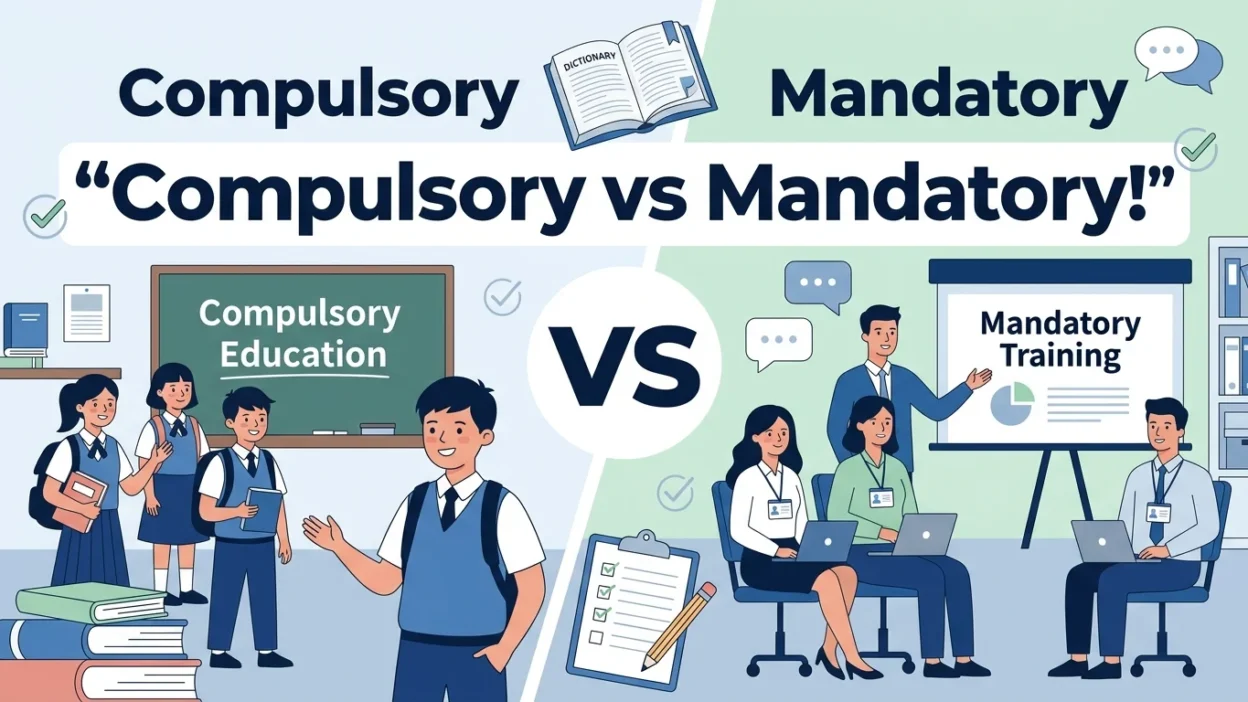
If you’ve ever wondered whether to use compulsory or mandatory, you’re not alone. These two words are often treated as synonyms because they both describe something that must be done. However, they are not always used in exactly the same way. The choice between them often depends on context, tone, and regional language preferences.
The good news is that understanding compulsory vs mandatory is simpler than it seems. Once you know the subtle differences, you’ll be able to use each word naturally in school assignments, workplace communication, legal documents, and everyday English. This guide explains their meanings, differences, examples, and common mistakes to help you choose the right word every time.
Quick Answer
Both compulsory and mandatory mean required or not optional, but they differ slightly in usage.
- Compulsory often refers to requirements imposed by laws, education systems, or official rules.
- Mandatory usually emphasizes an obligation created by an authority, policy, regulation, or organization.
- In many situations, the two words are interchangeable.
- Mandatory is generally more common in American English, while compulsory is used more frequently in British English, especially in education.
What Does “Compulsory” Mean?
Compulsory is an adjective that describes something that is required by law, regulation, or official rule. If something is compulsory, people have no choice but to do it.
The word commonly appears in discussions about:
- Education
- Government regulations
- Legal requirements
- Public policies
- Licensing
Examples
- School attendance is compulsory for children up to a certain age.
- Wearing a helmet is compulsory for all participants.
- English is a compulsory subject in many schools.
- Military service was once compulsory in several countries.
In these examples, the requirement comes from a law or formal rule.
What Does “Mandatory” Mean?
Mandatory is also an adjective that means required or obligatory. However, it often emphasizes that an authority, organization, or institution requires something.
You frequently see mandatory in:
- Workplace policies
- Corporate training
- Government regulations
- Legal documents
- Healthcare guidelines
Examples
- Attendance at the meeting is mandatory.
- Employees must complete the mandatory safety training.
- Seat belts are mandatory by law.
- The company introduced mandatory cybersecurity training.
The focus is usually on an official requirement rather than personal choice.
Compulsory vs Mandatory: Key Differences
Although their meanings overlap, there are subtle distinctions.
| Feature | Compulsory | Mandatory |
|---|---|---|
| Meaning | Required by law or official rule | Required by authority or policy |
| Part of Speech | Adjective | Adjective |
| Common Context | Education, laws, public rules | Business, legal, workplace policies |
| Tone | Slightly traditional | Slightly modern and formal |
| Interchangeable | Often | Often |
In many situations, either word is acceptable.
When Should You Use Compulsory?
Use compulsory when discussing legal obligations, education, or government requirements.
Common situations include:
- School subjects
- Education systems
- National laws
- Public safety regulations
- Civic responsibilities
Examples
- Mathematics is a compulsory subject.
- Voting is compulsory in some countries.
- Health insurance is compulsory under the new law.
- The course includes several compulsory modules.
This word is especially common in educational settings.
When Should You Use Mandatory?
Use mandatory when referring to official organizational requirements or institutional rules.
Common examples include:
- Employee training
- Workplace policies
- Compliance procedures
- Company regulations
- Legal obligations
Examples
- Completing the orientation is mandatory.
- Face masks were mandatory during the emergency.
- All applicants must attend the mandatory interview.
- The company introduced mandatory ethics training.
This word is particularly common in business and professional communication.
Compulsory vs Mandatory in Education
Educational institutions often use both words.
Compulsory
- Compulsory education
- Compulsory subjects
- Compulsory attendance
- Compulsory examinations
Mandatory
- Mandatory orientation
- Mandatory workshops
- Mandatory registration
- Mandatory safety briefing
Although both are correct, compulsory is more traditional in educational contexts.
Compulsory vs Mandatory in the Workplace
Businesses typically prefer mandatory.
Examples include:
- Mandatory meeting
- Mandatory training
- Mandatory reporting
- Mandatory certification
While compulsory is still correct, mandatory sounds more natural in modern workplace communication.
Examples in Everyday English
Here are side-by-side examples.
Using Compulsory
- School uniforms are compulsory.
- Attendance is compulsory for first-year students.
- The government introduced compulsory licensing.
- Eye examinations became compulsory.
Using Mandatory
- The workshop is mandatory for all employees.
- Wearing an ID badge is mandatory.
- Completing the application form is mandatory.
- Security training is mandatory every year.
Both sets of examples express obligation but in different contexts.
Common Mistakes to Avoid
Many English learners misuse these words.
1. Assuming They Always Mean Exactly the Same Thing
Although they often overlap, context matters.
Education commonly uses compulsory, while businesses often prefer mandatory.
2. Using Them for Personal Preferences
Incorrect:
- Drinking coffee is mandatory for me.
Correct:
- I always drink coffee.
Neither word should describe personal habits unless there is an actual requirement.
3. Ignoring Tone
In a workplace email, mandatory usually sounds more natural.
In discussions about school systems, compulsory is often the better choice.
American vs British English
One of the biggest differences involves regional preference.
American English
American English commonly prefers:
- Mandatory training
- Mandatory attendance
- Mandatory reporting
- Mandatory requirements
British English
British English more often uses:
- Compulsory education
- Compulsory schooling
- Compulsory subjects
- Compulsory attendance
Despite these preferences, both words are understood and accepted in both varieties of English.
Tips for Remembering the Difference
These simple memory tricks can help.
- Think of compulsory when discussing schools or laws.
- Think of mandatory when discussing companies or policies.
- Both mean “required.”
- If you’re writing for an international audience, either word is usually acceptable.
- Pay attention to the context rather than looking for a strict grammar rule.
Quick Comparison Table
| Situation | Better Choice |
|---|---|
| School attendance | Compulsory |
| Required school subjects | Compulsory |
| Government education law | Compulsory |
| Employee training | Mandatory |
| Workplace meeting | Mandatory |
| Company policy | Mandatory |
| Compliance requirement | Mandatory |
| Official regulation | Either |
Frequently Asked Questions
What is the difference between compulsory and mandatory?
Both words mean required, but compulsory is more commonly associated with education and legal obligations, while mandatory is frequently used for workplace rules, organizational policies, and official requirements.
Are compulsory and mandatory interchangeable?
Yes, in many situations they are interchangeable. However, context and regional language preferences may make one word sound more natural than the other.
Is compulsory more common in British English?
Yes. British English often uses compulsory, especially when discussing education and public laws.
Is mandatory more common in American English?
Yes. American English frequently uses mandatory in workplaces, legal documents, healthcare, and government regulations.
Which word should I use in business writing?
Mandatory is usually the better choice because it sounds more natural in professional and corporate communication.
Can compulsory and mandatory both refer to laws?
Yes. Both words can describe legal requirements, although compulsory is slightly more common in discussions about education and public obligations.
Is compulsory stronger than mandatory?
Not necessarily. Both indicate that something is required. The difference lies more in context and usage than in strength.
Summary
Understanding compulsory vs mandatory is largely about recognizing the context in which each word is used. Both describe something that is required and not optional, but compulsory is more commonly associated with education, public laws, and civic obligations. Mandatory, on the other hand, is especially common in workplace policies, business communication, healthcare, and organizational rules. In many situations, either word is grammatically correct, but choosing the one that best fits the context makes your writing sound more natural.
Whether you’re writing an academic paper, drafting a business email, or reading official documents, knowing the subtle difference between compulsory and mandatory can improve both your vocabulary and your confidence. Paying attention to audience, setting, and regional language preferences will help you select the most appropriate word every time.

Dani Morrison is a dedicated language writer and spelling expert at Spelword.com, where she focuses on helping readers understand common English spelling mistakes and confusing word pairs. With a passion for clear communication, Dani creates easy-to-follow guides that simplify complex grammar and spelling rules for everyday use.