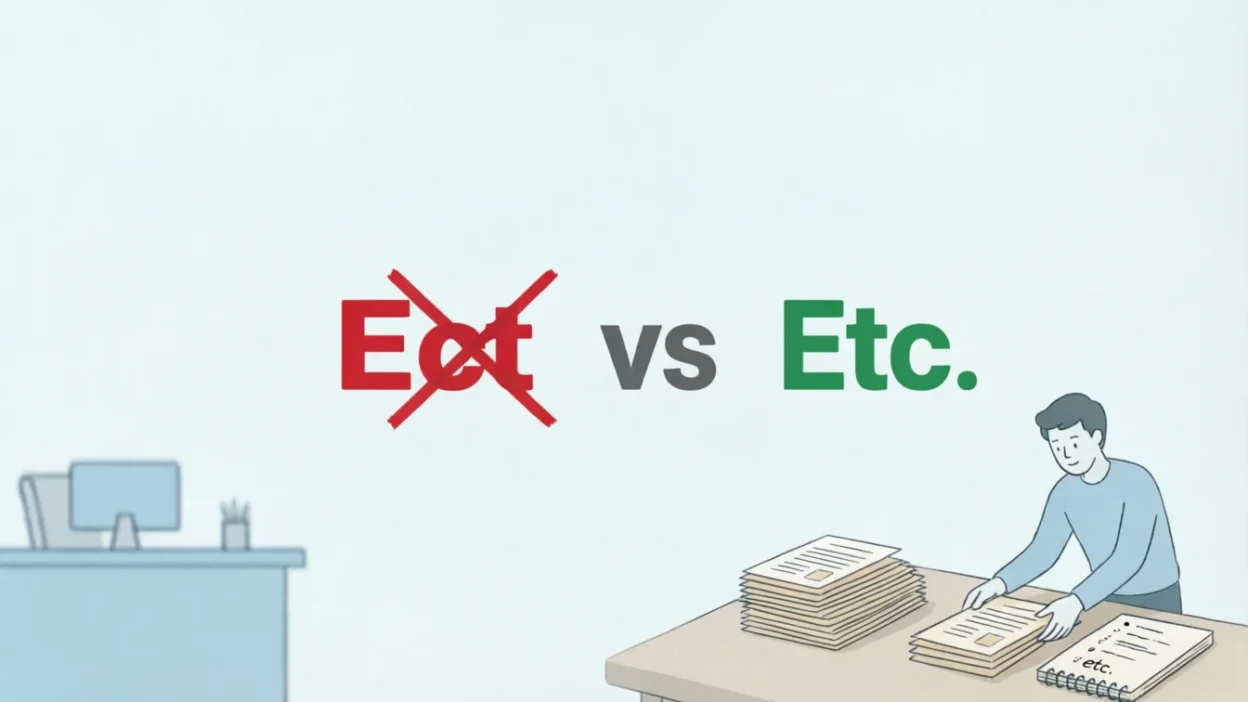
Have you ever typed ect at the end of a list and moved on without a second thought? It looks familiar, and many people use it casually but here’s the catch: it’s actually incorrect. This small mix up is incredibly common and often slips into emails, essays, and even professional writing.
If you want your writing to feel polished and accurate, understanding the difference between ect and etc. is essential. The good news is that the rule is simple, and once you learn it, you’ll never get it wrong again.
Quick Answer
“Etc.” is the correct abbreviation.
“Ect” is a misspelling and should not be used.
What Does “Etc.” Mean?
The abbreviation etc. stands for the Latin phrase et cetera, which means “and other things” or “and so on.”
It’s used at the end of a list to indicate that there are additional similar items not mentioned.
Examples:
- Bring snacks like chips, cookies, fruit, etc.
- The store sells clothes, shoes, accessories, etc.
It helps keep writing concise without listing every single item.
Why “Ect” Is Incorrect
“Ect” is simply a common spelling mistake. It happens because people:
- Mishear the pronunciation of “etc.”
- Rearrange the letters accidentally while typing
- Assume it follows a phonetic pattern
However, “ect” has no meaning as an abbreviation for et cetera and is not recognized in standard English.
Using “ect” can:
- Make your writing look careless
- Reduce credibility
- Confuse readers in formal contexts
The Correct Structure of “Etc.”
Understanding the origin makes it easier to remember:
- Et = “and”
- Cetera = “the rest”
So, the correct abbreviation is:
- etc. ✔
- ect ❌
Notice the order: e-t-c, not e-c-t.
Examples in Sentences
Correct Usage (Etc.)
- We need pens, notebooks, markers, etc.
- She enjoys reading, writing, painting, etc.
- The recipe includes flour, sugar, eggs, etc.
Incorrect Usage (Ect)
- We need pens, notebooks, markers, ect. ❌
- She enjoys reading, writing, painting, ect. ❌
Comparison Table: Ect vs Etc
| Feature | Etc. ✅ | Ect ❌ |
|---|---|---|
| Correct spelling | Yes | No |
| Meaning | “And so on” | No meaning |
| Origin | Latin (et cetera) | Not applicable |
| Usage in writing | Formal and informal | Incorrect everywhere |
| Professional impact | Enhances clarity | Reduces credibility |
Common Mistakes to Avoid
Even though “etc.” is simple, it’s often misused. Here are some common errors:
- ❌ Writing ect instead of etc.
- ❌ Using “and etc.” (redundant, since “et” already means “and”)
- ❌ Overusing “etc.” in formal writing
- ❌ Forgetting the period in “etc.”
Correct vs Incorrect
- ✔ Apples, bananas, oranges, etc.
- ❌ Apples, bananas, oranges, and etc.
- ❌ Apples, bananas, oranges, ect
When to Use “Etc.” (and When Not To)
“Etc.” is helpful, but it should be used thoughtfully.
Use it when:
- The list is obvious or repetitive
- You want to avoid unnecessary length
- The reader can easily guess the remaining items
Avoid it when:
- The list is unclear or incomplete
- In formal or academic writing where precision is needed
- It may confuse the reader
Example:
- Weak: The report includes data, analysis, conclusions, etc.
- Better: The report includes data, analysis, and conclusions.
American vs British English
There is no difference in spelling between American English and British English when it comes to “etc.”
However, there are small style differences:
- In American English, a period is always used: etc.
- In British English, the period may sometimes be omitted in informal contexts, but etc. is still widely accepted
In both varieties, “ect” is always incorrect.
Related Terms and Usage Tips
Here are a few related phrases and alternatives you can use instead of “etc.”:
- “and so on”
- “and more”
- “among others”
- “such as”
Using these alternatives can sometimes make your writing clearer, especially in formal contexts.
Why This Small Detail Matters
It might seem like a minor typo, but spelling “etc.” correctly can make a noticeable difference.
- Shows attention to detail
- Improves readability
- Builds trust with your audience
Small grammar improvements like this can elevate your overall writing quality.
FAQs
Is “ect” ever correct in English?
No, “ect” is always incorrect. The correct abbreviation is “etc.”
What does “etc.” stand for?
It stands for the Latin phrase “et cetera,” meaning “and so on.”
Why do people write ect instead of etc.?
Because of pronunciation confusion and typing errors.
Can I use “and etc.” together?
No, it’s redundant because “et” already means “and.”
Is “etc.” appropriate in formal writing?
It can be used, but it’s better to avoid it when clarity is important.
Do British and American English use etc. differently?
Both use “etc.”, though punctuation rules may vary slightly.
Should I always include a period after etc?
Yes, especially in American English, the period is standard.
Final Summary
The difference between ect and etc. is simple but important. “Etc.” is the correct abbreviation of et cetera, meaning “and so on,” while “ect” is just a common misspelling with no place in proper English. Understanding the correct order of letters helps you avoid this frequent mistake.
Paying attention to small details like this can significantly improve your writing. Whether you’re composing emails, essays, or professional content, using “etc.” correctly ensures your message is clear, accurate, and polished.

William Harved is a passionate language enthusiast and digital writer specializing in English spelling, grammar clarity, and common writing mistakes. As the primary author of Spelword.com, he focuses on helping readers understand confusing word pairs, correct spelling errors, and improve everyday communication.