Have you ever come across the words remediated and remedied and wondered whether they mean the same thing? Because both words relate to fixing problems, many people assume they are interchangeable. However, they are used in different contexts and carry slightly different meanings.
In this guide, you’ll learn the difference between remediated vs remedied, understand when to use each word, explore practical examples, avoid common mistakes, and discover simple memory tricks that make choosing the correct word much easier.
Quick Answer
The difference between remediated and remedied is mainly about context.
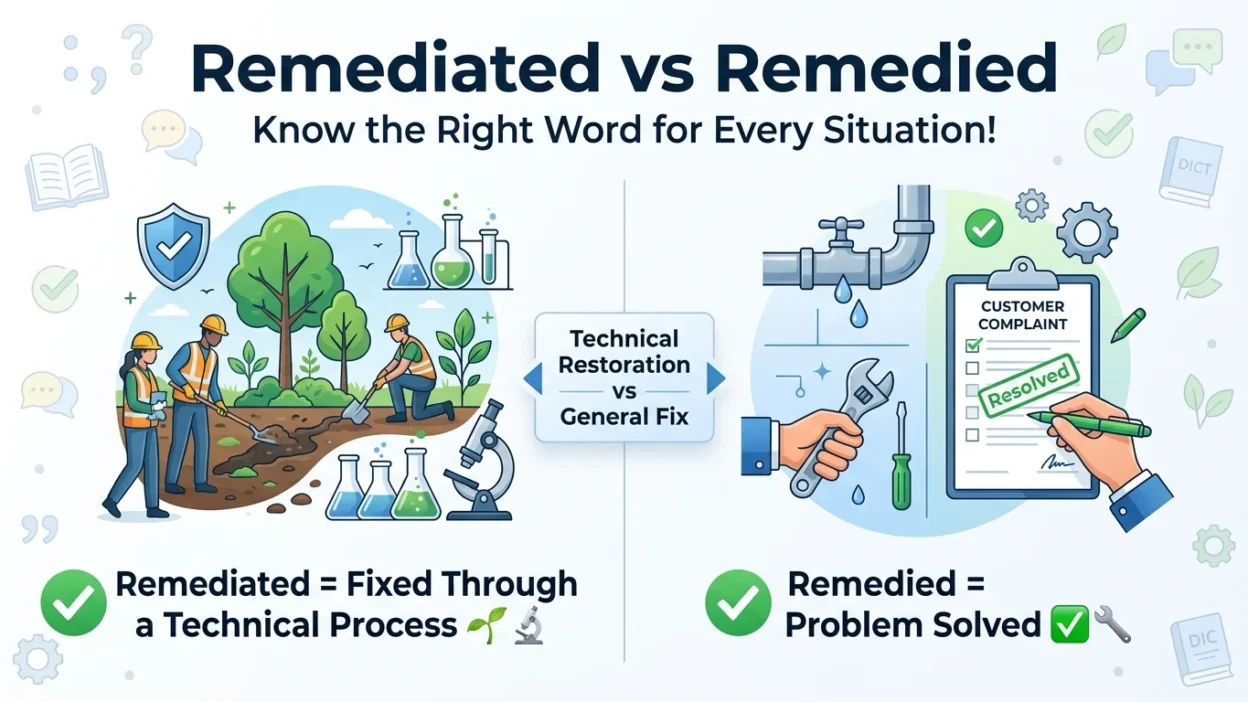
- Remediated means corrected or cleaned up through a planned process, especially in technical, environmental, educational, or information technology settings.
- Remedied means fixed, corrected, or solved, especially referring to a problem, fault, or undesirable situation.
Examples:
- The contaminated soil was remediated using biochar. ✅
- The company quickly remedied the customer complaint. ✅
Think of it this way:
- Remediated = corrected through a specialized or systematic process.
- Remedied = fixed or solved.
What Does “Remediated” Mean?
Remediated is the past tense and past participle of the verb remediate.
It usually refers to correcting a problem through a structured, technical, or professional process.
The word is especially common in:
- Environmental science
- Information technology
- Education
- Engineering
- Healthcare
Examples
- The polluted river was remediated using biological treatment.
- Engineers remediated the contaminated site.
- The cybersecurity team remediated the software vulnerability.
- The school remediated learning gaps through additional instruction.
- The hazardous waste was safely remediated.
In each case, the correction involves a systematic process rather than a simple fix.
What Does “Remedied” Mean?
Remedied is the past tense and past participle of the verb remedy.
It means to fix, correct, or remove a problem.
Unlike remediated, it is used much more broadly in everyday English.
Examples
- The mechanic remedied the engine problem.
- The company remedied the billing error.
- The doctor remedied the patient’s discomfort.
- The software update remedied several bugs.
- The landlord remedied the water leak quickly.
Here, the emphasis is simply on solving the problem.
Remediated vs Remedied: Comparison Table
| Feature | Remediated | Remedied |
|---|---|---|
| Verb Base | Remediate | Remedy |
| Meaning | Corrected through a technical or systematic process | Fixed or solved |
| Common Context | Environmental science, IT, education, engineering | Everyday problems, business, healthcare |
| Formality | Technical and specialized | General and widely used |
| Example | The soil was remediated. | The issue was remedied. |
When Should You Use “Remediated”?
Use remediated when discussing problems that require professional, scientific, or structured corrective actions.
Examples
- The industrial site was remediated before construction.
- Researchers remediated heavy metal contamination.
- The IT department remediated the security breach.
- The damaged ecosystem was successfully remediated.
- The laboratory remediated chemical contamination.
These situations involve organized solutions rather than simple repairs.
When Should You Use “Remedied”?
Use remedied when referring to fixing or correcting problems in general.
Examples
- The mistake was immediately remedied.
- The customer service team remedied the complaint.
- The contractor remedied the defect.
- The teacher remedied the misunderstanding.
- The software update remedied the issue.
This word fits everyday communication as well as formal writing.
The Key Difference
Although both words involve solving problems, they differ in scope.
Remediated often suggests:
- Technical expertise
- Scientific methods
- Environmental restoration
- Long-term corrective actions
- Structured procedures
Remedied usually suggests:
- Solving a problem
- Correcting a mistake
- Repairing an issue
- Removing a difficulty
In many cases, remediated is a specialized type of remedied.
Common Mistakes People Make
These words are sometimes confused because they both involve correction.
Mistake 1: Using “Remediated” for Everyday Problems
❌ The waiter remediated my incorrect order.
✅ The waiter remedied my incorrect order.
Mistake 2: Using “Remedied” for Environmental Cleanup
❌ The contaminated landfill was remedied.
✅ The contaminated landfill was remediated.
Mistake 3: Assuming the Words Always Mean the Same Thing
They overlap in meaning but differ in usage and context.
Choosing the appropriate word makes your writing more precise.
Easy Trick to Remember the Difference
Here’s a simple memory tip.
Think about the setting.
If the situation involves:
- Environmental cleanup
- Engineering
- Scientific treatment
- Cybersecurity
- Professional restoration
Use remediated.
If you’re simply talking about fixing a problem in everyday life, use remedied.
For example:
- The billing error was remedied.
Everyday Examples
Using “Remediated”
- Engineers remediated the damaged infrastructure.
- The company remediated cybersecurity vulnerabilities.
- Scientists remediated polluted farmland.
Using “Remedied”
- The customer complaint was remedied.
- The school remedied the scheduling problem.
- We remedied the misunderstanding.
- The defect was quickly remedied.
- The manufacturer remedied the production issue.
Common Expressions
Here are some frequently used phrases.
With “Remediated”
- Remediated soil
- Remediated site
- Remediated contamination
- Remediated groundwater
- Remediated system
With “Remedied”
- Remedied the problem
- Remedied the defect
- Remedied the situation
- Remedied the error
- Remedied the complaint
American vs British English
There is no major difference between American and British English regarding remediated and remedied.
However, remediated appears more frequently in technical writing, environmental reports, engineering documents, and information technology publications in both varieties of English.
Remedied remains the more common choice in everyday conversation and general writing.
Practice Sentences
Choose the correct word.
- The polluted lake was __.
Answer: remediated
- The company quickly __ the complaint.
Answer: remedied
- Scientists __ the contaminated soil.
Answer: remediated
- The contractor __ the construction defect.
Answer: remedied
- The cybersecurity team __ the vulnerability.
Answer: remediated
Frequently Asked Questions (FAQs)
What is the difference between remediated and remedied?
Remediated usually refers to correcting problems through technical or systematic methods, while remedied simply means fixed or solved.
Is remediated the same as remedied?
Not exactly. They have similar meanings, but remediated is more specialized and commonly used in scientific and technical contexts.
Which word is used in environmental science?
Remediated is the preferred term for environmental cleanup and restoration.
Can remedied be used for technical problems?
Yes. However, in highly technical fields, remediated is often more precise.
Which word is more common in everyday English?
Remedied is much more common in general conversation and everyday writing.
Is there a difference between American and British English?
No significant difference exists. Both varieties use these words with the same meanings.
Summary
Understanding remediated vs remedied becomes much easier once you focus on the context. Remediated usually describes correcting problems through specialized, technical, or scientific methods, making it common in environmental science, engineering, cybersecurity, and education. Remedied, on the other hand, is the broader and more versatile word used for fixing everyday problems, mistakes, defects, and complaints.
Although the two words share the idea of correction, choosing the right one makes your writing more accurate and professional. Whether you’re describing contaminated soil that was remediated or a customer issue that was remedied, knowing the distinction helps you communicate clearly and confidently.