Have you ever typed make due only to wonder if it should actually be make do? You’re not alone. This is one of the most common English writing mistakes because both phrases sound almost identical when spoken. However, only one of them is correct in most situations.
In this guide, you’ll learn the difference between make do vs make due, discover why people confuse them, see plenty of real world examples, and understand which expression you should use in everyday conversation, professional writing, and academic work.
Quick Answer
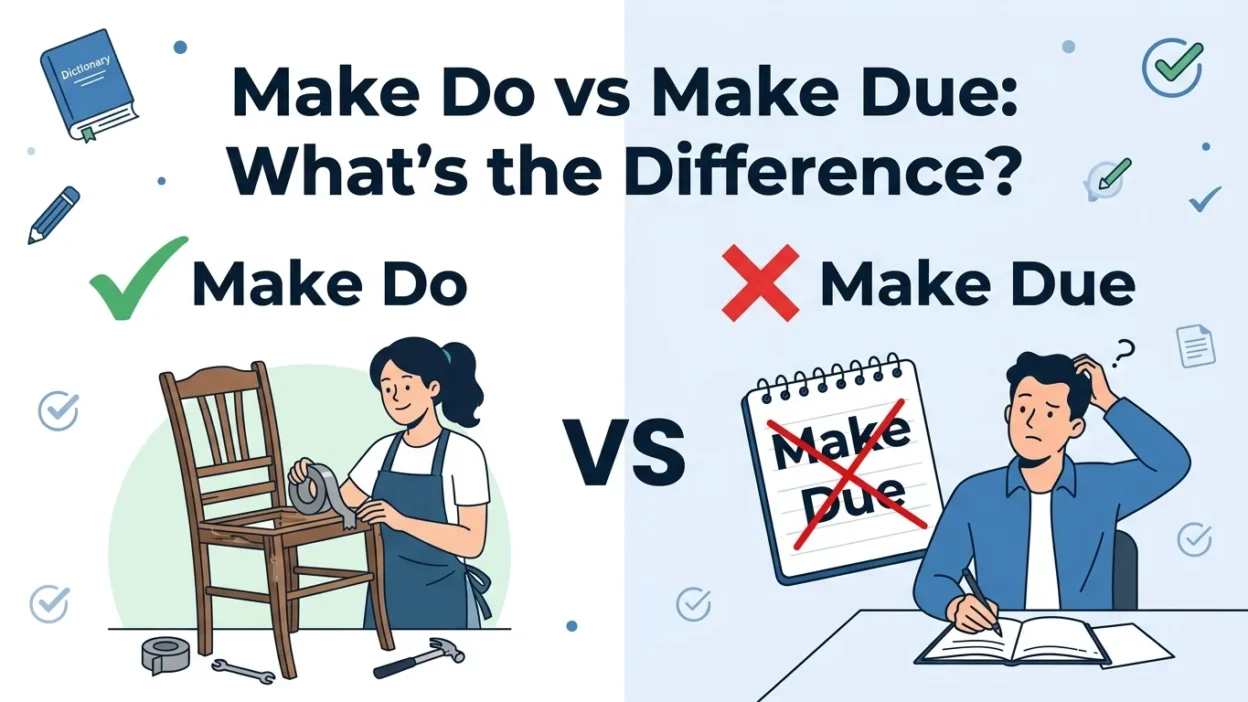
Make do is the correct English expression. It means to manage with what you have, even if it is not ideal.
Make due is almost always incorrect. People often write it by mistake because it sounds like make do, but standard English dictionaries do not recognize make due as an idiomatic phrase.
Correct: We had to make do with limited supplies.
Incorrect: We had to make due with limited supplies.
What Does “Make Do” Mean?
Make do is an idiom that means to manage successfully with whatever resources are available, even when they are insufficient or less than ideal.
People use this expression when they cannot get exactly what they want but still find a way to complete a task or solve a problem.
Examples
- We had to make do with an old laptop.
- Since the store was closed, we made do with frozen vegetables.
- They made do until the repairs were finished.
- During the trip, we made do without internet access.
In every example, the speaker adapts to a less-than-perfect situation.
What Does “Make Due” Mean?
In standard English, make due is generally considered an error when people intend to say make do.
The confusion happens because do and due have similar pronunciation in many accents.
Although the individual words make and due can appear together in other grammatical contexts, make due is not an established English idiom.
For example:
- ❌ We had to make due with what we had.
This sentence should be:
- ✅ We had to make do with what we had.
Make Do vs Make Due: Comparison Table
| Feature | Make Do | Make Due |
|---|---|---|
| Correct English idiom | ✅ Yes | ❌ No |
| Means manage with limited resources | ✅ Yes | ❌ No |
| Common writing mistake | No | Yes |
| Accepted in dictionaries | Yes | No (as an idiom) |
| Recommended for formal writing | Yes | No |
Why Do People Confuse “Make Do” and “Make Due”?
Several reasons explain this common mistake.
Similar Pronunciation
In fast speech, do and due often sound nearly identical.
As a result, many people assume the expression contains the word due.
Influence of Other Expressions
English includes many common phrases containing due, such as:
- Due date
- Due process
- Due diligence
- Payment due
- Due to
Because due appears so frequently, writers sometimes insert it where it doesn’t belong.
Learning by Sound
Many people hear the phrase before seeing it written.
Without checking a dictionary, they naturally spell it as make due.
Examples of “Make Do” in Sentences
Here are some natural examples.
- We had to make do with one chair.
- The family made do during difficult financial times.
- She forgot her notebook, so she made do with loose paper.
- Campers often make do with limited equipment.
- Until the replacement arrived, the team made do with temporary tools.
- We’ll have to make do until help arrives.
These examples all express adapting to limited resources.
Examples of Incorrect “Make Due”
The following examples are common mistakes.
❌ We had to make due with the supplies.
✅ We had to make do with the supplies.
❌ They made due without electricity.
✅ They made do without electricity.
❌ She can make due until Friday.
✅ She can make do until Friday.
Replacing due with do immediately makes the sentences correct.
Common Mistakes to Avoid
Many English learners—and even native speakers—make these errors.
Writing “Make Due”
This is by far the most common mistake.
Remember:
Make do is the correct idiom.
Assuming “Due” Makes More Sense
Some writers believe due relates to “what is owed” or “what is necessary.”
However, the idiom has nothing to do with that meaning.
Confusing Similar-Sounding Words
English contains many words that sound alike but have different meanings.
Always check the spelling when writing common expressions.
Overcorrecting Other Uses of “Due”
Keep in mind that due is still a perfectly correct word in many situations.
Examples include:
- Your payment is due tomorrow.
- The meeting was canceled due to bad weather.
- The assignment is due on Monday.
These uses are completely unrelated to the idiom make do.
Origin of the Phrase “Make Do”
The expression make do has existed in English for centuries.
Originally, it meant making something sufficient even when resources were limited.
The phrase became especially common during periods of economic hardship, when families learned to live with fewer possessions.
Today, it still conveys ideas such as:
- Adapting
- Improvising
- Coping
- Managing
- Using available resources wisely
American vs British English
There is no difference between American and British English regarding this expression.
Both varieties use make do as the standard idiom.
Neither American nor British dictionaries recommend make due.
Whether you’re writing for readers in the United States, the United Kingdom, Canada, or Australia, make do is the correct choice.
Easy Trick to Remember the Difference
Here’s a simple memory tip.
Think about the phrase:
Do what you can.
The idiom means you’re doing the best you can with what you have.
Since it involves doing, the correct word is do, not due.
Whenever you write the phrase, ask yourself:
“Am I talking about managing with limited resources?”
If the answer is yes, use make do.
Similar Expressions
If you’re looking for alternatives to make do, here are a few common expressions:
- Get by
- Manage somehow
- Cope with
- Work with what you have
- Adapt to the situation
- Improvise
- Make the best of it
Although these expressions have slightly different shades of meaning, they all communicate the idea of dealing with limited resources.
Frequently Asked Questions
Is make do or make due correct?
Make do is correct. Make due is a common spelling mistake.
What does make do mean?
It means to manage successfully with whatever resources are available, even if they are limited.
Why do people write make due?
People confuse the words because do and due often sound alike in spoken English.
Is make due ever correct?
Not as an English idiom. In almost every case, you should write make do instead.
Do American and British English both use make do?
Yes. Both American and British English recognize make do as the standard expression.
Can I use make do in formal writing?
Yes. It is a well-established English idiom that is acceptable in formal, academic, and professional writing when appropriate.
What is another way to say make do?
Alternatives include get by, cope, manage, adapt, or make the best of it, depending on the context.
Summary
The difference between make do vs make due is simple once you know the correct idiom. Make do means managing with what you have, especially when resources are limited or less than ideal. It is the accepted expression in modern English and appears regularly in everyday conversation, books, newspapers, and professional writing.
Although make due is a common mistake caused by similar pronunciation, it is not the correct idiomatic form. Whether you’re writing for school, work, or personal communication, choosing make do will ensure your writing is accurate, natural, and understood by readers around the world.