Have you ever paused while writing and wondered whether you should use hierarchical or hierarchal? You’re not alone. These two words look almost identical, have the same meaning, and even sound similar. Yet one appears much more often in books, research papers, business writing, and everyday English.
In this guide, you’ll learn the difference between hierarchical vs hierarchal, discover which form is preferred, explore real-life examples, avoid common mistakes, and understand whether American and British English treat these words differently. By the end, you’ll know exactly which spelling fits your writing best.
Quick Answer
Both hierarchical and hierarchal are correct English adjectives that describe something related to a hierarchy or organized levels of authority.
However:
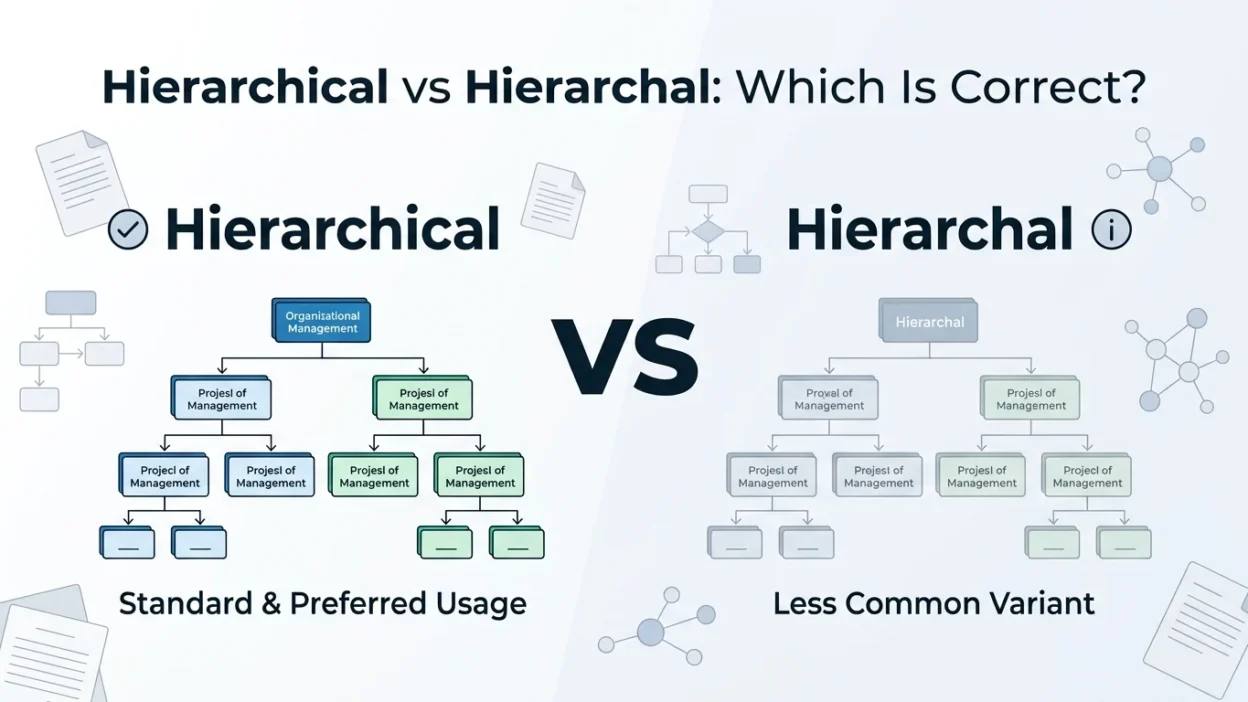
- Hierarchical is the standard and overwhelmingly preferred form in both American and British English.
- Hierarchal is an accepted but much less common variant that appears only occasionally.
For most writing—including academic, professional, and business communication—hierarchical is the safer and more natural choice.
What Does “Hierarchical” Mean?
The adjective hierarchical describes a system, organization, or structure arranged in different levels of rank, authority, or importance.
A hierarchy usually places people, ideas, or objects in an ordered system where higher levels have greater authority or significance than lower ones.
Examples
- The company has a hierarchical management structure.
- Schools often operate within a hierarchical administrative system.
- The military follows a highly hierarchical chain of command.
- Scientists studied the hierarchical organization of the ecosystem.
In modern English, hierarchical is the form you’ll encounter most frequently.
What Does “Hierarchal” Mean?
Hierarchal carries exactly the same meaning as hierarchical. It also refers to something organized according to levels or ranks.
Although dictionaries recognize hierarchal as a valid adjective, it appears much less often in contemporary writing.
Examples
- The church maintained a hierarchal leadership system.
- Some historical texts refer to hierarchal authority.
These sentences are grammatically correct, but replacing hierarchal with hierarchical would sound more natural to most readers.
Hierarchical vs Hierarchal: Side-by-Side Comparison
| Feature | Hierarchical | Hierarchal |
|---|---|---|
| Correct spelling | ✅ Yes | ✅ Yes |
| Most common usage | Yes | No |
| Preferred in academic writing | Yes | Rarely |
| Used in business writing | Very common | Uncommon |
| Accepted in dictionaries | Yes | Yes |
| Recommended for everyday writing | Yes | Usually not |
Why Is “Hierarchical” More Common?
Language naturally develops preferred forms over time. Although both words are correct, hierarchical became the dominant version because it aligns more closely with related words like:
- Hierarchy
- Hierarchically
- Hierarchies
Today, publishers, universities, businesses, and style guides almost always favor hierarchical.
As a result, readers are more familiar with it, making your writing clearer and more professional.
Examples of “Hierarchical” in Sentences
Here are several natural examples:
- The organization adopted a hierarchical decision-making process.
- Employees report through a hierarchical management system.
- The government operates under a hierarchical administrative structure.
- Social insects often have hierarchical colonies.
- The research paper explained the brain’s hierarchical processing model.
- Large corporations usually have a hierarchical chain of command.
Examples of “Hierarchal” in Sentences
Although less common, these examples are still correct.
- The historian described the hierarchal organization of medieval society.
- The religious community followed a hierarchal leadership model.
- Some older publications preferred the hierarchal spelling.
- The institution maintained a hierarchal system for promotions.
These examples show that the word is acceptable, but many editors would still recommend hierarchical.
Common Mistakes People Make
Many writers become confused because both spellings are valid. Here are the most common mistakes.
Assuming “Hierarchal” Is Incorrect
This isn’t true.
While hierarchical is much more common, hierarchal is also recognized by major dictionaries.
Mixing Spellings in One Document
Choose one spelling and remain consistent throughout your writing.
For example:
❌ The organization used a hierarchical structure with hierarchal leadership.
A better version would use one form consistently.
Using the Less Common Form in Formal Writing
Academic journals, business reports, and professional documents generally prefer hierarchical.
If you’re unsure, choose hierarchical.
American vs British English
One interesting fact is that there is no significant difference between American and British English regarding these words.
Both varieties strongly prefer hierarchical.
| English Variety | Preferred Form |
|---|---|
| American English | Hierarchical |
| British English | Hierarchical |
| Australian English | Hierarchical |
| Canadian English | Hierarchical |
Although hierarchal is accepted in all of these varieties, it remains much less common.
When Should You Use “Hierarchical”?
Use hierarchical when writing:
- Academic papers
- Business reports
- Research articles
- Technical documents
- Professional emails
- School assignments
- Government documents
- Website content
Because it is the standard choice, readers will immediately recognize it.
When Might “Hierarchal” Be Appropriate?
You might encounter hierarchal in:
- Older publications
- Historical writing
- Religious discussions
- Certain specialized texts
- Direct quotations that preserve original wording
Otherwise, hierarchical is usually the better option.
Easy Trick to Remember the Difference
If you’re ever uncertain, remember this simple rule:
When in doubt, choose “hierarchical.”
Think of it this way:
Modern English overwhelmingly prefers hierarchical, so using it is almost always the safest decision.
This trick works for nearly every writing situation.
Which Form Do Dictionaries Prefer?
Leading English dictionaries list both spellings, but they generally present hierarchical as the primary entry or the more common form.
That reflects how native speakers actually use the language today.
In newspapers, academic journals, business publications, and educational materials, hierarchical appears far more frequently than hierarchal.
Frequently Asked Questions
Is hierarchal a real word?
Yes. Hierarchal is a correct English word, but it is much less common than hierarchical.
Which is more correct: hierarchical or hierarchal?
Both are correct, but hierarchical is the preferred spelling in modern English.
Should I use hierarchical in academic writing?
Yes. Academic writing almost always favors hierarchical because it is the standard form.
Do hierarchical and hierarchal have different meanings?
No. Both words mean relating to a hierarchy or a ranked system.
Is hierarchal outdated?
Not exactly. It is still accepted, but it is considered an uncommon variant today.
Do Americans and British people use different spellings?
No. Both American and British English overwhelmingly prefer hierarchical.
Can I use hierarchal in professional documents?
You can, but hierarchical is the better choice because it is more familiar to readers and editors.
Summary
Understanding hierarchical vs hierarchal is easier than it first appears. Both spellings are correct and share the same meaning, describing something arranged in levels of authority or importance. The main difference lies in frequency rather than definition.
In modern English, hierarchical is the clear winner. It is the preferred spelling in American and British English, dominates academic and professional writing, and is the version most readers expect to see. While hierarchal remains an accepted alternative, choosing hierarchical will make your writing sound more natural, polished, and widely understood.

William Harved is a passionate language enthusiast and digital writer specializing in English spelling, grammar clarity, and common writing mistakes. As the primary author of Spelword.com, he focuses on helping readers understand confusing word pairs, correct spelling errors, and improve everyday communication.