
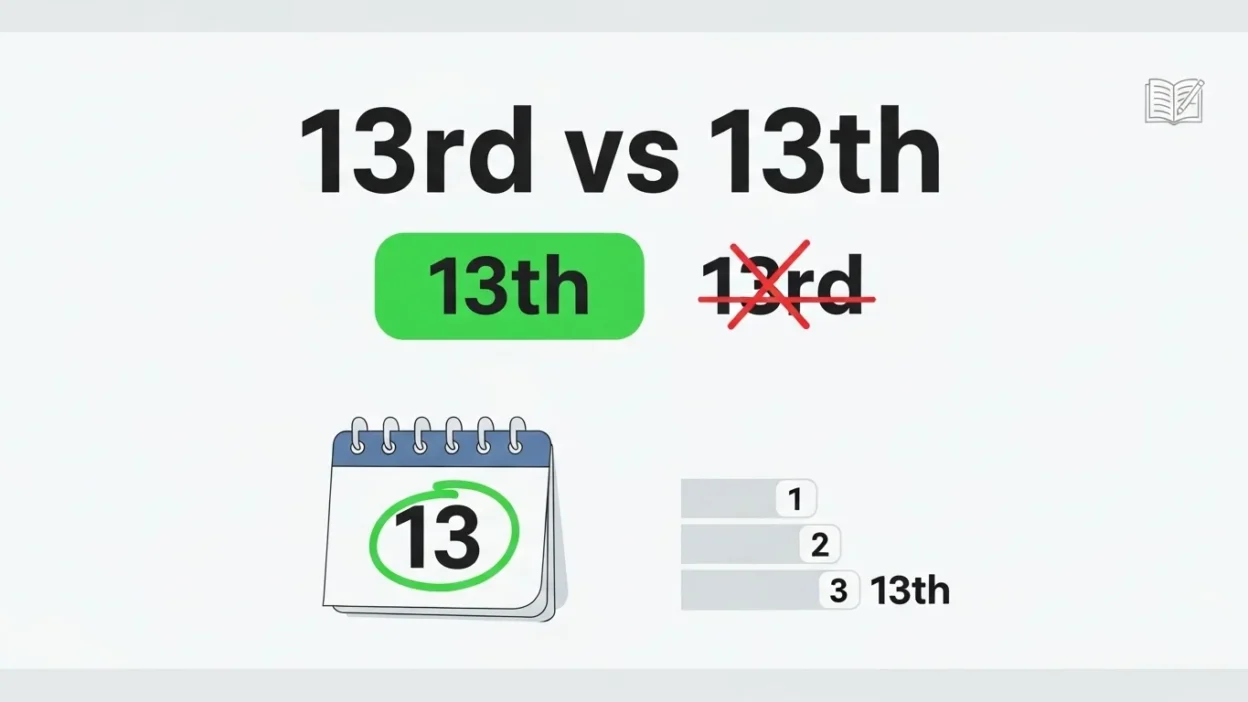
Numbers can be tricky, especially when it comes to ordinal forms like 13rd vs 13th. It’s a small detail, but using the wrong ending can make your writing look careless or confusing.
If you’ve ever hesitated while typing “13rd” or “13th,” you’re not alone. The good news is that once you understand the rule, you’ll never make this mistake again. This guide will walk you through the correct form, meaning, examples, and common pitfalls in a simple, friendly way.
Quick Answer: 13rd vs 13th
- ✅ Correct form: 13th
- ❌ Incorrect form: 13rd
The correct ordinal form of the number 13 is 13th. The form 13rd is incorrect and should never be used.
What Does “13th” Mean?
The term 13th is an ordinal number. It shows position or order in a sequence.
Simple Definitions:
- The number that comes after 12th and before 14th
- A position in a list or sequence
- A way to describe dates, rankings, or order
Examples in Sentences:
- My birthday is on the 13th of June.
- She finished in 13th place in the race.
- The meeting is scheduled for the 13th floor.
Why Do People Write “13rd”?
The incorrect form 13rd usually comes from confusion with ordinal endings.
Common Reasons:
- Mixing it up with numbers like 3rd or 23rd
- Forgetting special rules for teen numbers (11–13)
- Applying patterns incorrectly
The Key Issue:
People often assume that since 3 → 3rd, then 13 → 13rd. But English doesn’t follow that pattern for teen numbers.
Understanding the Correct Rule
Ordinal numbers follow specific suffix rules:
Basic Pattern:
- 1 → 1st
- 2 → 2nd
- 3 → 3rd
- 4 → 4th
Special Rule for 11, 12, 13:
👉 Numbers ending in 11, 12, or 13 always use “th”, not “st,” “nd,” or “rd.”
So:
- 11 → 11th
- 12 → 12th
- 13 → 13th
Key Insight:
👉 Even though 13 ends in 3, it still uses “th” because it’s a teen number.
13rd vs 13th: Comparison Table
| Feature | 13th ✅ | 13rd ❌ |
|---|---|---|
| Correct form | Yes | No |
| Meaning | 13th position | No meaning |
| Grammar rule | Follows teen rule | Incorrect pattern |
| Usage | Dates, rankings, order | Not used |
| Clarity | Clear and correct | Confusing |
Common Mistakes to Avoid
Even simple number rules can be confusing. Here are the most common errors:
1. Applying the “3rd” Rule to 13
❌ Today is the 13rd of May.
✅ Today is the 13th of May.
2. Forgetting Teen Number Exceptions
Numbers from 11 to 13 always break the usual pattern.
3. Relying on Last Digit Only
Looking only at the “3” in 13 leads to mistakes.
4. Typing Quickly Without Checking
Ordinal mistakes often happen in fast writing.
More Examples of “13th” in Context
In Dates:
- The event will take place on the 13th.
In Rankings:
- He secured the 13th position in the competition.
In Addresses:
- The office is on the 13th floor.
In History or Events:
- The 13th chapter explains the concept clearly.
American vs British English Differences
There is no difference between American and British English for this rule.
- 🇺🇸 American English: 13th
- 🇬🇧 British English: 13th
Both follow the same ordinal number rules.
Why Correct Usage Matters
Using the correct form 13th ensures your writing is accurate and professional.
Key Benefits:
- Improves clarity
- Avoids confusion
- Builds credibility
- Shows attention to detail
Even small errors like 13rd can make writing appear less polished.
Synonyms and Related Terms
While numbers themselves don’t have synonyms, you can express order in different ways:
- Thirteenth
- Position number thirteen
- Ranked thirteenth
Easy Memory Trick
Here’s a simple way to remember:
👉 “All teen numbers (11–13) always use ‘th’—no exceptions.”
This one rule can save you from multiple mistakes.
FAQs About 13rd vs 13th
Is “13rd” ever correct?
No, 13rd is always incorrect and should not be used.
What is the correct form of 13?
The correct ordinal form is 13th.
Why doesn’t 13 use “rd” like 3rd?
Because numbers ending in 11, 12, and 13 always use “th.”
Is this rule the same in British English?
Yes, both American and British English follow the same rule.
What about 23 or 33?
Those follow the normal pattern: 23rd, 33rd.
Can I write “thirteenth” instead?
Yes, writing it out fully is also correct.
Why do people make this mistake?
Because they focus on the last digit instead of the full number.
How can I avoid this error?
Remember the special rule for numbers 11–13.
Summary: 13rd vs 13th
The difference between 13rd vs 13th is simple but essential. 13th is the correct form and follows the rule for teen numbers, while 13rd is a common mistake caused by applying the wrong pattern.
Understanding this rule helps you use ordinal numbers correctly in dates, rankings, and everyday writing. Small details like this can greatly improve the clarity and professionalism of your work.
Final Thoughts
Mastering small grammar rules like this builds confidence in your writing. By remembering that all teen numbers use “th,” you can avoid common mistakes and write more accurately. Paying attention to these details ensures your communication is clear, polished, and effective.