Have you ever wondered whether you should write as soon as or once? These two expressions are often used to connect events in time, so it’s easy to think they mean exactly the same thing. While they can sometimes be interchangeable, they don’t always carry the same emphasis or tone.
In this guide, you’ll learn the difference between as soon as vs once, understand when each expression is appropriate, explore plenty of real-life examples, and avoid common grammar mistakes. By the end, you’ll know exactly which phrase best fits your sentence.
Quick Answer
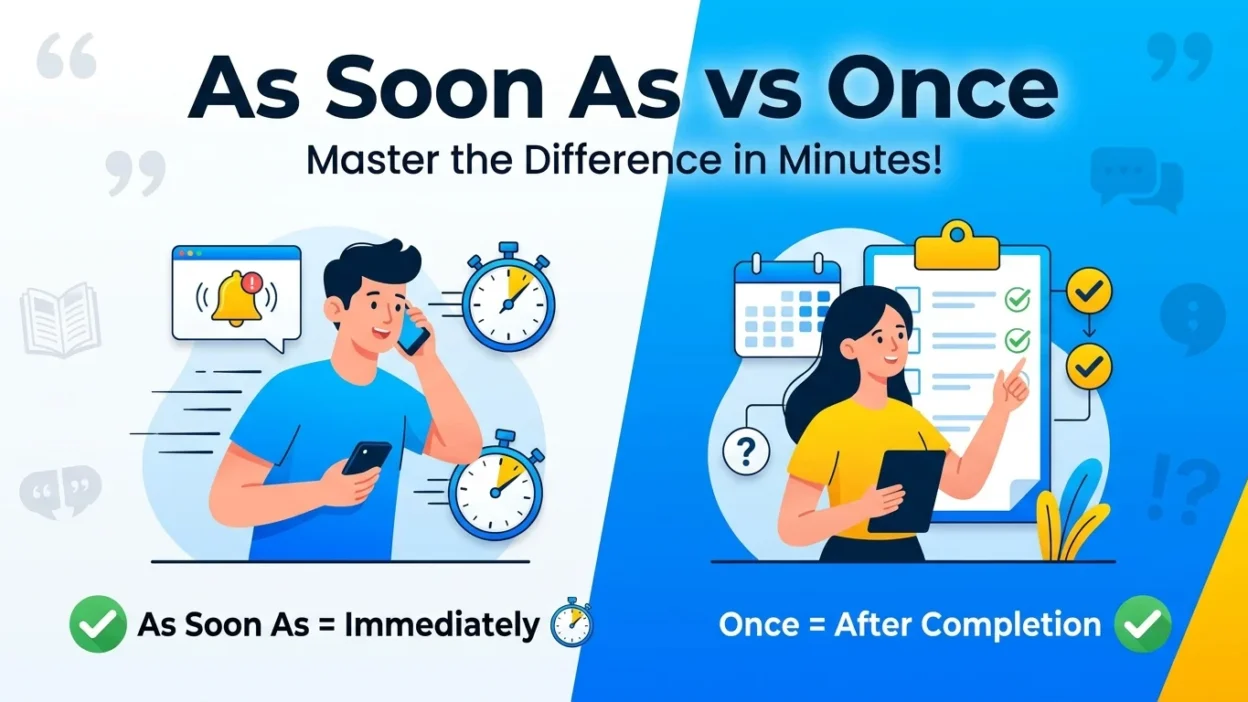
Both as soon as and once introduce a time clause, but they emphasize slightly different ideas.
- As soon as emphasizes that something happens immediately after another event.
- Once means after something has happened or when a condition has been completed.
Examples:
- I’ll call you as soon as I arrive. ✅
- I’ll call you once I arrive. ✅
Both sentences are correct, but as soon as places stronger emphasis on immediacy.
What Does “As Soon As” Mean?
As soon as is a conjunction used to show that one action happens immediately after another.
It highlights speed and urgency.
Examples
- Call me as soon as you get home.
- I’ll reply as soon as I receive your email.
- We left as soon as the rain stopped.
- Please let me know as soon as possible.
- She smiled as soon as she saw her family.
In each sentence, the second action follows without unnecessary delay.
What Does “Once” Mean?
Once is also a conjunction when it introduces a time clause. It means after, when, or following the completion of something.
Unlike as soon as, it doesn’t always emphasize immediate action.
Examples
- We’ll begin once everyone arrives.
- You can leave once your work is finished.
- I’ll send the documents once they’re ready.
- Once you’ve read the instructions, start the test.
- We’ll celebrate once the project is complete.
The focus is on the completion of the first event rather than how quickly the second begins.
As Soon As vs Once: Comparison Table
| Feature | As Soon As | Once |
|---|---|---|
| Part of Speech | Conjunction | Conjunction |
| Meaning | Immediately after | After or when |
| Emphasis | Speed and immediacy | Completion or condition |
| Formality | Neutral | Neutral to slightly more formal |
| Example | Call me as soon as you arrive. | Call me once you arrive. |
When Should You Use “As Soon As”?
Use as soon as when you want to stress that something should happen immediately.
It is common in:
- Everyday conversations
- Instructions
- Emails
- Requests
- Urgent situations
Examples
- Text me as soon as you land.
- I’ll help you as soon as I finish dinner.
- The meeting started as soon as the manager arrived.
- We left as soon as the movie ended.
- Contact customer support as soon as possible.
Notice how each example highlights prompt action.
When Should You Use “Once”?
Use once when the timing is less about speed and more about completing a condition.
Examples
- You may enter once the doors open.
- We’ll discuss the budget once everyone is present.
- She relaxed once the exam was over.
- I’ll review your application once I receive it.
- We can begin once the equipment is ready.
The emphasis is simply that one event follows another.
Can They Be Used Interchangeably?
Sometimes, yes.
For example:
- I’ll call you as soon as I arrive.
- I’ll call you once I arrive.
Both are grammatically correct.
However, the first sentence suggests the call will happen immediately, while the second simply indicates it will happen after arrival.
In formal instructions or situations requiring urgency, as soon as is often the better choice.
Common Mistakes to Avoid
Because these expressions are similar, learners often make a few common mistakes.
Mistake 1: Assuming They Always Mean Exactly the Same Thing
Although they are often interchangeable, as soon as adds emphasis to immediate action.
Mistake 2: Using Future “Will” in the Time Clause
❌ I’ll call you as soon as I will arrive.
✅ I’ll call you as soon as I arrive.
❌ We’ll start once everyone will come.
✅ We’ll start once everyone comes.
In English, time clauses introduced by as soon as and once normally use the present tense to refer to the future.
Mistake 3: Choosing the Wrong Expression for Urgency
If immediate action matters, prefer as soon as.
Instead of:
“We’ll respond once possible.”
Say:
“We’ll respond as soon as possible.”
Easy Trick to Remember the Difference
Here’s a simple memory tip.
Think of these questions:
Does it need to happen immediately?
Use as soon as.
Does it simply happen after another event?
Use once.
For example:
- I’ll text you as soon as I arrive.
- We’ll celebrate once the project ends.
The first stresses speed.
The second stresses completion.
Everyday Examples
Using “As Soon As”
- Please call me as soon as you wake up.
- I’ll visit as soon as I’m free.
- She answered as soon as the phone rang.
- Finish your homework as soon as possible.
- We started driving as soon as the storm ended.
Using “Once”
- We’ll leave once dinner is finished.
- You may join us once you’re ready.
- I’ll explain everything once we arrive.
- Once the lights turned green, traffic moved.
- They celebrated once the results were announced.
Common Expressions
Here are phrases you’ll often hear.
With “As Soon As”
- As soon as possible
- As soon as you can
- As soon as I know
- As soon as they arrive
- As soon as we’re ready
With “Once”
- Once again
- Once completed
- Once approved
- Once finished
- Once available
These expressions are widely used in both spoken and written English.
American vs British English
There is no significant difference between American and British English in the use of as soon as and once.
Both varieties use these expressions in the same way.
However, in formal business writing, once may sound slightly more concise and formal, while as soon as often feels warmer and more conversational.
Regardless of the variety of English, both expressions are grammatically correct when used appropriately.
Practice Sentences
Choose the correct expression.
- I’ll email you ______ I receive the report.
Answer: as soon as / once (both are correct)
- Please reply ______ possible.
Answer: as soon as
- We’ll begin ______ everyone arrives.
Answer: once
- Call me ______ you reach home.
Answer: as soon as
- You can leave ______ your shift ends.
Answer: once
Frequently Asked Questions (FAQs)
What is the difference between as soon as and once?
As soon as emphasizes immediate action, while once simply means after something has happened or a condition has been met.
Can I use once instead of as soon as?
Sometimes, yes. However, as soon as is better when you want to stress urgency or immediacy.
Is “as soon as possible” correct?
Yes. It is a very common and grammatically correct expression.
Which is more formal, once or as soon as?
Once often sounds slightly more formal because it is shorter and more concise, although both are acceptable in formal writing.
Can both expressions refer to future events?
Yes. They are commonly used to talk about future events, but the time clause normally uses the present tense.
Is there any difference between American and British English?
No. Both American and British English use as soon as and once with the same meanings and grammar.
Why can’t I use “will” after as soon as or once?
In English grammar, future time clauses introduced by as soon as or once usually take the present tense instead of will.
Summary
Understanding as soon as vs once is easier once you recognize the subtle difference in emphasis. As soon as highlights that one action follows another immediately, making it ideal for situations involving urgency or prompt responses. Once, on the other hand, simply indicates that one event happens after another or after a condition has been fulfilled, without emphasizing speed.
Although these expressions are often interchangeable, choosing the right one makes your communication more natural and precise. By remembering that as soon as focuses on immediacy while once focuses on sequence or completion, you’ll be able to write and speak English with greater confidence and accuracy.

William Harved is a passionate language enthusiast and digital writer specializing in English spelling, grammar clarity, and common writing mistakes. As the primary author of Spelword.com, he focuses on helping readers understand confusing word pairs, correct spelling errors, and improve everyday communication.