
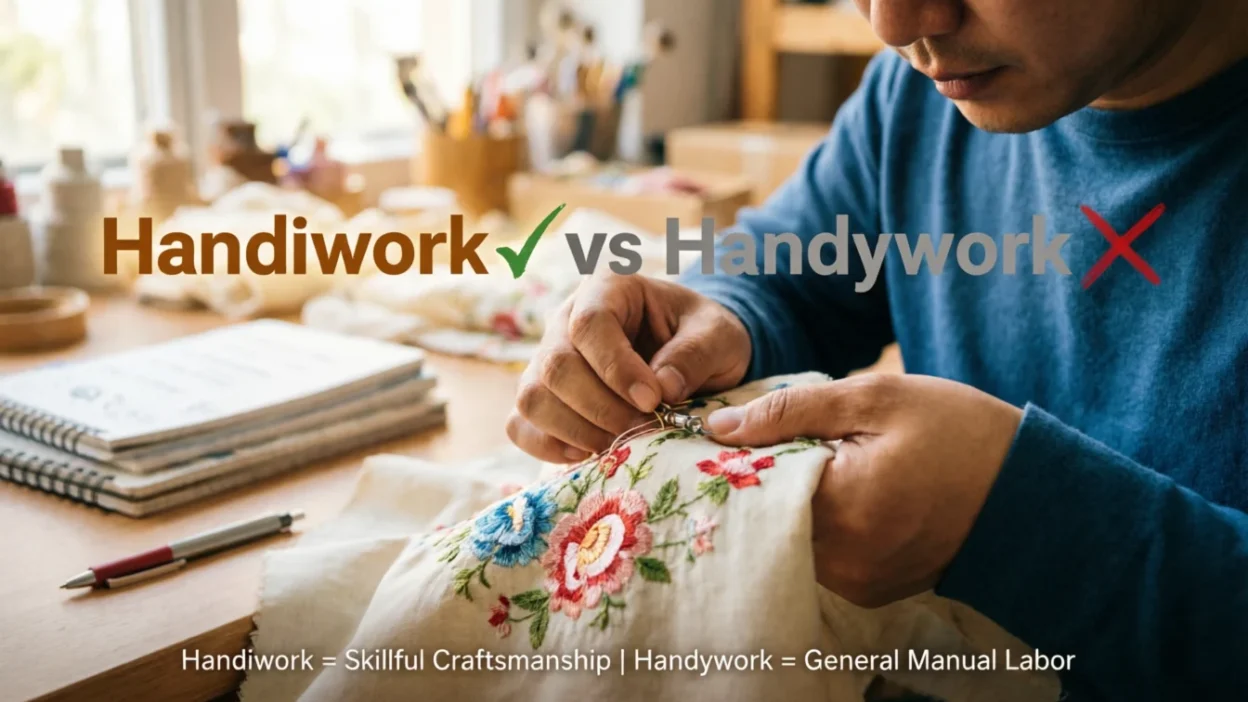
If you’ve ever paused while writing to wonder whether it’s handiwork or handywork, you’re not alone. These two spellings look almost identical, but only one is considered correct in standard English. The confusion often comes from how the words sound in conversation and how closely they relate to the idea of “handy” skills.
Understanding the difference between handiwork vs handywork is simple once you know the rule and using the correct form can instantly improve your writing clarity and credibility. Let’s break it down in a clear, friendly way so you’ll never second guess it again.
Quick Answer
“Handiwork” is the correct and standard spelling.
“Handywork” is a common misspelling and should be avoided in formal writing.
What Does “Handiwork” Mean?
The word handiwork refers to something made or created by hand rather than by machine. It often highlights craftsmanship, skill, and personal effort.
Common meanings:
- Work done manually
- Creative or skilled craftsmanship
- Something produced with care and attention
Examples:
- The intricate embroidery was clearly her handiwork.
- This wooden table is the handiwork of a local artisan.
- The damage appeared to be the handiwork of vandals.
Notice how the word can describe both positive creations (art, crafts) and negative actions (damage caused by someone).
What About “Handywork”?
Handywork is not considered a standard English word. It occasionally appears in informal writing or as a mistake influenced by the word handy (meaning useful or convenient).
Why the confusion happens:
- “Handy” is a familiar word, so people assume “handywork” follows the same pattern
- Pronunciation of handiwork can sound like “handy-work”
- Spellcheck tools don’t always catch it
Example of incorrect usage:
- ❌ This sculpture is beautiful handywork.
- ✔️ This sculpture is beautiful handiwork.
Handiwork vs Handywork: Key Differences
| Feature | Handiwork ✅ | Handywork ❌ |
|---|---|---|
| Correct spelling | Yes | No |
| Meaning | Work done by hand | Not a valid standard word |
| Usage | Formal and informal writing | Considered an error |
| Dictionary recognition | Yes | No |
Origins of “Handiwork”
The word handiwork dates back to Old English, combining hand (manual effort) and work (labor or creation). Over time, it evolved into the current spelling, which reflects traditional craftsmanship.
Interestingly, the “i” in handiwork doesn’t relate to the modern word handy. Instead, it comes from older linguistic patterns that have stayed consistent over centuries.
American vs British English Usage
Good news—there’s no regional difference here.
- American English: uses handiwork
- British English: also uses handiwork
Unlike many spelling variations (like color vs colour), this word remains the same across both forms of English.
Common Mistakes to Avoid
Even experienced writers sometimes slip up. Here are the most common errors and how to fix them:
1. Confusing “handy” with “handi”
Because handy is a real word, people naturally assume handywork must be correct. It’s not.
2. Phonetic spelling
Writing words the way they sound can lead to mistakes like this one.
3. Autocorrect reliance
Spellcheck doesn’t always flag handywork, especially in casual tools.
Quick tip:
If you’re ever unsure, remember:
👉 “Handiwork” contains “hand + i + work” — not “handy.”
When to Use “Handiwork”
Use handiwork whenever you want to describe something created or done manually.
Situations where it fits:
- Arts and crafts
- DIY projects
- Skilled labor
- Describing responsibility (positive or negative)
More examples:
- The quilt was her grandmother’s handiwork.
- Investigators confirmed it was the handiwork of a professional hacker.
- The garden’s beauty is the handiwork of dedicated volunteers.
Synonyms and Related Words
To enrich your writing, you can sometimes replace handiwork with similar expressions:
- Craftsmanship
- Manual work
- Creation
- Artwork
- Skillful work
Each carries a slightly different tone, so choose based on context.
Why Using the Correct Word Matters
Using handiwork instead of handywork might seem like a small detail, but it has a big impact:
- Improves credibility in writing
- Helps avoid confusion
- Shows attention to detail
- Strengthens professional communication
In SEO and content writing, even small spelling errors can affect trust and readability.
FAQs
Is “handywork” ever correct?
No, “handywork” is considered a misspelling. The correct form is always “handiwork.”
What does “handiwork” mean in simple terms?
It means something made or done by hand, often showing skill or craftsmanship.
Can “handiwork” be used negatively?
Yes, it can describe harmful actions, such as “the handiwork of criminals.”
Is “handiwork” formal or informal?
It works in both formal and informal contexts, depending on how you use it.
Why do people write “handywork”?
Because it sounds similar to “handiwork” and is influenced by the common word “handy.”
Does British English use “handywork”?
No, both British and American English use “handiwork” as the correct spelling.
Is “handiwork” still commonly used today?
Yes, especially in contexts related to crafts, art, and descriptive writing.
What is a simple way to remember the correct spelling?
Think of it as “hand + i + work” — not related to the word “handy.”
Summary
The difference between handiwork vs handywork is straightforward once you see it clearly: handiwork is the correct and widely accepted spelling, while handywork is a mistake. Despite how similar they sound, only one belongs in proper writing.
Whether you’re describing a beautiful handmade item or identifying the source of an action, handiwork is the word you can trust. It carries a sense of skill, effort, and intention that makes your writing more precise and engaging.

Dani Morrison is a dedicated language writer and spelling expert at Spelword.com, where she focuses on helping readers understand common English spelling mistakes and confusing word pairs. With a passion for clear communication, Dani creates easy-to-follow guides that simplify complex grammar and spelling rules for everyday use.