Have you ever stopped while writing and wondered whether you should use web site or website? You’re not alone. This is one of the most common spelling questions in English, especially for students, bloggers, business owners, and content writers. Since both versions have appeared in books and online sources, it’s easy to become confused.
The good news is that the difference between web site vs website is mostly about language evolution rather than meaning. In this guide, you’ll learn which spelling is correct today, why both forms exist, how American and British English treat them, and when you should use each one.
Quick Answer
Both web site and website refer to a collection of web pages available on the internet under one domain name.
- Website is the modern, standard, and widely preferred spelling.
- Web site is an older spelling that is now rarely used.
- In both American and British English, website is the recommended choice for modern writing.
What Does “Website” Mean?
A website is a group of connected web pages that users can access through a web browser using a specific internet address (domain name).
A website may include text, images, videos, contact information, products, blogs, or services.
Examples
- I created a new website for my business.
- Our school launched a modern website last month.
- You can find more information on the company’s website.
- The travel website offers excellent vacation deals.
Today, this is the spelling used by nearly all dictionaries, technology companies, universities, and media organizations.
What Does “Web Site” Mean?
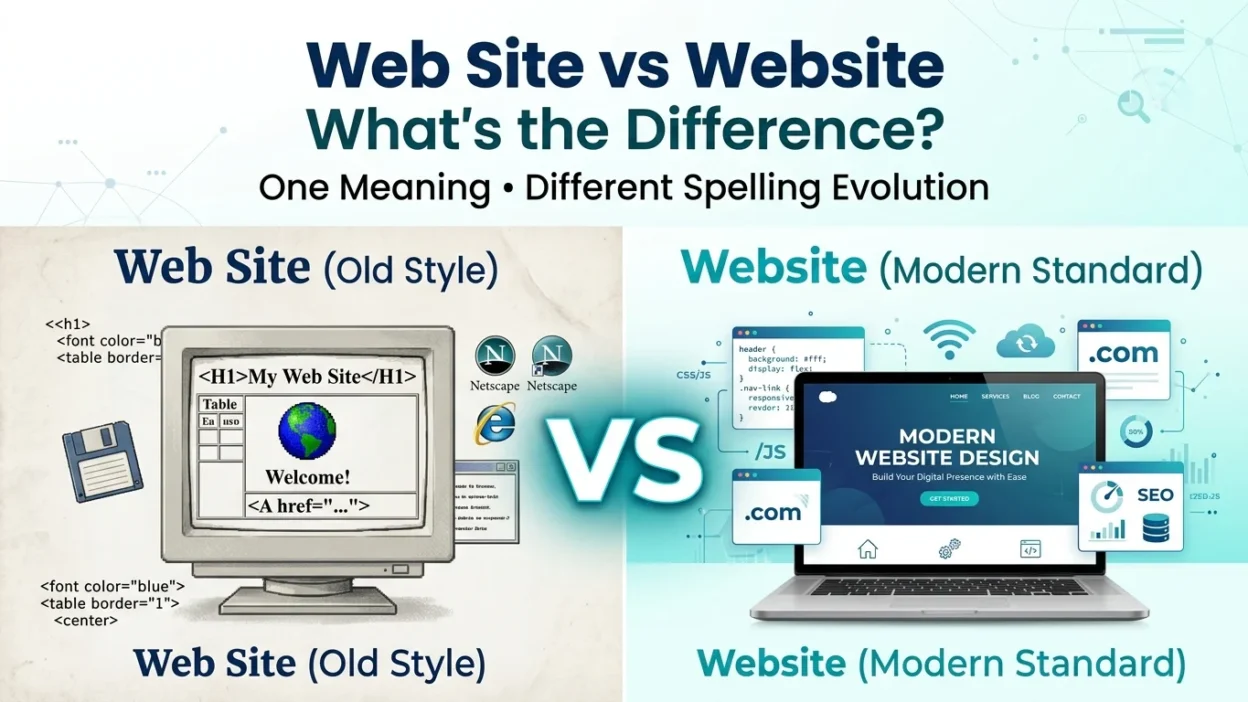
Web site has exactly the same meaning as website.
It was the original spelling when the World Wide Web became popular during the 1990s. At that time, writers often treated web and site as two separate words.
Although still understandable, web site is now considered outdated in most modern writing.
Examples
- The old manual referred to the company’s web site.
- Some archived articles still use web site instead of website.
You may still see this version in older books, documents, or websites that have not updated their style.
Web Site vs Website: Key Differences
Although both words have the same meaning, their usage has changed over time.
| Feature | Web Site | Website |
|---|---|---|
| Meaning | Collection of web pages | Collection of web pages |
| Correct? | Yes, but outdated | Yes, modern standard |
| Modern usage | Rare | Very common |
| American English | Rarely used | Preferred |
| British English | Rarely used | Preferred |
| Professional writing | Not recommended | Recommended |
| SEO and digital marketing | Uncommon | Standard choice |
Why Did the Spelling Change?
English often combines two separate words into one over time.
Examples include:
- Notebook
- Mailbox
- Keyboard
- Homepage
- Smartphone
The same happened with website.
Initially, people wrote web site, but as internet technology became part of everyday life, the combined spelling website became the accepted standard.
Today, almost every style guide recommends writing it as one word.
American vs British English
Unlike many English words, there is very little difference between American and British English here.
American English
American English almost always uses website.
Examples:
- Visit our website for more details.
- The website was updated yesterday.
British English
British English also strongly prefers website.
Examples:
- Their website contains useful information.
- The charity launched a new website this week.
Although web site may still appear in older British publications, modern British English generally follows the one-word spelling.
Which Spelling Is More Common Today?
The overwhelming majority of online publications, businesses, schools, and government organizations now use website.
You’ll find website in:
- Company websites
- University publications
- News articles
- Technical documentation
- Digital marketing content
- Software manuals
The two-word spelling has become increasingly rare.
Is “Website” One Word or Two?
Today, website is considered one word.
This is the preferred spelling in:
- Business writing
- Academic writing
- Professional emails
- Websites and blogs
- SEO content
- Technical documentation
If you’re unsure, choosing website is almost always the safest option.
Examples in Everyday Sentences
Using “Website”
- Please visit our website for updates.
- The school’s website is easy to navigate.
- I designed a new website for a local business.
- Their website loads quickly on mobile devices.
- Every company should have a professional website.
Using “Web Site”
- The magazine’s old edition referred to its web site.
- The printed guide listed every government web site.
These examples show that web site is mainly found in older materials.
Common Mistakes to Avoid
Many writers make small mistakes when using these words.
Avoid these common errors:
- Using web site in modern professional writing.
- Switching between website and web site in the same document.
- Assuming web site and website have different meanings.
- Writing WebSite with incorrect capitalization.
- Capitalizing Website in the middle of a sentence without a proper reason.
For consistency and professionalism, stick with website throughout your writing.
Tips for Choosing the Right Word
Here are some simple guidelines:
- Use website in all modern writing.
- Follow current dictionary and style guide recommendations.
- Stay consistent throughout your article or document.
- Use web site only when quoting historical material or preserving original wording.
- If writing SEO content, always choose website.
Why “Website” Is Better for SEO
Search engines recognize website as the standard spelling.
Most users also search using:
- website design
- business website
- website builder
- website development
- website hosting
Using the modern spelling improves consistency and matches user expectations.
How Dictionaries Treat These Words
Leading English dictionaries list website as the preferred spelling.
Many dictionaries include web site as an alternative or historical form but note that it is much less common today.
Professional style guides, technology companies, and publishers overwhelmingly recommend website.
A Simple Way to Remember
Here’s an easy memory trick:
Think of the internet today as one connected world.
Just as we write homepage, smartphone, and notebook as single words, website is also written as one word in modern English.
If you’re writing for today’s audience, website is almost always the correct choice.
FAQs
Is website or web site correct?
Both are correct, but website is the modern and preferred spelling.
Why was “web site” used before?
When the internet became popular, people treated web and site as separate words. Over time, they merged into website.
Which spelling is better for professional writing?
Website is the recommended spelling for professional, academic, and business writing.
Do American and British English use different spellings?
No. Both American and British English now strongly prefer website.
Is “web site” outdated?
Yes. It is still correct but is considered an older spelling that appears mostly in historical or archived content.
Should I use website in SEO articles?
Yes. Website is the standard spelling and aligns with how most users search online.
Can I use both spellings in the same article?
It’s better to use only website unless you are specifically discussing the historical difference between the two spellings.
Summary
The comparison of web site vs website is mainly about language change rather than meaning. Both terms refer to the same thing a collection of web pages under a single domain name. However, modern English has overwhelmingly adopted website as the standard spelling, while web site has become largely outdated.
Whether you’re writing a blog, business document, academic paper, or online content, website is the best choice. It reflects current language standards, improves consistency, and meets the expectations of today’s readers. Unless you’re quoting an older source, there’s little reason to use web site in modern writing.