Have you ever paused while writing and wondered whether in person or in-person is correct? You’re not alone. These two forms look almost identical, and both are widely used in emails, articles, workplace communication, and everyday English. The difference becomes much easier to understand once you know what role the phrase plays in a sentence.
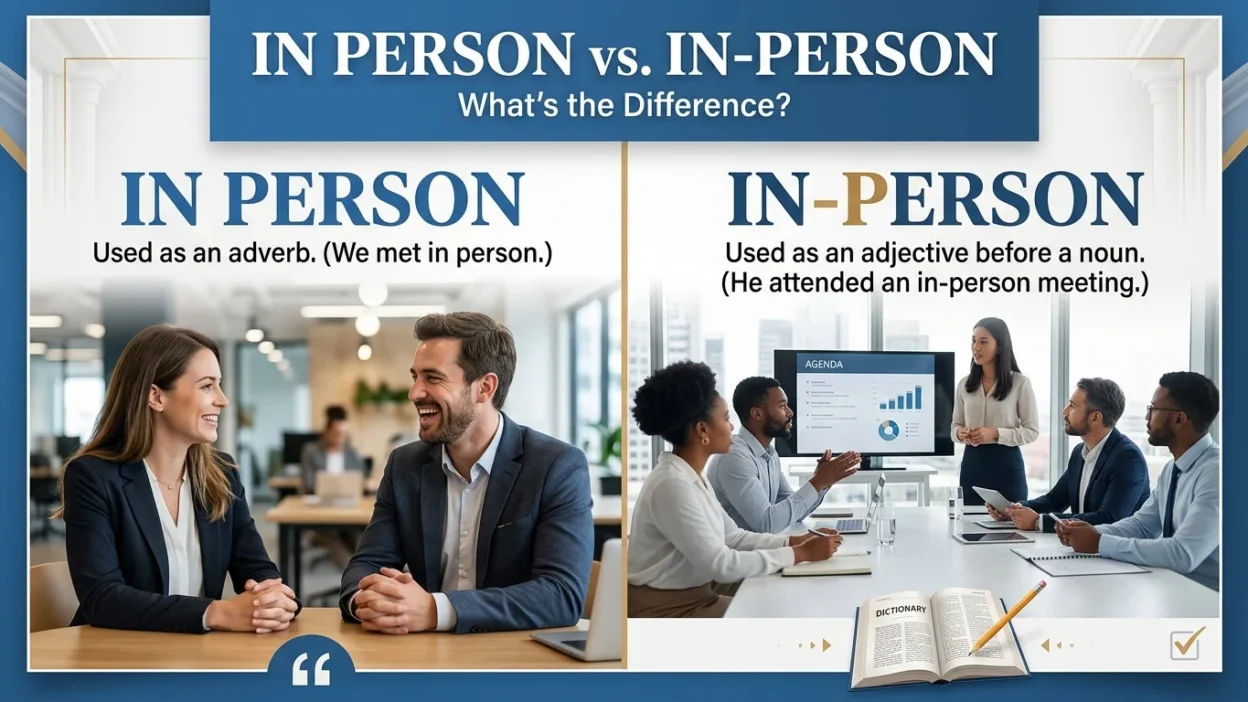
The good news is that both “in person” and “in-person” are correct, but they are not used in exactly the same way. Generally, in person is an adverbial phrase meaning physically present or face to face, while in-person is a compound adjective placed before a noun. Let’s explore the rules, examples, common mistakes, and American vs British English usage so you can choose the right form confidently.
Quick Answer
Use in person when the phrase describes how someone does something or means physically present.
Use in-person when it works as a compound adjective directly before a noun.
Examples
- I want to speak with you in person. ✅
- We had an in-person meeting. ✅
- She attended the interview in person. ✅
- She attended an in-person interview. ✅
A simple rule is:
Before a noun → in-person
After a verb → in person
What Does In Person Mean?
In person is a two-word adverbial phrase. It means being physically present rather than communicating through a phone call, video meeting, message, or another remote method.
It often means face-to-face, physically present, or personally.
Examples
- I’d rather discuss the issue in person.
- She met her supervisor in person.
- You need to submit the documents in person.
- We finally met in person after months of online communication.
- The doctor spoke to the patient in person.
In each example, in person describes how the action happens.
What Does In-Person Mean?
In-person is a hyphenated compound adjective. It usually appears directly before a noun to describe an activity, event, meeting, appointment, or interaction that happens physically rather than online.
Examples
- We scheduled an in-person meeting.
- The company requires an in-person interview.
- Students returned for in-person classes.
- The clinic offers in-person appointments.
- The organization is planning an in-person workshop.
Here, in-person modifies the noun that follows it.
In Person vs In-Person: Comparison Table
| Feature | In person | In-person |
|---|---|---|
| Form | Two words | Hyphenated |
| Grammatical role | Adverbial phrase | Compound adjective |
| Usually appears | After a verb or at the end of a sentence | Before a noun |
| Meaning | Physically present or face-to-face | Describes something conducted physically |
| Example | We met in person. | We had an in-person meeting. |
| Correct? | Yes | Yes |
The key difference is not meaning but grammatical function.
When Should You Use In Person?
Use in person when it describes an action or explains that someone is physically present.
Examples
- I prefer to discuss important matters in person.
- The manager wants to meet the employee in person.
- You must appear in person to verify your identity.
- They spoke in person after the conference.
- We had never met in person before the event.
A useful question to ask is:
How did the action happen?
If the answer is “in person,” use the two-word form.
When Should You Use In-Person?
Use in-person when it comes immediately before a noun and describes that noun.
Examples
- We arranged an in-person consultation.
- The school offers in-person learning.
- She has an in-person appointment tomorrow.
- The company conducts in-person training.
- They organized an in-person event.
Here, the phrase functions like an adjective.
A Simple Grammar Test
If you’re unsure which form to use, look at the word immediately after it.
Before a noun
Use in-person.
We scheduled an in-person interview.
Interview is a noun, and in-person describes it.
After a verb
Use in person.
We conducted the interview in person.
Here, in person describes how the interview was conducted.
This simple test works in most everyday situations.
Common Mistakes to Avoid
1. Writing In-Person After a Verb
Incorrect:
I want to talk to you in-person.
Preferred:
I want to talk to you in person.
Because the phrase comes after the verb and describes how the conversation will happen, the unhyphenated form is appropriate.
2. Leaving Out the Hyphen Before a Noun
Incorrect:
We scheduled an in person meeting.
Preferred:
We scheduled an in-person meeting.
When the phrase works together as a compound adjective before a noun, the hyphen improves clarity.
3. Assuming One Form Is Always Correct
Neither form is universally correct.
Both have legitimate grammatical functions.
The important question is how the phrase is being used in the sentence.
4. Using In-Person Everywhere
Because in-person has become extremely common, particularly in workplace communication, some writers use it even when the phrase is functioning adverbially.
For polished writing, maintain the distinction:
- Meet in person.
- Have an in-person meeting.
In Person and In-Person Examples
Seeing the two forms side by side makes the difference easier to understand.
| In Person | In-Person |
|---|---|
| Let’s discuss this in person. | Let’s schedule an in-person discussion. |
| She attended the interview in person. | She attended an in-person interview. |
| We met in person yesterday. | We had an in-person meeting yesterday. |
| He prefers to learn in person. | He prefers in-person learning. |
| The doctor saw her in person. | She had an in-person appointment. |
In Person vs Face-to-Face
In person and face-to-face can often express similar ideas.
For example:
- We should discuss this in person.
- We should discuss this face-to-face.
However, face-to-face can emphasize direct interaction between people, while in person often emphasizes physical presence rather than remote communication.
Both are common expressions in modern English.
American vs British English
There is no major spelling difference between American and British English for in person or in-person.
Both varieties generally follow the same grammatical distinction:
- in person as an adverbial phrase
- in-person as a compound adjective before a noun
Examples:
American English:
We need to meet in person.
We scheduled an in-person meeting.
British English:
We need to meet in person.
We scheduled an in-person meeting.
The forms are essentially the same in both varieties of English.
Why Is the Hyphen Important?
Hyphens can make compound adjectives easier to understand.
Consider:
We offer in person training.
This can look awkward because the reader has to determine how the words relate to training.
Compare:
We offer in-person training.
The hyphen shows that in-person works as a single descriptive unit modifying training.
This is one reason compound modifiers are often hyphenated before nouns.
In-Person in Professional Writing
The term in-person has become especially common in workplace and educational contexts.
You’ll often see expressions such as:
- in-person interview
- in-person meeting
- in-person training
- in-person consultation
- in-person appointment
- in-person workshop
- in-person classes
- in-person event
These phrases distinguish physical activities from their online or remote alternatives.
For example:
The company offers both virtual and in-person training.
In Person in Everyday Communication
The unhyphenated form is especially common after verbs.
Examples include:
- Let’s talk in person.
- I would like to meet you in person.
- She explained everything in person.
- We discussed the project in person.
- He apologized in person.
These sentences sound natural because in person describes the manner in which the action takes place.
FAQs
Is in person or in-person correct?
Both are correct. Use in person as an adverbial phrase and in-person as a compound adjective before a noun.
Is it an in-person meeting or an in person meeting?
The preferred form is an in-person meeting because the compound adjective comes directly before the noun.
Should I write “meet in person” or “meet in-person”?
Write meet in person. Here, the phrase follows the verb and describes how the meeting happens.
Is in-person hyphenated in American English?
Yes. When used as a compound adjective before a noun, in-person is commonly hyphenated in American English.
Is there a British English difference?
No major difference exists. British English also commonly uses in person and in-person according to their grammatical function.
Does in person mean face-to-face?
Usually, yes. In person generally means physically present rather than communicating remotely.
Can in-person be used after a verb?
In standard usage, in person is generally preferred after a verb. For example, “We met in person,” not “We met in-person.”
Why is in-person hyphenated?
The hyphen joins the words into a compound adjective when they work together to describe a noun, such as in-person interview.
Summary
The difference between in person vs in-person is mainly grammatical. In person is a two word phrase used to describe how something happens or to indicate physical presence. For example, “We discussed the matter in person.” In-person, with a hyphen, functions as a compound adjective before a noun, as in “We had an in-person discussion.”
Both forms are standard in American and British English, so the choice isn’t based on regional spelling. Instead, look at the sentence structure. If the phrase comes before a noun and describes it, in-person is usually the right choice. If it describes an action or follows a verb, use in person. Once you recognize this pattern, choosing between the two becomes simple.

William Harved is a passionate language enthusiast and digital writer specializing in English spelling, grammar clarity, and common writing mistakes. As the primary author of Spelword.com, he focuses on helping readers understand confusing word pairs, correct spelling errors, and improve everyday communication.