Have you ever typed “seel” when you actually meant “seal”? You’re not alone. These two words look similar, but they have very different meanings. In everyday English, seal is a common word, while seel is rare and mostly found in historical or literary contexts.
If you’re wondering whether to use seel or seal, this guide will clear up the confusion. We’ll explain the meanings, show real-life examples, compare the two words, point out common mistakes, and help you remember the correct choice with ease.
Quick Answer
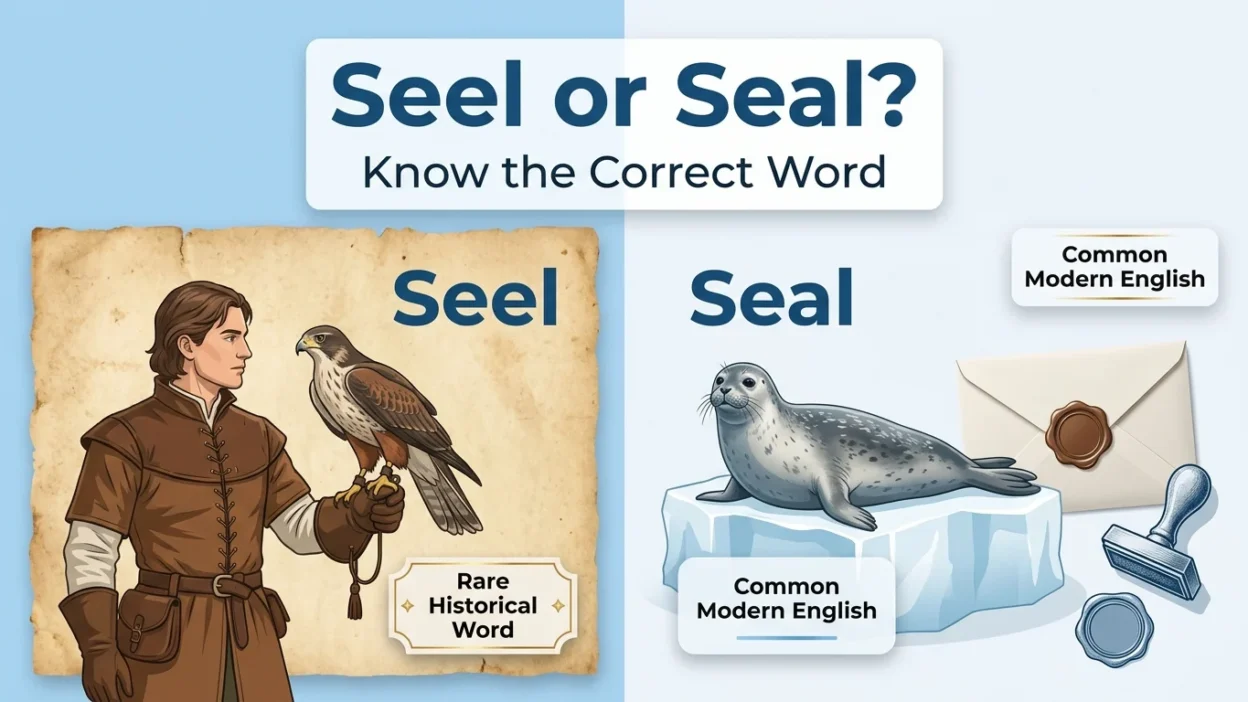
Seal is the correct word in almost all modern writing. It can refer to an animal, a stamp, closing something tightly, or officially approving a document. Seel is a rare English word that means to close or sew the eyes of a bird, especially in historical falconry. Most people never need to use seel in everyday communication.
| Word | Meaning | Common Today? |
|---|---|---|
| Seal | To close securely, an official stamp, or a marine animal | ✅ Yes |
| Seel | To sew or close a bird’s eyes (historical term) | ❌ Very Rare |
What Does “Seal” Mean?
Seal is a versatile English word used as both a noun and a verb.
As a noun, it can mean:
- A marine mammal.
- An official stamp or emblem.
- A device or material that prevents leaks.
- A sign of approval or authenticity.
As a verb, it means:
- To close something tightly.
- To make something airtight or waterproof.
- To finalize or confirm an agreement.
- To secure an envelope or package.
Examples
- Please seal the envelope before mailing it.
- The company placed its official seal on the certificate.
- We watched a seal swimming near the shore.
- The plumber used silicone to seal the leak.
- Their handshake helped seal the business deal.
What Does “Seel” Mean?
Seel is an old English verb that is rarely used today.
Traditionally, it means:
- To sew or partially close the eyelids of a falcon or hawk during training.
- To blind temporarily, especially in historical falconry.
The word appears mainly in:
- Historical texts.
- Shakespearean literature.
- Falconry references.
- Old dictionaries.
Examples
- The falconer would seel the bird before training.
- The ancient practice of seeling birds is no longer common.
- The poet used the word seel in a historical context.
Unless you are reading classic literature or discussing falconry, you are unlikely to encounter this word.
Seel vs Seal: What’s the Difference?
Although the words differ by only one letter, they have completely different meanings.
| Feature | Seel | Seal |
|---|---|---|
| Meaning | To sew shut a bird’s eyes (historical) | Close securely, official stamp, marine animal |
| Part of Speech | Verb | Noun and Verb |
| Common Usage | Very rare | Very common |
| Modern English | Rarely used | Frequently used |
| Everyday Writing | Almost never | Yes |
Why Do People Confuse Seel and Seal?
The confusion happens because:
- They look almost identical.
- They are pronounced similarly in many accents.
- Spell check may not always catch the mistake because seel is a real word.
- Many people have never seen the word seel before.
In almost every situation, seal is the word you want.
When Should You Use “Seal”?
Use seal whenever you’re referring to:
Closing Something
- Seal the package carefully.
- Seal the container to keep food fresh.
Official Approval
- The document carries the royal seal.
- The university placed its official seal on the diploma.
Business Agreements
- They signed the contract to seal the deal.
- The announcement sealed the partnership.
Marine Animals
- We saw a baby seal resting on the beach.
- Seals spend much of their lives in the ocean.
When Should You Use “Seel”?
Use seel only when discussing:
- Historical falconry.
- Medieval hunting practices.
- Shakespeare or classical literature.
- Historical language studies.
For example:
- Historians explained how trainers would seel hunting birds.
- The old manuscript described the practice of seeling falcons.
Outside these specialized subjects, seal is almost always the correct choice.
Examples in Everyday Sentences
Using “Seal”
- Please seal the box before shipping it.
- The judge stamped the document with the official seal.
- The bottle has a safety seal.
- We spotted a playful seal at the aquarium.
- The company hopes this agreement will seal the partnership.
Using “Seel”
- The medieval falconer chose to seel the hawk.
- The historian explained the meaning of seel in old English texts.
Notice how unusual seel sounds in modern conversation.
Common Mistakes to Avoid
Many writers accidentally confuse these words.
Avoid these errors:
- Writing seel the envelope instead of seal the envelope.
- Using seel when talking about official approval.
- Assuming both words are interchangeable.
- Thinking seel is simply another spelling of seal.
- Using seel because of autocorrect or typing mistakes.
Remember that seal is the standard word in modern English.
Easy Tips to Remember the Difference
Here are a few memory tricks.
- Seal is used every day.
- Seal can swim in the sea.
- Seal closes packages and documents.
- Seel is an old historical word.
- If you’re not talking about falconry, choose seal.
A simple reminder:
Seal = Modern English
Seel = Historical English
American vs British English
Unlike many spelling comparisons, seal and seel are not examples of American versus British English.
Both American and British English use seal in exactly the same way.
Likewise, seel remains an old literary word in both language varieties and is rarely used in modern writing.
| Feature | American English | British English |
|---|---|---|
| Seal | ✅ Standard | ✅ Standard |
| Seel | Rare historical word | Rare historical word |
There is no spelling difference between American and British English for these words.
How to Choose the Correct Word
Ask yourself one simple question:
Are you talking about closing something, an official mark, or the marine animal?
If the answer is yes, use seal.
Only use seel if you’re writing about historical falconry or quoting old literature.
This simple rule will help you avoid mistakes in nearly every situation.
FAQs
Is “seel” a real English word?
Yes. Seel is a real but very old English word used mainly in historical falconry and literature.
Is “seal” the correct spelling for closing an envelope?
Yes. You should always use seal when talking about closing an envelope, package, or container.
Do “seel” and “seal” mean the same thing?
No. They have completely different meanings and are not interchangeable.
Is “seel” commonly used today?
No. It is extremely rare in modern English and appears mostly in historical or literary works.
Is there an American and British English difference between seel and seal?
No. Both American and British English use seal as the standard word, while seel remains an uncommon historical term.
Why do people accidentally write “seel” instead of “seal”?
The words look similar, sound alike in many accents, and seel is an actual dictionary word, making it an easy typing mistake.
Which word should I use in everyday writing?
You should almost always use seal, unless you’re specifically discussing historical falconry or quoting old literature.
Summary
Although seel and seal differ by only one letter, they have very different meanings. Seal is the common modern English word used for closing something securely, referring to an official stamp, describing a marine mammal, or confirming an agreement. It is the correct choice in almost every everyday situation.
Seel, on the other hand, is a rare historical verb associated with falconry and old literary works. Most English writers will never need to use it outside specialized contexts. By remembering that seal belongs to modern English and seel belongs to historical English, you can confidently choose the right word every time.Seel or Seal