If you’ve ever wondered whether labelling vs labeling is the correct spelling, you’re not alone. These two spellings often appear in books, websites, product packaging, and academic writing, leaving many writers unsure which one they should use.
The truth is that both spellings are correct. The difference depends on whether you’re writing in American English or British English. Knowing when to use each spelling will help you write with confidence and maintain consistency in your work.
Quick Answer
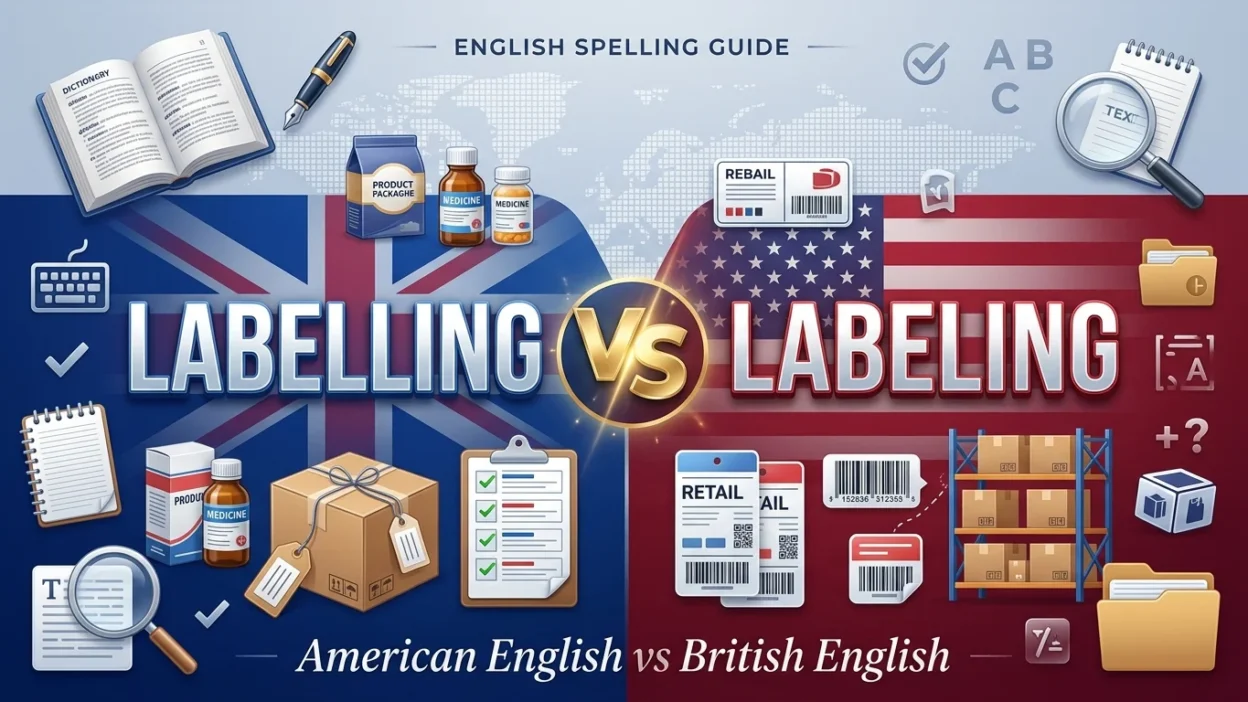
Labeling is the preferred spelling in American English, while labelling is the standard spelling in British English.
- American English: Labeling ✅
- British English: Labelling ✅
Both words have the same meaning. The only difference is the regional spelling convention.
What Do “Labelling” and “Labeling” Mean?
Both labelling and labeling refer to the act of attaching, writing, or assigning a label to something.
The word can describe:
- Putting labels on products.
- Naming or classifying people, objects, or ideas.
- Organizing files or documents.
- Identifying containers or packages.
Whether you write labelling or labeling, the meaning remains exactly the same.
Labelling vs Labeling: The Main Difference
| Feature | Labelling | Labeling |
|---|---|---|
| English Variety | British English | American English |
| Meaning | Same | Same |
| Correct Spelling | UK, Australia, New Zealand | United States |
| Pronunciation | Same | Same |
| Preferred in Academic Writing | UK institutions | US institutions |
The only distinction is the spelling style based on the version of English you are using.
Labeling in American English
In American English, labeling is the standard spelling.
The second “l” is not doubled before adding -ing.
Examples:
- The company is labeling all new products.
- Proper labeling helps customers find information quickly.
- Food labeling laws protect consumers.
- The teacher is labeling classroom supplies.
- Incorrect labeling can cause confusion.
American dictionaries consistently recommend labeling.
Labelling in British English
In British English, labelling is the accepted spelling.
British English usually doubles the final “l” before adding -ing to verbs ending in -l.
Examples:
- The pharmacist is labelling the medicine.
- Proper labelling improves workplace safety.
- The museum is labelling historical artifacts.
- Food labelling regulations have changed.
- Students are labelling diagrams in science class.
British publishers and educational institutions prefer labelling.
Why Are the Spellings Different?
The difference comes from spelling rules followed by different varieties of English.
American English Rule
American English often does not double the final “l” before adding endings like -ing or -ed.
Examples:
- Label → Labeling
- Travel → Traveling
- Cancel → Canceling
British English Rule
British English usually doubles the final “l” before adding -ing or -ed, even when the final syllable is not stressed.
Examples:
- Label → Labelling
- Travel → Travelling
- Cancel → Cancelling
This pattern appears in many British spellings.
Examples in Everyday Sentences
Using Labeling
- The warehouse is labeling every shipment carefully.
- Accurate labeling reduces mistakes.
- Product labeling is required by law.
- The nurse is labeling patient samples.
- Effective labeling improves organization.
Using Labelling
- The laboratory is labelling each specimen.
- Food labelling helps customers understand ingredients.
- Workers are labelling storage boxes.
- The school encourages proper labelling of notebooks.
- Clear labelling makes documents easier to find.
Common Uses of the Word
Both spellings commonly appear in many situations.
Product Packaging
Manufacturers use proper labeling or labelling to provide:
- Ingredients
- Instructions
- Expiration dates
- Safety warnings
Education
Teachers often use labeling or labelling for:
- Diagrams
- Maps
- Charts
- Science projects
Business
Companies rely on accurate labeling for:
- Inventory
- Shipping
- File organization
- Product identification
Common Mistakes to Avoid
Many writers accidentally mix British and American spellings in the same document.
Mixing Regional Styles
❌ The company is labelling products for an American audience.
✅ The company is labeling products.
Using American Spelling in British Documents
❌ Food labeling requirements (UK government document)
✅ Food labelling requirements
Switching Spellings Midway
Avoid writing:
- labeling
- labelling
- labeling
Instead, choose one spelling style and use it consistently throughout your article or document.
How to Choose the Right Spelling
Ask yourself one simple question:
Who is your audience?
Use labeling if you’re writing for:
- American readers
- U.S. businesses
- American universities
- U.S. publications
Use labelling if you’re writing for:
- British readers
- UK companies
- British universities
- UK publications
Consistency is more important than choosing one spelling over the other.
Similar British and American Spelling Differences
The same spelling pattern appears in many English words.
| American English | British English |
|---|---|
| Labeling | Labelling |
| Traveling | Travelling |
| Counseling | Counselling |
| Canceling | Cancelling |
| Modeling | Modelling |
| Signaling | Signalling |
Recognizing this pattern makes it easier to remember the correct spelling.
Tips to Remember the Difference
A simple memory trick is:
- America keeps one “L” → Labeling
- Britain doubles the “L” → Labelling
If you remember traveling vs travelling, you’ll also remember labeling vs labelling.
Is One Spelling More Correct?
No.
Neither spelling is more correct than the other.
Both are accepted by major dictionaries, style guides, universities, and publishers. The appropriate spelling depends entirely on whether you’re using American English or British English.
As long as you remain consistent throughout your writing, either spelling is correct.
Frequently Asked Questions
Is labeling or labelling correct?
Both are correct. Labeling is the American English spelling, while labelling is the British English spelling.
Why does British English spell it as labelling?
British English generally doubles the final “l” before adding -ing to many words ending in -l.
Which spelling should I use in the United States?
Use labeling because it follows American English spelling conventions.
Which spelling should I use in the United Kingdom?
Use labelling because it is the standard British English spelling.
Are labeling and labelling pronounced differently?
No. Both spellings have exactly the same pronunciation.
Can I use both spellings in the same article?
No. Choose either American English or British English and use that spelling consistently.
Is labelling considered incorrect in America?
It is not technically incorrect, but it is uncommon. Most American readers expect labeling.
Summary
The difference between labelling vs labeling comes down to regional spelling preferences rather than meaning. Labeling is the standard spelling in American English, while labelling is preferred in British English. Both words describe the process of attaching labels, identifying items, or classifying people, objects, or information.
When choosing between the two spellings, think about your audience and remain consistent throughout your writing. Whether you’re creating academic papers, business documents, product descriptions, or blog posts, using the appropriate regional spelling helps your content look polished, professional, and trustworthy.