English is full of words that sound alike but have completely different meanings. One common example is borders vs boarders. Since both words are pronounced almost the same, it’s easy to mix them up in writing. However, using the wrong one can completely change the meaning of your sentence.
If you’ve ever wondered whether to write borders or boarders, you’re not alone. This guide explains the difference in simple language, provides plenty of examples, highlights common mistakes, and gives you an easy way to remember which word fits your sentence.
Quick Answer
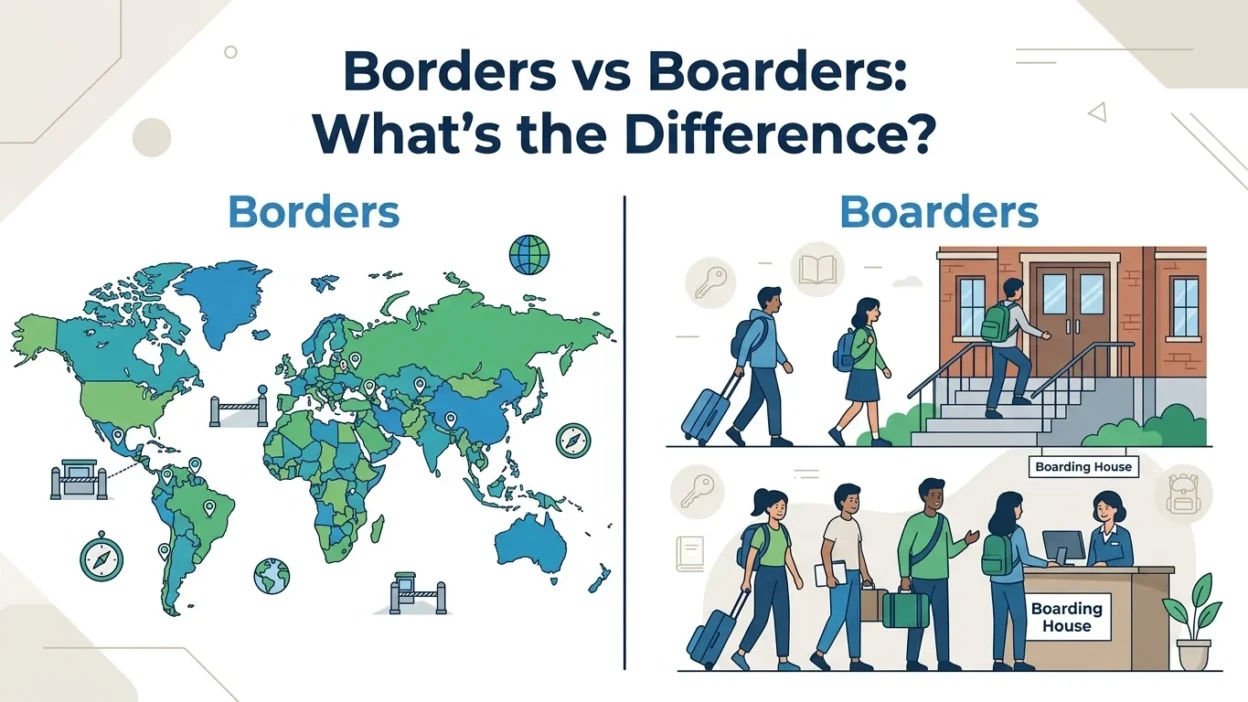
Borders refers to boundaries or edges between places, countries, regions, or objects.
Boarders refers to people who pay to live and usually eat meals in someone else’s home, school, or lodging.
- ✅ Canada and the United States share long borders.
- ✅ The school has over 300 boarders living on campus.
The easiest way to remember is:
- Borders = boundaries
- Boarders = people who board (stay or live somewhere)
What Does “Borders” Mean?
Borders is the plural form of border. It usually refers to the edge or boundary of a place, object, country, state, or region.
Borders can be physical, political, geographical, or decorative.
Examples of “Borders”
- France has borders with several European countries.
- The garden has beautiful flower borders.
- Thick black borders surrounded the picture.
- Security was increased along the national borders.
- The map clearly shows state borders.
In every example, borders refers to an edge, boundary, or dividing line.
What Does “Boarders” Mean?
Boarders is the plural form of boarder. A boarder is a person who pays to live, and often eat, in another person’s home, school, hostel, or boarding house.
The word comes from the phrase room and board, where board refers to meals.
Examples of “Boarders”
- The hostel accommodates twenty boarders.
- Several boarders stayed at the guesthouse for the summer.
- The school provides meals for all boarders.
- The landlady welcomed her new boarders.
- International boarders arrived before the semester began.
Here, boarders always refers to people.
Borders vs Boarders: Key Differences
| Feature | Borders | Boarders |
|---|---|---|
| Meaning | Boundaries or edges | People who live and eat somewhere for payment |
| Part of Speech | Noun (plural) | Noun (plural) |
| Refers To | Places, countries, regions, objects | People |
| Common Topics | Geography, maps, decoration | Schools, homes, hostels |
| Example | National borders | School boarders |
Although the words sound nearly identical, their meanings are completely different.
When Should You Use “Borders”?
Use borders whenever you are talking about boundaries, edges, limits, or dividing lines.
Common situations include:
- Country borders
- State borders
- Property borders
- Garden borders
- Decorative borders
- Picture borders
- Map borders
Example Sentences
- Soldiers guarded the country’s borders.
- The painting has elegant gold borders.
- Rivers often form natural borders.
- The two nations agreed to reopen their borders.
- The blanket has colorful embroidered borders.
When Should You Use “Boarders”?
Use boarders when referring to people who live in boarding schools, boarding houses, hostels, or private homes while paying for accommodation and meals.
Common situations include:
- Boarding schools
- Boarding houses
- Student housing
- Guest accommodation
- Long-term lodging
Example Sentences
- All boarders must return before 9 p.m.
- The boarding school has students from many countries.
- The owner prepared breakfast for the boarders.
- New boarders moved into the hostel this week.
- The house has enough rooms for six boarders.
Side-by-Side Examples
Comparing the two words makes the distinction much clearer.
- The country closed its borders during the emergency.
- The hostel welcomed several new boarders.
- Mountains formed natural borders between the regions.
- The school provided comfortable rooms for its boarders.
- Decorative borders improved the invitation card.
- The guesthouse offered discounts to long-term boarders.
Notice that borders refers to places or edges, while boarders refers to people.
Common Mistakes to Avoid
These errors are common because the words sound alike.
Incorrect: The country opened its boarders.
✅ Correct: The country opened its borders.
Countries have borders, not boarders.
Incorrect: The school has hundreds of borders.
✅ Correct: The school has hundreds of boarders.
Schools have boarders if students live there.
Incorrect: The picture has decorative boarders.
✅ Correct: The picture has decorative borders.
Frames and decorations have borders.
Incorrect: The hotel welcomes international borders.
✅ Correct: The hotel welcomes international boarders.
Hotels and boarding houses accommodate boarders.
Easy Memory Trick
Here’s a simple way to remember the difference.
Borders = Boundary
Think of the letter “i” in border as standing for an invisible dividing line between places.
Whenever you think about maps, countries, edges, or outlines, choose borders.
Boarders = Boarding
Notice that boarders begins with board, just like:
- Boarding school
- Boarding house
- Room and board
If you’re talking about people staying somewhere, use boarders.
Common Expressions Using “Borders”
You’ll frequently hear these phrases.
- National borders
- Open borders
- Closed borders
- Border security
- Border crossing
- Border control
- Decorative borders
Example
Several countries strengthened their border security.
Common Expressions Using “Boarders”
These phrases are also common.
- Boarding school boarders
- Student boarders
- Long-term boarders
- Paying boarders
- Hostel boarders
- Residential boarders
Example
The boarding school provides excellent facilities for its boarders.
American vs British English
There is no difference between American and British English regarding the meanings or spellings of borders and boarders.
Both varieties use:
- Borders for boundaries or edges.
- Boarders for people living in boarding accommodation.
Examples:
- American English: The country strengthened its borders.
- British English: The country strengthened its borders.
- American English: The school welcomed new boarders.
- British English: The school welcomed new boarders.
Only pronunciation may vary slightly depending on regional accents.
Practice Sentences
Choose the correct word.
- The map shows international ______.
- ✅ Borders
- The boarding school has 500 ______.
- ✅ Boarders
- Beautiful flower ______ surrounded the garden.
- ✅ Borders
- The guesthouse accepts long-term ______.
- ✅ Boarders
- The government increased security along its ______.
- ✅ Borders
FAQs
What is the difference between borders and boarders?
Borders are boundaries or edges, while boarders are people who pay to live and usually eat in another person’s home or institution.
Is borders related to countries?
Yes. Borders commonly refer to the boundaries between countries, states, regions, or properties.
Who are boarders?
Boarders are people who live in boarding schools, boarding houses, hostels, or private homes while paying for accommodation and often meals.
Can I use boarders instead of borders?
No. Although the words sound alike, they have different meanings and cannot be used interchangeably.
Why do people confuse borders and boarders?
They are homophones, meaning they have nearly identical pronunciations but different spellings and meanings.
Is there a difference between American and British English?
No. Both American and British English use borders and boarders in exactly the same way.
What is a border in art or design?
A border is a decorative edge or frame placed around a picture, page, or object.
Summary
Understanding borders vs boarders becomes much easier once you remember what each word represents. Borders refers to boundaries, edges, or dividing lines between countries, regions, objects, or decorative designs. Boarders, on the other hand, refers to people who pay to live and often eat in a boarding school, boarding house, hostel, or private residence. Although the words sound almost identical, their meanings are entirely different.
Using the correct word improves both your writing and communication. Whenever you’re talking about maps, geography, property lines, or decorative edges, choose borders. When referring to students, guests, or residents staying somewhere for accommodation and meals, choose boarders. Keeping this simple distinction in mind will help you avoid one of the most common homophone mistakes in English.

William Harved is a passionate language enthusiast and digital writer specializing in English spelling, grammar clarity, and common writing mistakes. As the primary author of Spelword.com, he focuses on helping readers understand confusing word pairs, correct spelling errors, and improve everyday communication.