The English language has many word pairs that sound similar but carry very different meanings. One such pair is invoke vs provoke. Because both words often appear in formal writing and share similar endings, it’s easy to confuse them. However, using the wrong one can completely change the meaning of a sentence.
If you’ve ever wondered whether you should invoke a law or provoke a reaction, you’re in the right place. This guide explains the meaning of each word, their differences, examples, common mistakes, and practical tips to help you use them correctly and confidently.
Quick Answer
The difference between invoke vs provoke is straightforward:
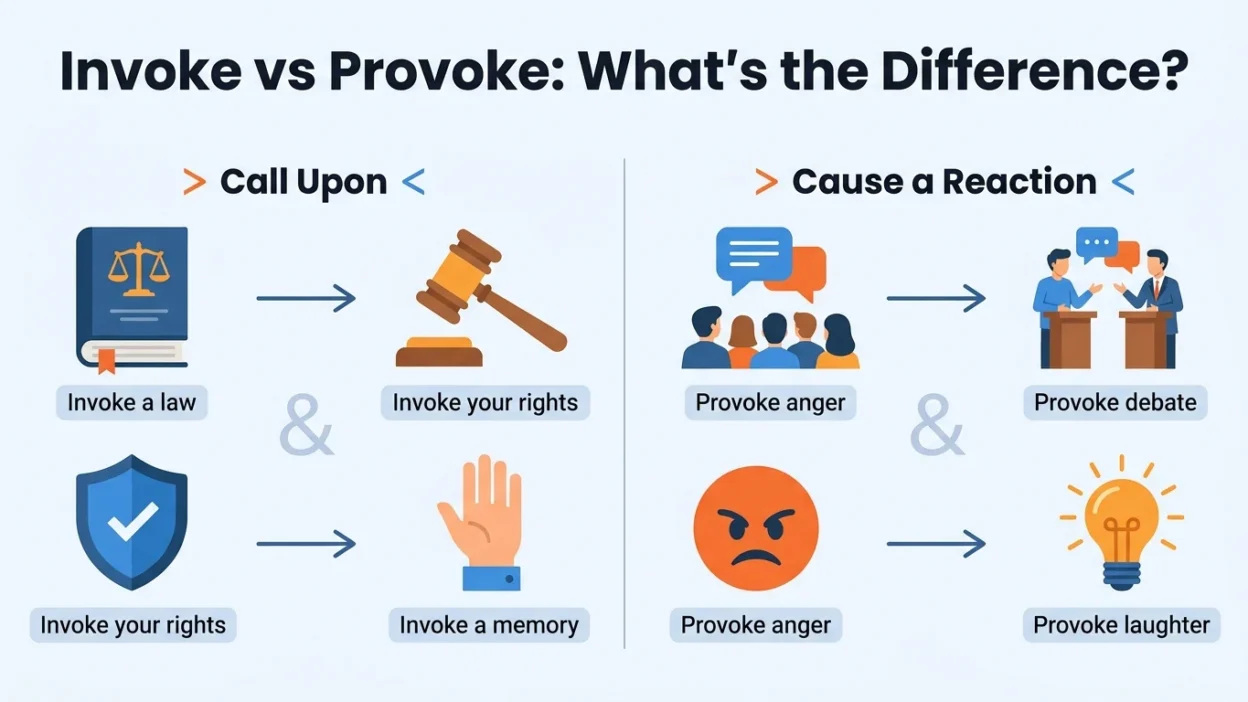
- Invoke means to call upon, appeal to, or bring something into effect, such as a law, authority, memory, or emotion.
- Provoke means to cause, trigger, or stimulate a reaction, often an emotional response like anger, laughter, or debate.
Examples:
- The lawyer invoked the constitutional right to remain silent. ✅
- His rude comments provoked an argument. ✅
Think of it this way:
- Invoke = Call upon
- Provoke = Cause a reaction
What Does “Invoke” Mean?
Invoke is a verb that means to call upon something for help, support, authority, protection, or effect. It is commonly used in legal, religious, literary, and formal contexts.
Examples
- The judge invoked the law.
- She invoked her right to privacy.
- The speech invoked memories of childhood.
- The ceremony invoked blessings for the community.
- The company invoked a safety policy during the emergency.
In each example, invoke means calling upon or referring to something.
Common Uses of “Invoke”
People commonly use invoke when talking about:
- Laws
- Rights
- Rules
- Authority
- Traditions
- Religious blessings
- Memories
- Emotions
- Historical references
It often appears in professional, legal, academic, and official writing.
What Does “Provoke” Mean?
Provoke is a verb that means to cause or trigger a reaction, feeling, or response.
The reaction can be positive, negative, or neutral, although it most often refers to anger, disagreement, or strong emotions.
Examples
- His comments provoked laughter.
- The announcement provoked criticism.
- The decision provoked public debate.
- She didn’t mean to provoke an argument.
- Loud noises can provoke anxiety.
In every example, provoke causes someone or something to respond.
Common Uses of “Provoke”
You often see provoke used with:
- Anger
- Debate
- Discussion
- Violence
- Laughter
- Curiosity
- Thought
- Emotion
- Questions
- Reactions
Unlike invoke, provoke focuses on the result rather than appealing to something.
Invoke vs Provoke: Comparison Table
| Feature | Invoke | Provoke |
|---|---|---|
| Meaning | Call upon or appeal to | Cause or trigger a reaction |
| Purpose | Bring something into effect | Stimulate a response |
| Common Contexts | Law, religion, authority, memories | Emotions, debates, conflicts |
| Usually Followed By | Rights, laws, traditions, memories | Anger, laughter, discussion, reactions |
| Example | She invoked her legal rights. | She provoked an angry response. |
When Should You Use “Invoke”?
Use invoke when you are referring to something that already exists and calling upon it for support, authority, or effect.
Examples
- The president invoked emergency powers.
- The teacher invoked school policy.
- He invoked his constitutional rights.
- The poem invoked feelings of nostalgia.
- The priest invoked divine protection.
Notice that invoke never means causing a reaction directly. Instead, it means appealing to or bringing something into use.
When Should You Use “Provoke”?
Use provoke when you mean causing someone to react emotionally or physically.
Examples
- The joke provoked laughter.
- The article provoked discussion.
- The unfair decision provoked protests.
- His behavior provoked criticism.
- The movie provoked deep thought.
The focus is always on the response that follows.
Real-Life Examples of Invoke vs Provoke
Here are a few situations where choosing the correct word matters.
Legal Context
Correct:
- The attorney invoked attorney-client privilege.
Incorrect:
- The attorney provoked attorney-client privilege.
Rights are called upon, not caused.
Public Speaking
Correct:
- Her speech invoked hope.
Correct:
- Her speech provoked applause.
The first means the speech brought hope to mind.
The second means it caused people to clap.
Politics
Correct:
- The government invoked emergency legislation.
Correct:
- The decision provoked nationwide protests.
One refers to using legal authority, while the other refers to causing public reaction.
Common Mistakes People Make
Many learners confuse these words because both are formal verbs ending in “-voke.
Here are the most common mistakes.
Incorrect
- The judge provoked the Constitution.
Correct:
- The judge invoked the Constitution.
Incorrect
- His speech invoked an argument.
Correct:
- His speech provoked an argument.
Incorrect
- She provoked her legal rights.
Correct:
- She invoked her legal rights.
Incorrect
- The article invoked controversy.
Correct:
- The article provoked controversy.
Pay attention to whether you’re calling upon something or causing a reaction.
Easy Trick to Remember the Difference
Here’s a simple memory tip.
Invoke = Call Upon
Think of invoke whenever someone appeals to a law, rule, memory, authority, or tradition.
Example:
- Invoke your rights.
Provoke = Produce a Reaction
Think of provoke whenever something causes an emotional or physical response.
Example:
- Provoke laughter.
- Provoke anger.
- Provoke discussion.
This distinction makes the choice much easier.
Why the Difference Matters
Using the wrong word can confuse readers because the meanings are quite different.
For example:
“I invoked a debate.”
This sounds awkward because debates are usually caused, not called upon.
Instead:
“I provoked a debate.”
Likewise:
“He provoked the law.”
This doesn’t make sense because laws are invoked, not provoked.
Accurate word choice improves:
- Academic writing
- Professional communication
- Legal documents
- Business reports
- Public speaking
- Everyday English
American vs British English Differences
There is no significant difference between American and British English in the meanings or usage of invoke and provoke.
Both varieties use these verbs in the same grammatical way.
The only minor differences you may notice involve writing style or punctuation, not the meanings of the words themselves.
Whether you’re writing in American or British English:
- Invoke a law.
- Invoke a right.
- Provoke anger.
- Provoke discussion.
These usages are standard in both forms of English.
Tips for Remembering Invoke vs Provoke
Keep these simple tips in mind:
- Invoke = Appeal to something.
- Provoke = Trigger something.
- You invoke rights.
- You invoke laws.
- You provoke emotions.
- You provoke reactions.
- If a response happens afterward, provoke is probably the correct choice.
These small reminders make remembering the difference much easier.
FAQs
What is the main difference between invoke and provoke?
Invoke means to call upon or appeal to something, while provoke means to cause or trigger a reaction.
Can invoke and provoke be used interchangeably?
No. They have different meanings and are not interchangeable.
What does it mean to invoke a law?
It means to officially use or rely on a law as authority or protection.
What does it mean to provoke someone?
It means to cause someone to react emotionally or physically, often with anger, discussion, or another strong response.
Can a speech invoke emotions?
Yes. A speech can invoke memories or emotions by bringing them to mind.
Can a speech provoke emotions?
Yes. A speech can also provoke emotions by causing people to feel strongly about something.
Which word is commonly used in legal writing?
Invoke is far more common because legal professionals often invoke rights, laws, or constitutional protections.
Are invoke and provoke different in British and American English?
No. Both varieties of English use these words with the same meanings and grammatical rules.
Summary
Understanding invoke vs provoke helps you communicate more precisely. While the two words look and sound somewhat similar, they serve very different purposes. Invoke means to call upon or appeal to something such as a law, authority, right, tradition, or memory. Provoke, on the other hand, means to trigger or cause a reaction, emotion, discussion, or response.
By recognizing whether you’re appealing to something or causing something to happen, you’ll know which word to choose. Mastering this distinction will improve your writing, strengthen your vocabulary, and help you express your ideas more clearly in academic, professional, and everyday communication.

William Harved is a passionate language enthusiast and digital writer specializing in English spelling, grammar clarity, and common writing mistakes. As the primary author of Spelword.com, he focuses on helping readers understand confusing word pairs, correct spelling errors, and improve everyday communication.