Have you ever written the phrase “my interest was peaked” and wondered if it was actually correct? You’re not alone. Piqued and peaked are commonly confused because they sound exactly alike, but they have very different meanings. Choosing the wrong one can change the meaning of your sentence and make your writing less accurate.
In this guide, you’ll learn the difference between piqued vs peaked, understand the meaning of each word, explore real life examples, avoid common mistakes, and discover simple memory tricks to help you use the correct spelling every time.
Quick Answer
The difference between piqued and peaked is simple.
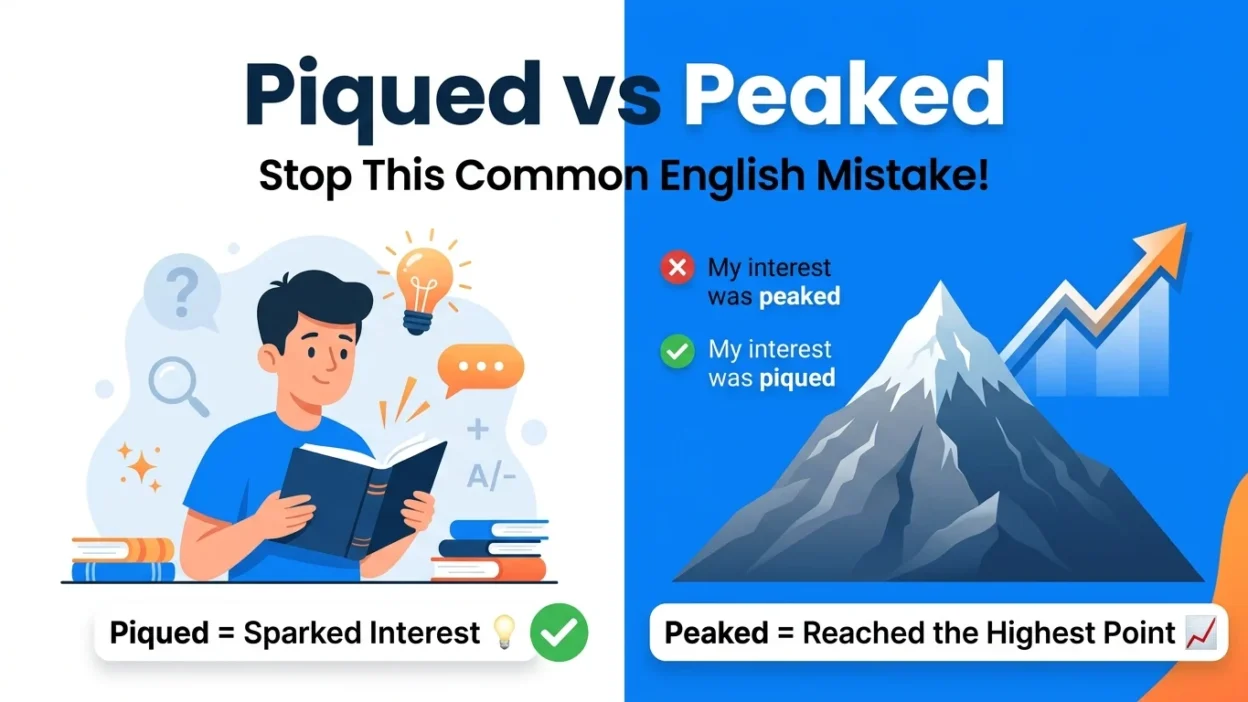
- Piqued means aroused, stimulated, or sparked, especially in reference to interest, curiosity, or emotions.
- Peaked means reached the highest point or refers to something that has climbed to its maximum level.
Examples:
- The documentary piqued my curiosity. ✅
- Sales peaked during the holiday season. ✅
Remember this common expression:
- My interest was piqued. ✅
- My interest was peaked. ❌
What Does “Piqued” Mean?
Piqued is the past tense and past participle of the verb pique.
It means to stimulate, arouse, or awaken interest, curiosity, or emotion.
Examples
- The mystery novel piqued my interest.
- Her question piqued everyone’s curiosity.
- The unusual advertisement piqued my attention.
- His speech piqued public interest.
- The documentary piqued my desire to learn more.
In each sentence, piqued refers to something that sparked or increased interest.
What Does “Peaked” Mean?
Peaked is the past tense of the verb peak.
It means to reach the highest point, maximum level, or greatest intensity.
Examples
- Tourism peaked in July.
- The athlete peaked before the championship.
- Demand peaked during the festival.
- Temperatures peaked in the afternoon.
- Website traffic peaked last weekend.
Unlike piqued, peaked has nothing to do with curiosity or interest.
Piqued vs Peaked: Comparison Table
| Feature | Piqued | Peaked |
|---|---|---|
| Part of Speech | Verb (Past tense) | Verb (Past tense) |
| Meaning | Stimulated interest or curiosity | Reached the highest point |
| Common Context | Interest, curiosity, emotions | Numbers, performance, temperature, sales |
| Example | The article piqued my curiosity. | Sales peaked in December. |
| Interchangeable? | No | No |
When Should You Use “Piqued”?
Use piqued whenever you’re talking about something that awakens interest, curiosity, excitement, or emotion.
Examples
- The trailer piqued my interest in the movie.
- Her presentation piqued investors’ curiosity.
- The headline piqued readers’ attention.
- His comments piqued public debate.
- The travel brochure piqued our interest in visiting Japan.
One of the most common phrases is:
- Piqued my interest
- Piqued my curiosity
These are standard and widely accepted expressions.
When Should You Use “Peaked”?
Use peaked when something reaches its highest level or maximum point.
Examples
- Inflation peaked last year.
- His confidence peaked after winning.
- Electricity demand peaked in the evening.
- The mountain trail peaked at over 2,000 meters.
- Productivity peaked before lunch.
The emphasis is always on reaching a high point.
Why People Confuse These Words
The confusion happens because piqued and peaked are perfect homophones—they sound exactly alike.
Many people hear the phrase:
“My interest was piqued.”
Since peaked is a much more familiar spelling, they mistakenly write:
“My interest was peaked.”
Although this mistake is very common, it is incorrect in standard English.
Common Mistakes to Avoid
Here are the most frequent errors.
Mistake 1: Writing “My Interest Was Peaked”
❌ My interest was peaked.
✅ My interest was piqued.
Mistake 2: Using “Piqued” for Maximum Levels
❌ Sales piqued in December.
✅ Sales peaked in December.
Mistake 3: Assuming the Words Are Interchangeable
Although they sound the same, they describe completely different ideas.
Always think about the meaning before choosing the spelling.
Easy Trick to Remember the Difference
Here’s a simple memory tip.
Piqued contains the letter Q.
Think of:
Q = Questions
Questions create curiosity.
Curiosity is piqued.
Now think about peaked.
A peak is the top of a mountain.
Something that reaches the top has peaked.
This simple association makes the difference much easier to remember.
Everyday Examples
Using “Piqued”
- The science experiment piqued my curiosity.
- The advertisement piqued consumer interest.
- The professor’s lecture piqued our enthusiasm.
- His story piqued everyone’s imagination.
- The exhibition piqued public attention.
Using “Peaked”
- Attendance peaked during summer.
- Prices peaked in August.
- The singer peaked early in her career.
- The river peaked after heavy rainfall.
- Energy use peaked in the afternoon.
Common Expressions
These expressions are widely used.
With “Piqued”
- Piqued my interest
- Piqued curiosity
- Piqued attention
- Piqued enthusiasm
- Piqued public interest
With “Peaked”
- Peaked early
- Peaked last year
- Peaked at
- Peaked during
- Peaked before
Learning these common phrases helps you choose the correct word naturally.
American vs British English
There is no significant difference between American and British English regarding piqued and peaked.
Both varieties use:
- Piqued for stimulating curiosity.
- Peaked for reaching the highest point.
The spellings and meanings are identical in both forms of English.
Practice Sentences
Choose the correct word.
- The article ______ my curiosity.
Answer: piqued
- Demand ______ during the holidays.
Answer: peaked
- The unusual headline ______ my interest.
Answer: piqued
- The company’s profits ______ in 2025.
Answer: peaked
- The documentary ______ public attention.
Answer: piqued
Frequently Asked Questions (FAQs)
Is it “piqued my interest” or “peaked my interest”?
The correct expression is “piqued my interest.” It means something sparked your curiosity.
What does piqued mean?
Piqued means stimulated, aroused, or awakened interest, curiosity, or emotion.
What does peaked mean?
Peaked means reached the highest point or maximum level.
Why do people confuse piqued and peaked?
They sound exactly alike but have different spellings and meanings.
Is “my curiosity was peaked” correct?
No. The correct expression is “my curiosity was piqued.”
Can peaked describe a person’s performance?
Yes. It means someone reached their highest level of performance.
Is there a difference between American and British English?
No. Both American and British English use piqued and peaked with the same meanings and spellings.
Summary
Understanding piqued vs peaked becomes much easier once you focus on their meanings instead of their pronunciation. Piqued refers to sparking interest, curiosity, or emotion, while peaked describes reaching the highest point or maximum level. Although they sound identical, they serve entirely different purposes in English.
Using the correct word helps make your writing more precise and professional. Whether you’re saying that a fascinating story piqued your interest or explaining that sales peaked during the holiday season, remembering the difference will help you avoid one of the most common homophone mistakes in English.