Have you ever typed tieing and wondered if your spell checker was right to flag it? You’re not alone. Many English learners and native speakers become confused because most verbs ending in ie follow unusual spelling rules when adding ing.
In this guide, you’ll learn the difference between tying vs tieing, discover which spelling is correct, understand the grammar rule behind it, explore plenty of examples, avoid common mistakes, and gain confidence in using the correct form every time.
Quick Answer
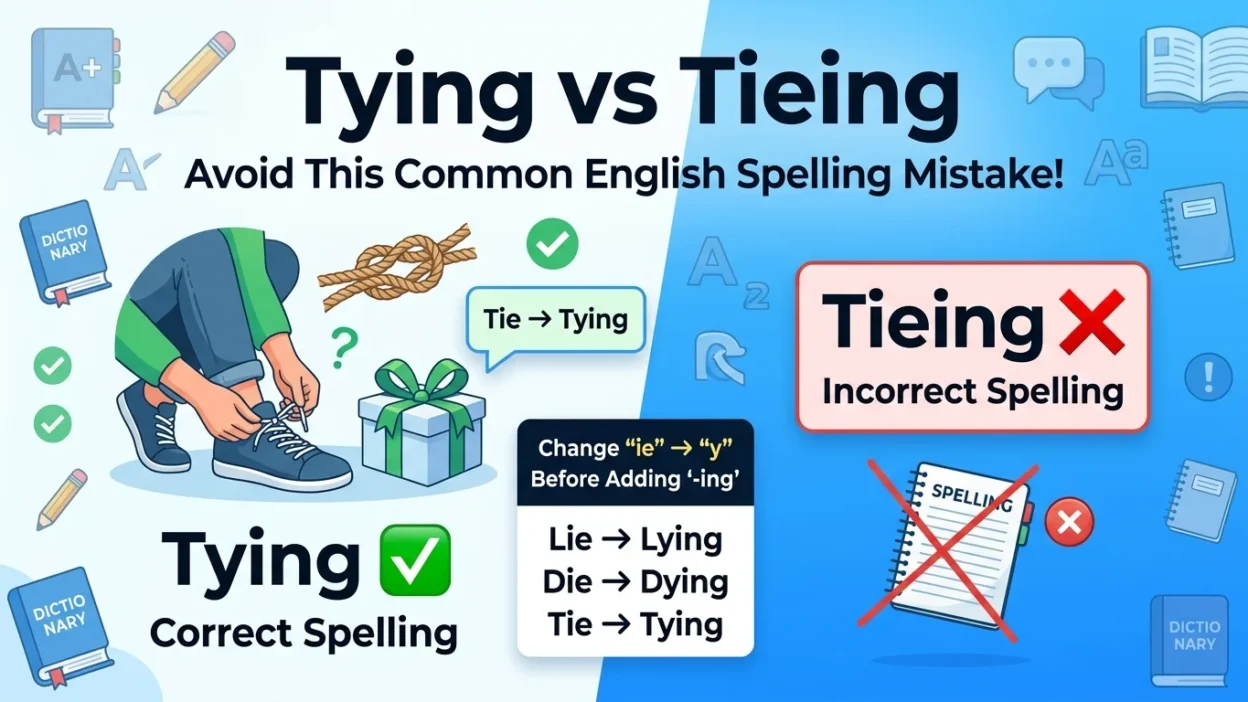
The correct spelling is tying.
- Tying is the correct present participle and gerund of the verb tie.
- Tieing is considered incorrect in standard English and should generally be avoided.
Examples:
- She is tying her shoes. ✅
- They are tying the rope securely. ✅
- She is tieing her shoes. ❌
Simply remember:
Tie → Tying
Not:
Tie → Tieing
Why Is “Tying” Correct?
The verb tie ends with the letters -ie.
In English spelling, when many verbs ending in -ie take -ing, the ie changes to y before adding -ing.
This prevents awkward letter combinations and makes pronunciation easier.
The pattern is:
- Lie → Lying
- Die → Dying
- Tie → Tying
This is one of the standard spelling rules in English grammar.
What Does “Tying” Mean?
Tying is the present participle and gerund of the verb tie.
It means fastening, securing, connecting, or making a knot.
Examples
- She is tying her shoelaces.
- They are tying the packages together.
- We spent the afternoon tying fishing knots.
- He is tying a ribbon around the gift.
- The workers are tying steel bars before pouring concrete.
The word may also be used figuratively.
Figurative Examples
- The project is tying up company resources.
- The victory is tying the teams in the standings.
- She enjoys tying ideas together in her writing.
Is “Tieing” Ever Correct?
In modern English, tieing is generally considered an incorrect spelling of the verb tie.
Most dictionaries, grammar guides, publishers, schools, and style manuals recommend using tying instead.
Occasionally, you may see tieing in very old texts or as part of specialized terminology or proper names, but it is not accepted as the standard spelling for the verb in everyday English.
For almost every writing situation, choose tying.
Tying vs Tieing: Comparison Table
| Feature | Tying | Tieing |
|---|---|---|
| Spelling | Correct | Incorrect in standard English |
| Part of Speech | Present participle / Gerund | Nonstandard spelling |
| Grammar Rule | Changes ie to y before -ing | Breaks the standard spelling rule |
| Recommended? | Yes | No |
| Example | Tying a knot | Tieing a knot ❌ |
The Grammar Rule Behind “Tying”
English has a specific spelling rule for many verbs ending in -ie.
When adding -ing:
- Remove ie
- Add y
- Then add -ing
Examples
| Base Verb | Correct -ing Form |
|---|---|
| Die | Dying |
| Lie | Lying |
| Tie | Tying |
This is why tying is correct and tieing is not.
When Should You Use “Tying”?
Use tying whenever you want to describe the action of fastening, securing, connecting, or making a knot.
Examples
- She is tying balloons for the party.
- He enjoys tying flies for fishing.
- The nurse is tying the bandage securely.
- We are tying the boat to the dock.
- They finished tying the decorations.
Every one of these examples follows standard English spelling.
Common Mistakes People Make
Many learners accidentally write tieing because they simply add -ing to tie.
Here are the most common errors.
Mistake 1: Writing “Tieing”
❌ She is tieing her shoes.
✅ She is tying her shoes.
Mistake 2: Forgetting the “-ie” Rule
Many learners know that verbs usually take -ing, but forget that verbs ending in -ie change to y.
Mistake 3: Assuming Spell Check Is Wrong
Modern spell checkers correctly identify tieing as incorrect in standard English.
If your software suggests tying, it is giving the correct recommendation.
Easy Trick to Remember the Difference
Here’s a simple memory tip.
Think about these three common verbs:
- Die → Dying
- Lie → Lying
- Tie → Tying
All three follow exactly the same spelling pattern.
If you remember dying and lying, you’ll easily remember tying.
Everyday Examples
Using “Tying”
- She’s tying her apron.
- We’re tying the tent ropes.
- The child is tying a bow.
- They’re tying the score in the final minutes.
- He spent hours tying fishing lines.
Incorrect Usage
- She is tieing her shoes. ❌
- They’re tieing the packages. ❌
- We are tieing ribbons. ❌
Replace tieing with tying in every case.
Common Expressions with “Tying”
Here are some phrases you’ll often hear.
- Tying the knot
- Tying shoelaces
- Tying a ribbon
- Tying up loose ends
- Tying the score
- Tying together ideas
- Tying the boat
- Tying a package
These expressions all use the correct spelling: tying.
American vs British English
There is no difference between American and British English regarding tying and tieing.
Both varieties of English use:
- Tying as the correct spelling.
- Tieing as a nonstandard or incorrect spelling for the verb tie.
Whether you’re writing in American English or British English, tying is the accepted form.
Practice Sentences
Choose the correct spelling.
- She is ______ her shoelaces.
Answer: tying
- They are ______ the rope securely.
Answer: tying
- We finished ______ the gift ribbons.
Answer: tying
- The workers are ______ steel bars together.
Answer: tying
- He enjoys ______ fishing knots.
Answer: tying
Frequently Asked Questions (FAQs)
Which is correct: tying or tieing?
Tying is the correct spelling. Tieing is not accepted in standard English.
Why is tying spelled with a “y”?
Because verbs ending in -ie usually change ie to y before adding -ing.
Is tieing ever correct?
In modern standard English, tieing is generally considered incorrect for the verb tie. It may appear in rare historical texts or specialized names, but it is not the accepted spelling for everyday writing.
What is the grammar rule for tie?
When adding -ing to tie, change ie to y, forming tying.
Is tying used as both a verb and a noun?
Yes. It can function as a present participle (“She is tying the rope.”) and as a gerund (“Tying knots takes practice.”).
Is there a difference between American and British English?
No. Both American and British English use tying as the correct spelling.
What are other verbs that follow this spelling rule?
Common examples include die → dying and lie → lying.
Summary
Understanding tying vs tieing is actually quite simple once you know the spelling rule. Tying is the only correct spelling in standard English because verbs ending in ie usually change ie to y before adding ing. Although tieing may occasionally appear in outdated texts or rare contexts, it is not the accepted form for modern writing.
Whether you’re talking about tying shoelaces, tying a knot, tying ribbons, or tying the score in a game, the correct spelling is always tying. Remembering the pattern shared by die → dying, lie → lying, and tie → tying will help you avoid this common spelling mistake and write with greater confidence.

William Harved is a passionate language enthusiast and digital writer specializing in English spelling, grammar clarity, and common writing mistakes. As the primary author of Spelword.com, he focuses on helping readers understand confusing word pairs, correct spelling errors, and improve everyday communication.