Many English learners and even native speakers confuse past and passed because they sound exactly the same. Although they are homophones, they have completely different meanings and grammatical functions. Using the wrong one can make your writing look less polished and even change the meaning of your sentence.
If you’ve ever paused while writing past or passed, you’re not alone. This guide explains past vs passed in simple language, with clear definitions, practical examples, common mistakes, and memory tricks to help you choose the correct word every time.
Quick Answer
The difference between past vs passed is straightforward:
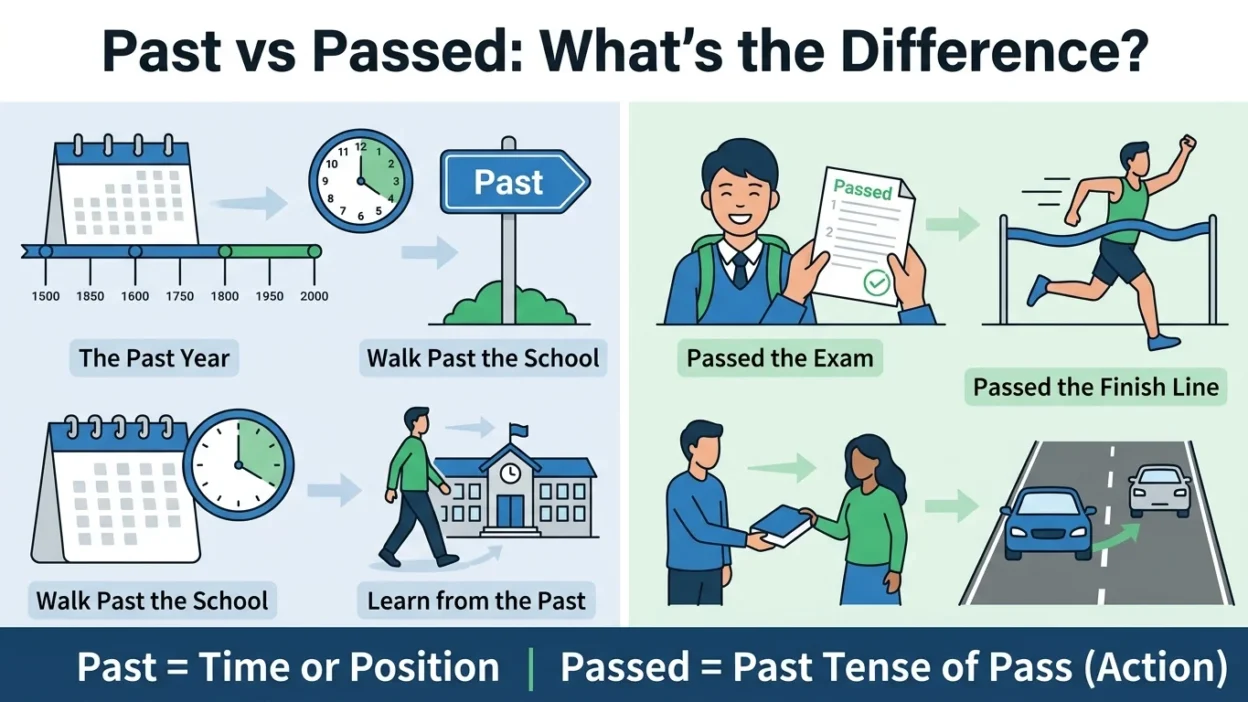
- Past is usually a noun, adjective, adverb, or preposition referring to time gone by or movement beyond something.
- Passed is the past tense and past participle of the verb “pass.” It means to move by, succeed, hand over, or complete something.
Examples:
- We walked past the library. ✅
- She passed the driving test. ✅
A simple rule is:
- Past = Time or position
- Passed = Action
What Does “Past” Mean?
Past is a versatile word that can function as several parts of speech, but it never acts as the main verb.
It generally refers to something that has already happened or something beyond a particular place or point.
Past as a Noun
It means a previous period of time.
Examples
- Learn from the past.
- We cannot change the past.
Past as an Adjective
It describes something that has already happened.
Examples
- During the past year, sales increased.
- The past president attended the event.
Past as a Preposition
It means beyond or by.
Examples
- We drove past the museum.
- Walk past the supermarket.
Past as an Adverb
It means beyond a particular point.
Examples
- Time flew past quickly.
- He hurried past without stopping.
What Does “Passed” Mean?
Passed is the past tense and past participle of the verb pass.
It describes an action that has already happened.
Examples
- She passed the exam.
- The train passed the station.
- He passed me the keys.
- We passed several villages.
- They passed the law unanimously.
Every example contains an action performed in the past.
Common Meanings of “Passed”
The verb passed can mean:
- Moved by something
- Succeeded in a test
- Handed something to someone
- Approved officially
- Completed successfully
- Died (a polite expression)
Examples
- She passed her final exam.
- Please passed the note. ❌
Correct:
- Please pass the note.
- She passed away peacefully.
Past vs Passed: Comparison Table
| Feature | Past | Passed |
|---|---|---|
| Part of Speech | Noun, adjective, adverb, preposition | Verb (past tense of pass) |
| Refers To | Time or position | An action |
| Indicates Movement? | Sometimes | Yes |
| Indicates Completed Action? | No | Yes |
| Example | We walked past the park. | We passed the park. |
When Should You Use “Past”?
Use past when referring to time, direction, or position.
Examples
- The past few weeks have been busy.
- We walked past the school.
- Forget the past.
- It’s half past six.
- She looked past the crowd.
Notice that past is not functioning as the main verb.
When Should You Use “Passed”?
Use passed whenever you need the past tense of the verb pass.
Examples
- He passed the interview.
- The bus passed our stop.
- She passed me the documents.
- Parliament passed the new bill.
- The athlete passed the finish line.
Each sentence describes an action.
Real-Life Examples
Let’s compare the two words.
Movement
Correct:
- We walked past the hospital.
Correct:
- We passed the hospital.
Both are correct but have different grammar.
The first uses past as a preposition.
The second uses passed as a verb.
Time
Correct:
- Think about the past.
Incorrect:
- Think about the passed.
Only past refers to previous time.
School
Correct:
- She passed the exam.
Incorrect:
- She past the exam.
The sentence requires a verb, so passed is correct.
Common Mistakes People Make
Here are some frequent errors.
Incorrect
- We past the building.
Correct:
- We passed the building.
Incorrect
- During the passed year…
Correct:
- During the past year…
Incorrect
- She walked passed the store.
Correct:
- She walked past the store.
After the verb walked, you need the preposition past.
Incorrect
- The teacher past the papers around.
Correct:
- The teacher passed the papers around.
This sentence requires the past tense verb.
Easy Trick to Remember the Difference
Here’s a simple memory aid.
Passed = Verb
If you can replace it with another action word, choose passed.
Example:
- She passed the exam.
- She completed the exam.
Both are verbs.
Past = Time or Place
If you’re talking about time or location, choose past.
Examples:
- The past year
- Walk past the bank
Why the Difference Matters
Although these words sound identical, using the wrong one changes the grammar of the sentence.
For example:
Incorrect:
- We passed the restaurant and turned left.
Correct.
Incorrect:
- We walked passed the restaurant.
Here, past is needed because it follows the verb walked.
Understanding this distinction improves both grammar and clarity.
American vs British English Differences
There is no significant difference between American and British English in the meanings or usage of past and passed.
Both varieties follow the same grammatical rules.
Examples accepted in both:
- She passed the exam.
- We drove past the station.
- It’s half past eight.
The words are used consistently across both forms of English.
Memory Tips
- Past relates to time or place.
- Passed is always a verb.
- If an action happened, use passed.
- If discussing time or direction, use past.
- Ask yourself whether the sentence needs a verb.
This quick check usually gives you the correct answer.
FAQs
What is the difference between past and passed?
Past usually refers to time or position, while passed is the past tense of the verb pass.
Is passed a verb?
Yes. Passed is the past tense and past participle of the verb pass.
Is past ever a verb?
No. Past is not used as a verb.
Which is correct: walked past or walked passed?
Walked past is correct because past functions as a preposition after the verb.
Which is correct: passed the exam or past the exam?
Passed the exam is correct because passing an exam is an action.
Why do people confuse past and passed?
They are homophones, meaning they sound the same but have different meanings and grammatical roles.
Are the words different in British and American English?
No. Both American and British English use past and passed in the same way.
How can I remember the difference?
Remember that passed is always a verb, while past usually refers to time or position.
Summary
Understanding past vs passed becomes much easier once you remember their grammatical roles. Past refers to time, direction, or position and can function as a noun, adjective, adverb, or preposition. Passed, on the other hand, is the past tense of the verb pass and always describes an action, such as moving by something, succeeding in an exam, or handing something to another person.
Although the two words sound identical, they are not interchangeable. Choosing the correct one makes your writing more accurate and professional. By remembering that passed is always a verb and past usually refers to time or place, you’ll avoid one of the most common mistakes in English grammar.

Dani Morrison is a dedicated language writer and spelling expert at Spelword.com, where she focuses on helping readers understand common English spelling mistakes and confusing word pairs. With a passion for clear communication, Dani creates easy-to-follow guides that simplify complex grammar and spelling rules for everyday use.