
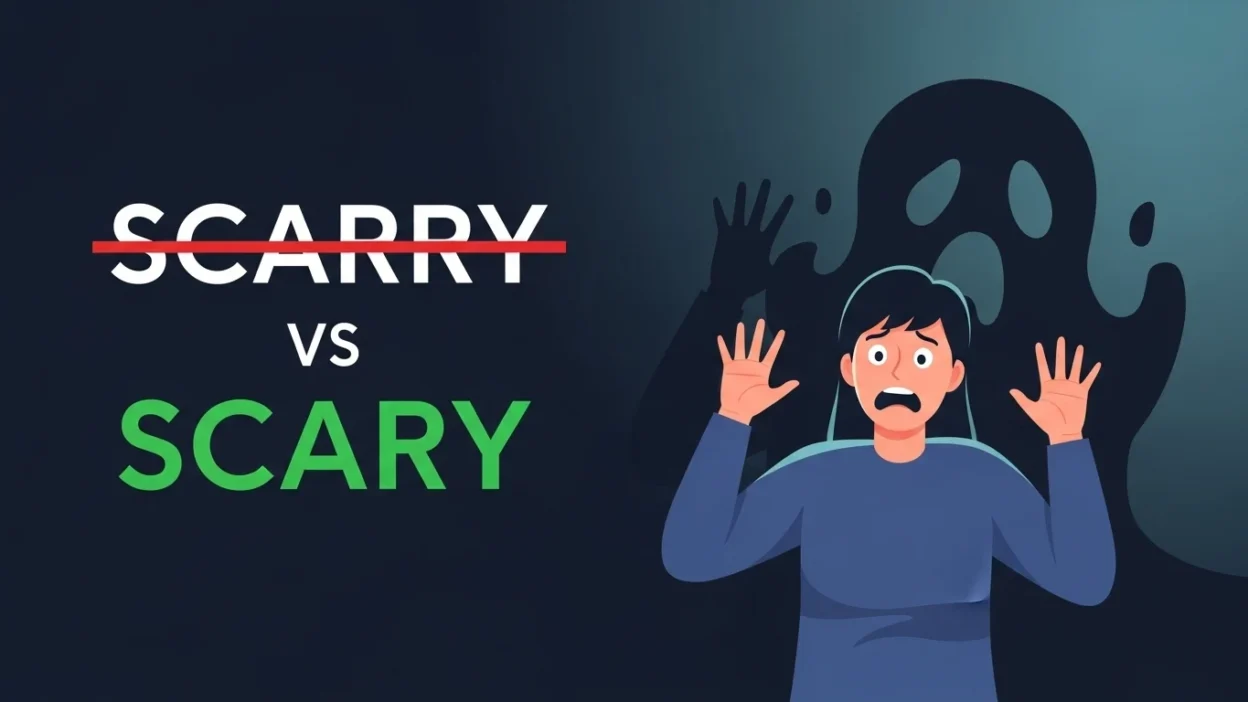
Have you ever typed scarry and paused, wondering if it’s right or just looks right? You’re not alone. This common spelling mix up appears everywhere, from casual texts to social media posts, and it can quietly undermine the clarity of your writing.
The truth is simple, but understanding why one is correct makes it easier to remember forever. Whether you’re writing a story, a message, or content for an audience, getting this right helps you sound polished and confident.
Quick Answer
“Scary” is the correct spelling.
“Scarry” is incorrect and not a real word in standard English.
What Does “Scary” Mean?
The word scary is an adjective used to describe something that causes fear, fright, or unease. It’s often used in both literal and figurative contexts.
Examples:
- That movie was really scary.
- Walking alone at night can feel scary.
- The sudden noise was scary at first.
It’s a commonly used everyday word, especially when talking about emotions, experiences, or things that make us feel afraid.
Why “Scarry” Is Incorrect
“Scarry” is simply a misspelling of “scary.” It doesn’t exist in standard English dictionaries and has no recognized meaning.
This mistake usually happens because:
- People assume doubling letters makes words sound stronger or more intense
- Confusion with similar patterns like “carry” or “marry”
- Typing quickly without checking spelling
But unlike words such as “carry,” the base word here is scare, and the correct transformation is straightforward.
How the Correct Spelling Works
The word scary comes from the noun scare. When forming the adjective:
- Drop the silent “e” from scare
- Add -y
So:
- scare → scary ✔
- scare → scarry ❌
This follows a common English spelling rule:
When adding a suffix like “-y” to a word ending in “e,” the “e” is usually dropped.
Examples in Sentences
Correct Usage (Scary)
- That haunted house looks scary.
- It’s scary how fast time flies.
- The thunderstorm was loud and scary.
Incorrect Usage (Scarry)
- That haunted house looks scarry. ❌
- It’s scarry how fast time flies. ❌
Comparison Table: Scarry vs Scary
| Feature | Scary ✅ | Scarry ❌ |
|---|---|---|
| Correct spelling | Yes | No |
| Recognized word | Yes | No |
| Dictionary presence | Included | Not listed |
| Usage in writing | Formal and informal | Incorrect everywhere |
| Grammar basis | From “scare” + “y” | Misspelling |
Common Mistakes to Avoid
Spelling errors like this are easy to make but just as easy to fix once you know what to look for.
Here are a few related mistakes:
- ❌ Adding extra letters unnecessarily (scarry)
- ❌ Confusing similar-looking words (carry, marry)
- ❌ Ignoring base word rules (scare → scary)
Helpful Tip
Think of the base word:
- Scare → Scary
If you remember “scare,” you’ll never accidentally write “scarry.”
American vs British English
There’s no difference in spelling here.
Both American English and British English use “scary” as the correct form. The incorrect version “scarry” is not accepted in either variety of English.
However, usage and tone may vary slightly:
- In American English, “scary” is often used casually and figuratively (“That test was scary hard”)
- In British English, it’s also common but may be slightly less exaggerated in informal speech
Still, the spelling remains the same across regions.
Related Words and Forms
Understanding related words can strengthen your spelling confidence:
- Scare (verb/noun): to frighten someone
- Scared (adjective): feeling afraid
- Scaring (verb form): causing fear
- Scary (adjective): causing fear
All follow consistent spelling patterns based on the root word scare.
Why Correct Spelling Matters
It may seem like a small detail, but correct spelling plays a big role in communication.
Using the right word:
- Builds trust with readers
- Improves readability
- Enhances professionalism
- Helps avoid misunderstandings
Even in casual writing, consistent accuracy reflects care and attention.
FAQs
Is “scarry” ever correct in English?
No, “scarry” is always incorrect. The correct spelling is “scary.”
Why do people spell scary as scarry?
Because they confuse it with words that double consonants, like “carry” or “marry.”
What is the correct spelling: scary or scarry?
The correct spelling is “scary.”
Does “scarry” exist in any dictionary?
No, it is not recognized in standard English dictionaries.
How can I remember the correct spelling of scary?
Think of the base word “scare” and simply add “-y” after removing the “e.”
Is scary used in formal writing?
Yes, “scary” can be used in both formal and informal contexts depending on the sentence.
Are there any regional differences in spelling scary?
No, both American and British English use “scary.”
Final Summary
The difference between scarry and scary is clear once you understand the root word and spelling rule. “Scary” is the correct and widely accepted form, derived from “scare” by dropping the “e” and adding “y.” On the other hand, “scarry” is simply a misspelling with no place in standard English.
Mastering small details like this can make a big difference in how your writing is perceived. Whether you’re writing casually or professionally, using “scary” correctly helps you communicate clearly and confidently.