Have you ever stopped while writing and wondered whether to use theirs or theres? If so, you’re not alone. These words are often confused because they look similar and are related to other commonly mixed up words like there, their, and they’re. However, one of these words is correct in standard English, while the other is usually considered a spelling mistake.
Understanding the difference between theirs vs theres can improve your writing, help you avoid grammar errors, and make your communication more professional. In this guide, you’ll learn what each term means, how to use the correct form, common mistakes to avoid, and easy memory tricks to remember the difference.
Quick Answer
- Theirs is a correct English word. It is a possessive pronoun that shows ownership.
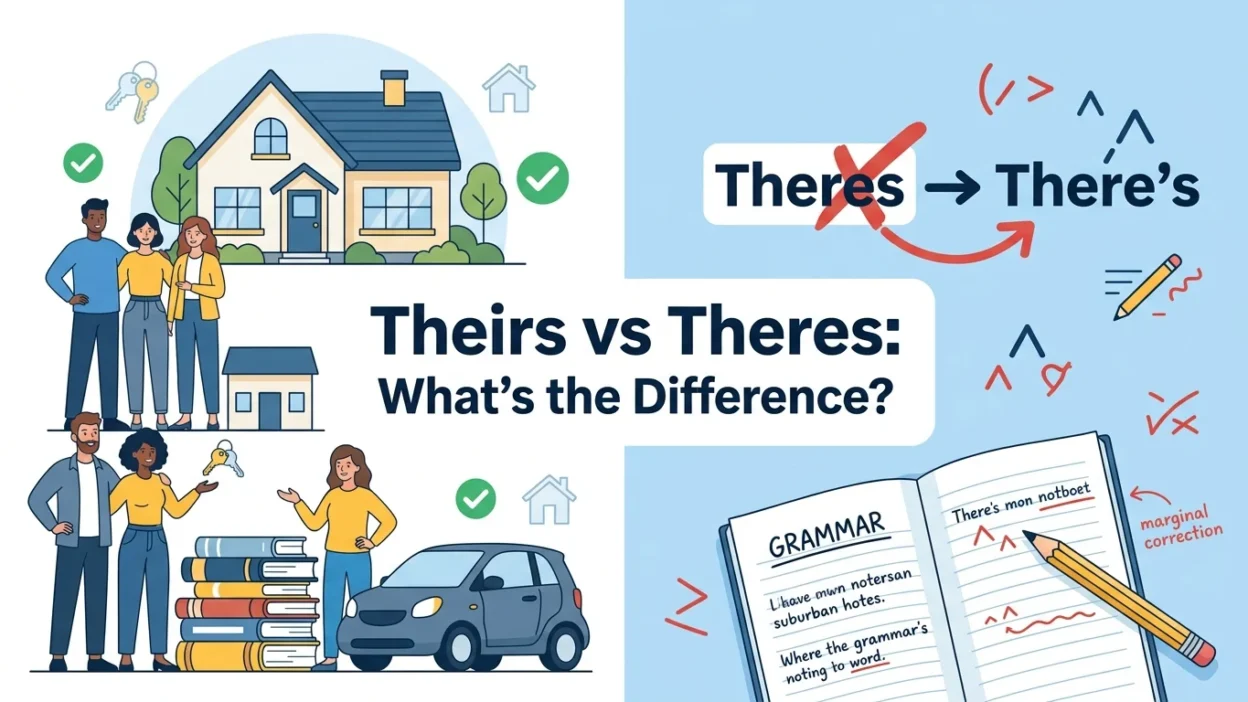
- Theres is generally not a correct standard English word. Most of the time, writers mean there’s, which is a contraction of there is or there has.
Examples:
- The blue car is theirs.
- There’s a problem with the computer.
- The decision was theirs to make.
- There’s been a misunderstanding.
If you see theres without an apostrophe, it is usually a spelling error.
What Does “Theirs” Mean?
Theirs is a possessive pronoun. It shows that something belongs to a group of people or to multiple individuals.
Unlike many possessive forms, theirs does not use an apostrophe.
Examples of Theirs in Sentences
- The house on the corner is theirs.
- That idea was completely theirs.
- The responsibility is theirs, not ours.
- Those books are theirs.
- The final choice was theirs to make.
In each example, theirs shows ownership or possession.
Why Doesn’t Theirs Have an Apostrophe?
Many people assume possessive words need apostrophes. However, possessive pronouns do not.
Similar examples include:
- Mine
- Yours
- His
- Hers
- Ours
- Theirs
All of these words show possession without apostrophes.
What Does “Theres” Mean?
In standard English grammar, theres is not considered a correct word.
Most of the time, people accidentally write theres when they actually mean:
There’s
The contraction there’s combines:
- There + is
- There + has
Examples of There’s
- There’s a cat in the garden.
- There’s no reason to worry.
- There’s been a change of plans.
- There’s plenty of time left.
Without the apostrophe, the spelling is generally incorrect.
Theirs vs Theres: Main Difference
The key difference is simple.
| Word | Meaning | Correct Usage |
|---|---|---|
| Theirs | Possessive pronoun showing ownership | Yes |
| Theres | Usually a misspelling of “there’s” | No |
| There’s | Contraction of “there is” or “there has” | Yes |
Examples
Correct:
- The car is theirs.
- There’s a new restaurant nearby.
Incorrect:
- The car is theres.
- Theres a new restaurant nearby.
Understanding Theirs in Detail
The word theirs answers the question:
Who does it belong to?
For example:
- That backpack is theirs.
- The victory was theirs.
- The project belongs to them, so it is theirs.
Possessive pronouns help avoid repetition.
Instead of writing:
- The books belong to them.
You can write:
- The books are theirs.
This makes writing smoother and more natural.
Understanding There’s in Detail
Many writers who type theres actually mean there’s.
The apostrophe is important because it indicates a contraction.
There’s = There Is
- There’s a bird on the roof.
- There’s an answer to every question.
There’s = There Has
- There’s been a mistake.
- There’s never been a better opportunity.
Removing the apostrophe creates a spelling error in formal writing.
Common Mistakes With Theirs and Theres
Because these words look similar, mistakes are common.
Incorrect: The house is theres.
Correct: The house is theirs.
The sentence refers to ownership.
Incorrect: Theres a problem.
Correct: There’s a problem.
The sentence needs the contraction there is.
Incorrect: The decision is theres.
Correct: The decision is theirs.
The word shows possession.
Incorrect: Theres been an update.
Correct: There’s been an update.
The apostrophe is required.
Easy Trick to Remember the Difference
A simple memory trick can help.
Theirs Contains “Their”
Notice that theirs starts with their.
Both words relate to possession.
- Their house
- The house is theirs
If ownership is involved, theirs is likely correct.
There’s Contains an Apostrophe
When you mean:
- There is
- There has
Use there’s with an apostrophe.
If you can expand the sentence and it still makes sense, use there’s.
Example:
- There’s a dog outside.
- There is a dog outside.
Since the expanded version works, there’s is correct.
Examples of Theirs in Everyday Writing
Here are additional examples of theirs:
- The achievement was entirely theirs.
- Those tickets are theirs.
- The success belongs to them, so it is theirs.
- The choice was theirs alone.
- Everything in that room is theirs.
Each sentence expresses ownership.
Examples of There’s in Everyday Writing
Here are examples of the contraction there’s:
- There’s a meeting at noon.
- There’s no need to rush.
- There’s been a misunderstanding.
- There’s enough food for everyone.
- There’s still hope.
These examples show the meaning of “there is” or “there has.
Why Do Writers Confuse These Words?
Several factors contribute to confusion.
Similar Appearance
The words look similar at first glance.
Fast Typing
Many spelling mistakes happen while typing quickly.
Apostrophe Errors
English apostrophes often confuse learners and native speakers alike.
Similar-Sounding Grammar Terms
Words like:
- There
- Their
- They’re
- There’s
- Theirs
are commonly mixed up because they sound similar in conversation.
Theirs vs There, Their, and They’re
Understanding related words can help avoid mistakes.
| Word | Meaning |
|---|---|
| There | Refers to a place or position |
| Their | Shows ownership before a noun |
| They’re | Means “they are” |
| There’s | Means “there is” or “there has” |
| Theirs | Possessive pronoun showing ownership |
Examples
- Put the bag over there.
- It is their house.
- They’re coming tomorrow.
- There’s a problem.
- The house is theirs.
American vs British English Differences
There is no meaningful difference between American and British English regarding theirs and there’s.
Both forms follow the same grammar rules.
In both varieties of English:
- Theirs is the possessive pronoun.
- There’s is the contraction.
- Theres is generally considered incorrect.
Writers on both sides of the Atlantic use these words in the same way.
Frequently Asked Questions
Is theres a real word?
No. In standard English, theres without an apostrophe is generally considered a spelling mistake.
What does theirs mean?
Theirs is a possessive pronoun that shows something belongs to them.
Is theirs possessive?
Yes. Theirs is a possessive pronoun.
Why doesn’t theirs have an apostrophe?
Possessive pronouns such as mine, yours, ours, and theirs do not use apostrophes.
Is there’s the same as theres?
No. There’s is correct because it includes an apostrophe. Theres is usually incorrect.
How do I know when to use theirs?
Use theirs when referring to ownership or possession.
Can theirs refer to one person?
Yes. It can refer to a singular person when using singular “they.”
Is theres ever acceptable?
In formal and standard English writing, theres is generally not accepted. Use there’s instead.
Summary
The difference between theirs vs theres is straightforward once you understand the grammar. Theirs is a possessive pronoun that shows ownership, while theres is usually a misspelling of there’s, which means “there is” or “there has.” Knowing this distinction helps eliminate one of the most common writing errors.
Whenever you write, ask yourself whether you’re showing ownership or creating a contraction. If something belongs to someone, use theirs. If you mean “there is” or “there has,” use there’s with an apostrophe. Mastering this simple rule will make your writing clearer, more accurate, and easier to understand.

William Harved is a passionate language enthusiast and digital writer specializing in English spelling, grammar clarity, and common writing mistakes. As the primary author of Spelword.com, he focuses on helping readers understand confusing word pairs, correct spelling errors, and improve everyday communication.