Have you ever described a messy desk, a chaotic schedule, or an unfinished project and wondered whether disorganized or unorganized was the better word? You’re not alone. These two terms are often used interchangeably, but they don’t always mean exactly the same thing.
Understanding the difference between disorganized vs unorganized can make your writing more precise and help you communicate ideas more clearly. While both words relate to a lack of order or structure, they carry different shades of meaning. In this guide, you’ll learn what each word means, when to use it, common mistakes to avoid, and how to choose the right one in different situations.
Quick Answer
Both disorganized and unorganized describe a lack of order, but there is a subtle difference:
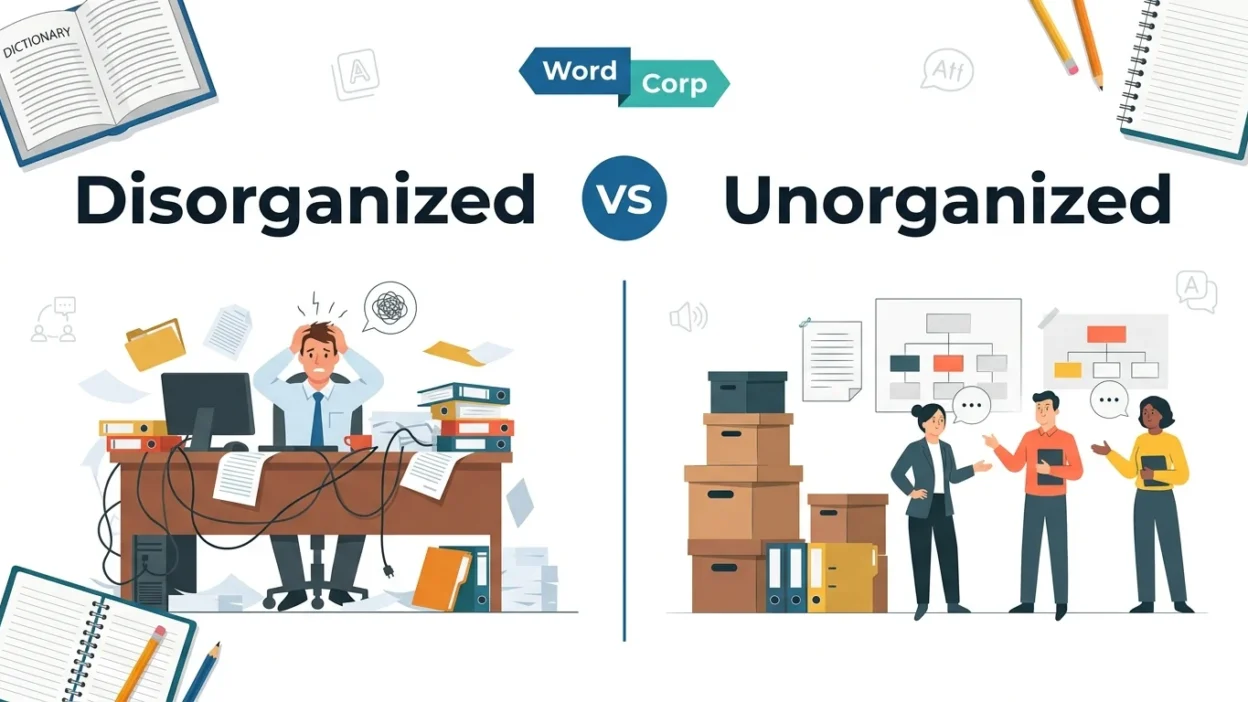
- Disorganized usually means something was organized at one time but has become messy, chaotic, or poorly arranged.
- Unorganized generally means something has never been organized or lacks structure from the beginning.
Examples
✅ My office became disorganized after a busy week.
✅ The volunteer group was still unorganized because it had just been formed.
In many situations, the words overlap, but disorganized often suggests disorder, while unorganized suggests the absence of organization.
What Does “Disorganized” Mean?
The word disorganized describes something that is messy, chaotic, confused, or lacking proper arrangement.
It often implies that order existed at some point but has been lost.
Definition of Disorganized
Not arranged properly; lacking order, structure, or efficiency.
Examples of Disorganized
- Her desk looked completely disorganized.
- The event became disorganized due to poor planning.
- The files were so disorganized that nobody could find the information.
- A disorganized schedule caused several delays.
In these examples, there is a sense of confusion, disorder, or ineffective management.
What Does “Unorganized” Mean?
The word unorganized refers to something that has not yet been arranged, structured, or formally organized.
It often indicates a lack of organization rather than active disorder.
Definition of Unorganized
Not organized; lacking formal structure or arrangement.
Examples of Unorganized
- The club remained unorganized during its first month.
- The materials were unorganized because no filing system existed.
- An unorganized group of volunteers gathered for the project.
- The information was stored in an unorganized manner.
Unlike disorganized, this word does not always imply chaos.
Disorganized vs Unorganized: Comparison Table
| Feature | Disorganized | Unorganized |
|---|---|---|
| Meaning | Chaotic or poorly arranged | Not yet organized |
| Suggests Disorder | Yes | Sometimes |
| Implies Previous Structure | Often | Usually No |
| Common Usage | People, plans, spaces | Groups, systems, projects |
| Negative Tone | Stronger | Milder |
| Example | A disorganized office | An unorganized committee |
The biggest difference is that disorganized often sounds more negative than unorganized.
How to Use “Disorganized” Correctly
Use disorganized when describing something that appears chaotic, messy, or inefficient.
- He is extremely disorganized and often misses deadlines.
- A disorganized employee may struggle with time management.
- The garage became disorganized after the move.
- Her workspace looked disorganized and cluttered.
- The conference felt disorganized from the start.
- Poor communication made the project seem disorganized.
In these examples, the word suggests confusion and a lack of effective structure.
How to Use “Unorganized” Correctly
Use unorganized when something simply lacks organization or formal structure.
- The workers remained unorganized before forming a union.
- The volunteers were still unorganized.
- The records were unorganized because no filing method existed.
- The data remained unorganized until the team sorted it.
- The initiative was still unorganized during its early stages.
- The committee began as an unorganized group.
These examples focus on the absence of organization rather than active disorder.
Why People Confuse Disorganized and Unorganized
The confusion happens because both words involve a lack of order.
Consider these examples:
- A disorganized office
- An unorganized office
Both may seem correct, and in everyday conversation, many people use them interchangeably.
However, the nuance matters:
- Disorganized = messy and chaotic.
- Unorganized = not yet arranged or structured.
Understanding this subtle distinction improves writing accuracy.
Common Mistakes with Disorganized and Unorganized
Mistake 1: Treating Them as Exact Synonyms
Although they overlap, they are not always identical.
❌ The newly formed committee was disorganized.
✅ The newly formed committee was unorganized.
If no structure ever existed, unorganized may be more accurate.
Mistake 2: Using Unorganized for Obvious Chaos
❌ The papers were unorganized all over the floor.
✅ The papers were disorganized all over the floor.
Visible disorder usually calls for disorganized.
Mistake 3: Ignoring Context
The best choice depends on whether you’re describing:
- Lack of structure → unorganized
- Actual disorder → disorganized
Context determines which word fits best.
Easy Memory Trick
A simple trick can help you remember the difference.
Disorganized = Disorder
Notice that both words begin with “dis.”
Think:
- Disorganized = Disorder
If something is messy or chaotic, choose disorganized.
Unorganized = Not Organized Yet
Think:
- Unorganized = Unfinished organization
If something simply hasn’t been organized, choose unorganized.
This quick method works in most situations.
Examples in Everyday Writing
Disorganized Examples
- The classroom became disorganized after the activity.
- His notes were so disorganized that studying was difficult.
- A disorganized approach led to mistakes.
Unorganized Examples
- The new association was still unorganized.
- The documents remained unorganized until filing began.
- Several unorganized teams joined the event.
These examples demonstrate the practical difference between the two words.
Synonyms of Disorganized
Depending on context, alternatives include:
- Chaotic
- Messy
- Confused
- Cluttered
- Disorderly
- Unsystematic
Examples
- The room was chaotic.
- The records were cluttered.
These alternatives often emphasize visible disorder.
Synonyms of Unorganized
Similar words include:
- Unstructured
- Informal
- Unarranged
- Unplanned
- Undefined
- Unsystematized
Examples
- The group lacked formal structure.
- The information was unarranged.
These words highlight the absence of organization.
Disorganized vs Unorganized in Professional Writing
Professional communication often benefits from precise word choice.
Use Disorganized When:
- Describing inefficiency
- Highlighting confusion
- Discussing poor management
Example:
- The workflow became disorganized after staffing changes.
Use Unorganized When:
- Discussing new systems
- Describing groups without formal structure
- Referring to unfinished planning
Example:
- The project remained unorganized during its initial phase.
Choosing the right word makes your message clearer.
American vs British English
There is very little difference between American and British English regarding disorganized and unorganized.
Similarities
Both varieties:
- Recognize both words.
- Use them with similar meanings.
- Distinguish between disorder and lack of organization.
Usage Trends
In both American and British English:
- Disorganized is generally more common.
- Unorganized appears more often in specific contexts such as groups, institutions, and systems.
The meanings remain essentially the same.
Why Understanding the Difference Matters
Selecting the correct word improves:
- Writing precision
- Professional communication
- Academic accuracy
- Reader understanding
- Vocabulary skills
Although many readers may understand either term, choosing the more accurate word demonstrates strong language awareness.
Frequently Asked Questions
What is the difference between disorganized and unorganized?
Disorganized means messy or chaotic, while unorganized usually means not yet organized or lacking structure.
Is disorganized more negative than unorganized?
Yes. Disorganized often carries a stronger negative meaning and suggests confusion or disorder.
Can disorganized and unorganized be used interchangeably?
Sometimes, but not always. Context often determines which word is more accurate.
Which word is more common?
Disorganized is generally more common in everyday English.
Can a person be described as unorganized?
Yes, but disorganized is usually the more natural choice when describing someone’s habits.
What is the opposite of disorganized?
Common opposites include organized, orderly, and structured.
Is unorganized grammatically correct?
Yes. It is a standard English word with a distinct meaning.
Do British and American English use these words differently?
No major differences exist. Both varieties use them in largely the same way.
Summary
The difference between disorganized vs unorganized comes down to the type of lack of order being described. Disorganized usually refers to something that is messy, chaotic, or poorly arranged, often implying that order has been lost. Unorganized, on the other hand, generally refers to something that has not yet been organized or lacks formal structure from the start.
Although the words sometimes overlap, choosing the more precise option can improve clarity and strengthen your writing. When discussing confusion, clutter, or inefficiency, disorganized is usually the better choice. When referring to a lack of structure or organization that has not yet been established, unorganized is often more accurate.

Dani Morrison is a dedicated language writer and spelling expert at Spelword.com, where she focuses on helping readers understand common English spelling mistakes and confusing word pairs. With a passion for clear communication, Dani creates easy-to-follow guides that simplify complex grammar and spelling rules for everyday use.