If you’ve ever stopped while writing because you couldn’t decide between gray and grey, you’re not alone. These two spellings refer to the same color, yet they appear differently depending on where you’re reading or writing. Whether you’re working on an essay, creating website content, or simply describing someone’s hair, it’s helpful to know which spelling is most appropriate.
The good news is that both gray and grey are correct. The difference is not in meaning but in regional spelling preferences. This guide explains when to use each form, provides practical examples, compares American and British English, highlights common mistakes, and answers the most frequently asked questions.
Quick Answer
Gray and grey both refer to the same color between black and white.
The only real difference is regional preference:
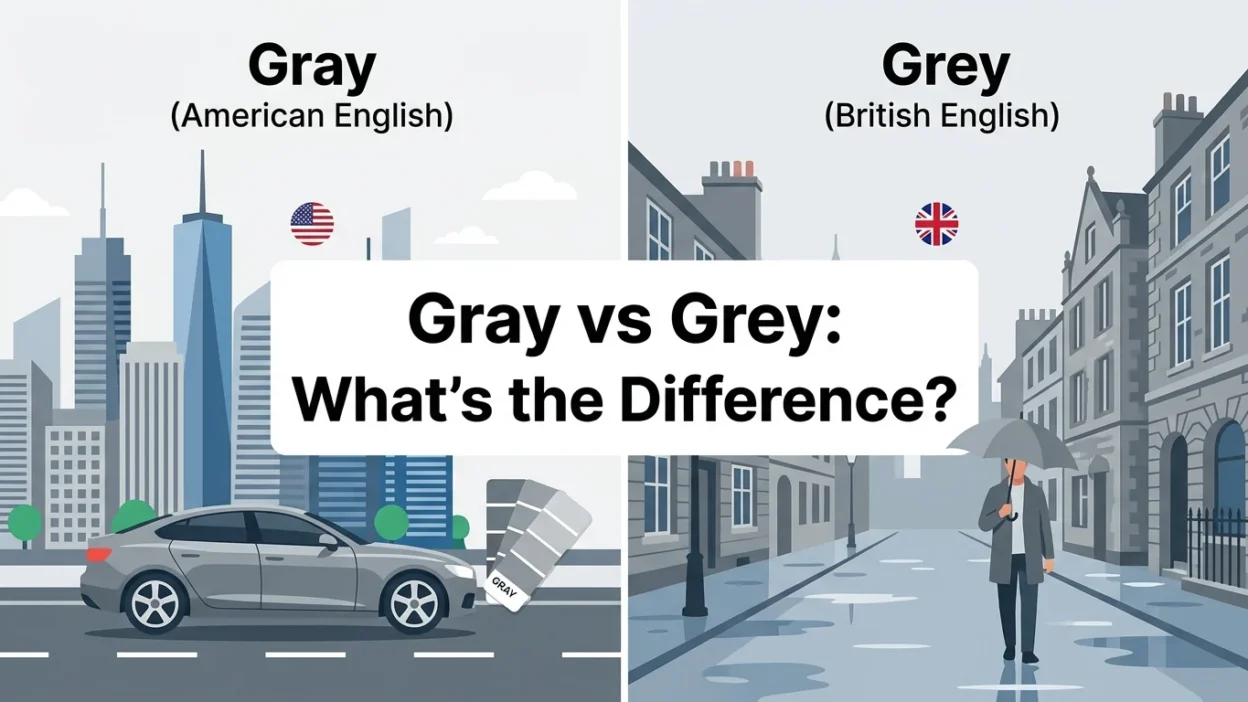
- Gray is the preferred spelling in American English.
- Grey is the preferred spelling in British English.
Examples:
- ✅ The sky turned gray before the storm. (American English)
- ✅ The sky turned grey before the storm. (British English)
Both spellings are correct and mean exactly the same thing.
What Does “Gray” Mean?
Gray is the American English spelling of the color that falls between black and white on the color spectrum.
It is widely used in the United States in books, newspapers, websites, schools, businesses, and everyday conversation.
Examples of “Gray”
- She wore a gray sweater.
- The clouds looked gray before it rained.
- His gray hair made him look distinguished.
- We painted the walls gray.
- The cat has soft gray fur.
In each example, gray refers to the color.
What Does “Grey” Mean?
Grey is the British English spelling of the same color.
It is commonly used in the United Kingdom, Ireland, Australia, New Zealand, and many other countries that follow British English conventions.
Examples of “Grey”
- He bought a grey jacket.
- The sky became grey during the afternoon.
- Her grey eyes were striking.
- The building was painted grey.
- They chose a light grey carpet.
The meaning is identical to gray.
Gray vs Grey: Key Differences
| Feature | Gray | Grey |
|---|---|---|
| Meaning | Color between black and white | Color between black and white |
| Part of Speech | Noun, adjective, verb | Noun, adjective, verb |
| American English | Preferred spelling | Less common |
| British English | Less common | Preferred spelling |
| Meaning Difference | None | None |
The difference is purely one of spelling preference based on regional English.
When Should You Use “Gray”?
Use gray when writing primarily for an American audience or following American English style.
You’ll commonly see it in:
- American books
- U.S. newspapers
- Academic writing
- Business communication
- Product descriptions
- Everyday conversation
Example Sentences
- The room has gray walls.
- My grandfather has gray hair.
- The weather turned gray and gloomy.
- She prefers gray furniture.
- The artist used several shades of gray.
When Should You Use “Grey”?
Use grey when writing for readers who use British English or when following British style guides.
It commonly appears in:
- British newspapers
- UK educational materials
- Australian publications
- Canadian publications (often mixed, though grey is slightly more common)
- International English
Example Sentences
- He wore a grey coat.
- The grey clouds covered the hills.
- Their living room features grey curtains.
- She adopted a grey kitten.
- The road disappeared into the grey fog.
Side-by-Side Examples
These examples show that both spellings express the same meaning.
- The car is gray. (American English)
- The car is grey. (British English)
- She has gray hair.
- She has grey hair.
- We painted the fence gray.
- We painted the fence grey.
Only the spelling changes—not the meaning.
Common Mistakes to Avoid
These are some of the most common errors.
Thinking One Spelling Is Incorrect
Both gray and grey are correct English spellings.
The choice depends on your audience.
Mixing Both Spellings in One Article
If you’re writing an article, blog post, or report, choose one spelling and use it consistently throughout.
Ignoring Your Audience
For American readers, gray usually feels more natural.
For British readers, grey is generally expected.
Confusing the Color with Proper Names
Some names and brands use a specific spelling regardless of regional English.
Examples include:
- Gray may appear as a surname.
- Grey may appear in personal names, place names, or brand names.
Always preserve the official spelling of proper nouns.
Easy Memory Trick
Here’s a simple way to remember the difference.
Gray = America
Both Gray and America contain the letter A.
Think:
A = America = Gray
Grey = England
Both Grey and England contain the letter E.
Think:
E = England = Grey
This simple memory trick helps many learners remember the preferred spelling.
Common Expressions with “Gray”
These expressions are common in American English.
- Gray hair
- Gray skies
- Gray clouds
- Gray matter
- Gray area
- Gray sweater
Example
The lawyer explained the legal gray area.
Common Expressions with “Grey”
These expressions are common in British English.
- Grey hair
- Grey skies
- Grey clouds
- Grey area
- Grey matter
- Grey suit
Example
The hikers walked beneath the grey sky.
American vs British English
This is where the primary distinction appears.
American English
American English almost always prefers gray.
Examples:
- Gray hair
- Gray walls
- Gray clouds
British English
British English generally prefers grey.
Examples:
- Grey hair
- Grey walls
- Grey clouds
Although readers on both sides of the Atlantic understand either spelling, using the preferred regional version makes your writing feel more natural.
Practice Sentences
Choose the spelling that matches the style.
- The sky turned ______ before sunset.
- ✅ Gray (American)
- ✅ Grey (British)
- She painted the bedroom ______.
- ✅ Gray
- ✅ Grey
- His ______ beard gave him a distinguished appearance.
- ✅ Gray
- ✅ Grey
- We bought a ______ sofa.
- ✅ Gray
- ✅ Grey
- The clouds looked dark and ______.
- ✅ Gray
- ✅ Grey
FAQs
What is the difference between gray and grey?
There is no difference in meaning. Gray is the preferred spelling in American English, while grey is preferred in British English.
Is gray correct?
Yes. Gray is the standard American English spelling of the color between black and white.
Is grey correct?
Yes. Grey is the standard British English spelling of the same color.
Which spelling should I use?
Choose the spelling that matches your audience. Use gray for American English and grey for British English.
Is one spelling more formal than the other?
No. Both spellings are equally correct and appropriate. The choice depends on regional writing conventions.
Can I use both spellings in one article?
It’s better to choose one spelling and use it consistently throughout your writing unless you’re discussing the spelling differences themselves.
Do gray and grey have different meanings?
No. They refer to the exact same color and can also be used in expressions like “gray area” or “grey area,” depending on regional preference.
Summary
Understanding gray vs grey is simple because the two words have identical meanings. They both refer to the color between black and white and can also appear in figurative expressions such as “gray area” or “grey area.” The only meaningful distinction is regional spelling. Gray is the preferred form in American English, while grey is favored in British English and many other English speaking countries.
When deciding which spelling to use, think about your audience rather than grammar. If you’re writing for readers in the United States, gray is usually the best choice. If your audience follows British English, grey will feel more familiar. Staying consistent with one spelling throughout your writing will help your content appear polished, professional, and easy to read.