
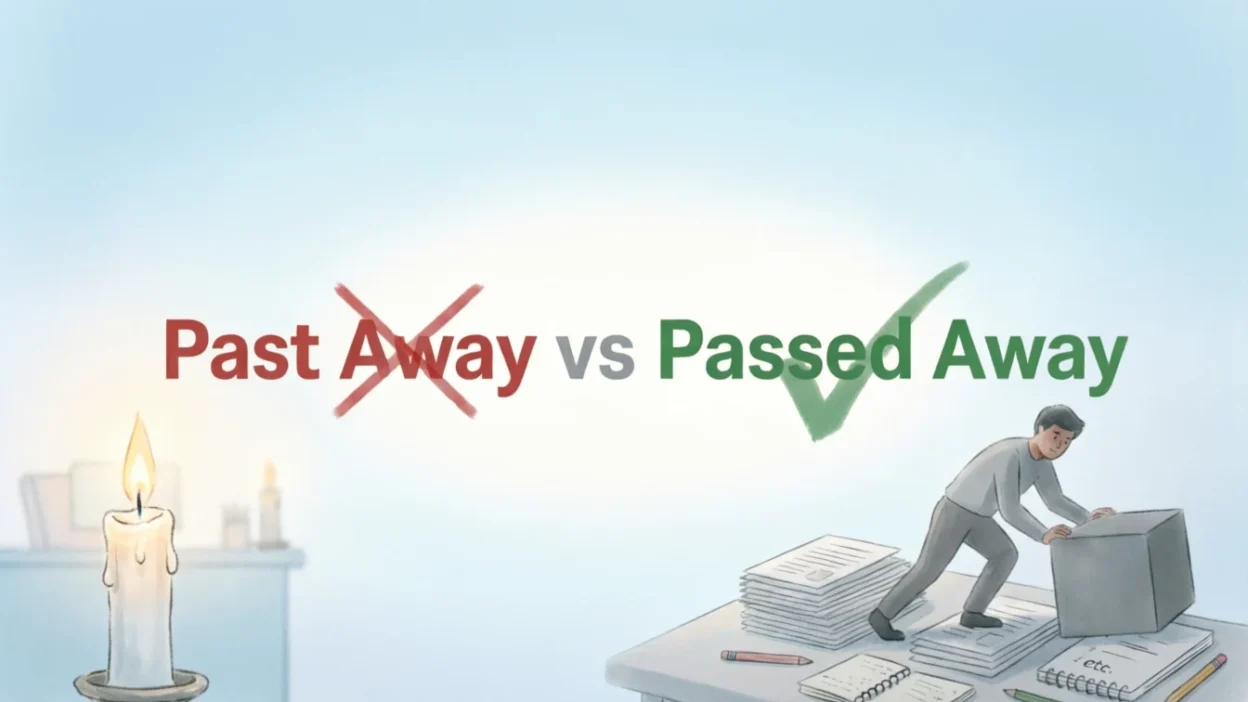
It’s a sensitive phrase, often used during emotional moments but many people still pause before writing it: past away or passed away? Because both words sound the same, it’s easy to mix them up, especially in writing.
If you’ve ever felt unsure, you’re not alone. In this guide, we’ll gently and clearly explain past away vs passed away, so you can use the correct form with confidence and respect in any situation.
Quick Answer: Past Away vs Passed Away
- Passed away is the correct and standard phrase.
- Past away is incorrect and should not be used.
What Does “Passed Away” Mean?
The phrase passed away is a polite and respectful way to say that someone has died. It’s commonly used in both personal and formal communication to soften the expression.
Definition:
A gentle expression used to indicate that someone has died.
Examples:
- Her grandfather passed away peacefully.
- He passed away last year after a long illness.
- We are saddened to hear she has passed away.
This phrase is widely used in obituaries, conversations, and written messages of sympathy.
Is “Past Away” a Real Phrase?
No, past away is not correct in this context. It is a common error caused by confusion between two similar-sounding words: past and passed.
Why does this mistake happen?
- Both words are pronounced the same (homophones)
- People confuse noun/adjective forms (past) with verb forms (passed)
- Typing quickly or relying on sound instead of grammar
Even though it may look right at a glance, “past away” is incorrect and should be avoided.
Past Away vs Passed Away: Key Differences
| Feature | Passed Away | Past Away |
|---|---|---|
| Correct usage | ✅ Yes | ❌ No |
| Meaning | A polite way to say someone died | No valid meaning |
| Grammar role | Verb phrase | Incorrect combination |
| Usage | Formal and informal | Should not be used |
Understanding “Passed” vs “Past”
To fully understand the difference, it helps to break down the words:
Passed:
- Past tense of the verb pass
- Refers to an action
Examples:
- She passed the exam.
- Time has passed quickly.
Past:
- Can be a noun, adjective, or preposition
- Refers to time before now
Examples:
- In the past, things were different.
- He walked past the building.
In the phrase passed away, the verb form is needed—so passed is correct.
Examples of “Passed Away” in Context
In personal communication:
- I’m sorry to hear that your aunt passed away.
In formal writing:
- The author passed away in 2010.
- We regret to inform you that he has passed away.
- She passed away peacefully in her sleep.
Using this phrase helps convey empathy and respect.
Common Mistakes to Avoid
Because of pronunciation, these errors are very common:
1. Writing “past away” instead of “passed away”
Incorrect: He past away last night.
Correct: He passed away last night.
2. Confusing verb and noun forms
Remember, this phrase requires a verb (passed), not a noun or adjective (past).
3. Relying on sound instead of grammar
Just because words sound the same doesn’t mean they are interchangeable.
4. Skipping proofreading
This mistake often slips through without careful review.
Easy Ways to Remember the Correct Form
Here are a few helpful tips:
- Think: passed = action (from “pass”)
- Remember: if it’s about something happening, use passed
- Associate with similar phrases:
- passed on
- passed through
These connections make it easier to recall the correct form.
American vs British English Differences
There is no difference between American and British English in this case:
- Both use passed away as the correct phrase
- Past away is incorrect everywhere
This consistency makes it simple to apply the rule globally.
Why Using the Correct Phrase Matters
This phrase is often used in emotional or serious contexts, so accuracy is especially important.
- Respect: Shows care and sensitivity in difficult moments
- Clarity: Ensures your message is understood correctly
- Professionalism: Important in formal writing and announcements
- Trust: Proper language reflects attention to detail
Using the correct form helps you communicate with empathy and clarity.
Frequently Asked Questions (FAQs)
Is past away ever correct?
No, past away is incorrect. The correct phrase is passed away.
What does passed away mean?
It is a polite way to say that someone has died.
Why is it passed away and not past away?
Because passed is a verb, and the phrase requires an action.
Can I use passed away in formal writing?
Yes, it is commonly used in both formal and informal contexts.
Are passed and past interchangeable?
No, they have different meanings and grammatical roles.
How can I remember the correct form?
Think of passed as the past tense of pass, which indicates action.
Is there any regional difference in usage?
No, both British and American English use passed away.
Summary
The difference between past away vs passed away is simple but important. Passed away is the correct and respectful phrase used to describe someone’s death, while past away is a common error that should be avoided in all forms of writing.
By understanding the difference between passed and past, you can communicate more clearly and sensitively. Using the correct phrase not only improves your grammar but also ensures your message is thoughtful, respectful, and appropriate.

Dani Morrison is a dedicated language writer and spelling expert at Spelword.com, where she focuses on helping readers understand common English spelling mistakes and confusing word pairs. With a passion for clear communication, Dani creates easy-to-follow guides that simplify complex grammar and spelling rules for everyday use.