Many English learners and even native speakers get confused by past vs passed. The two words sound exactly the same, but they have different meanings and grammatical functions. Because they are homophones, it’s easy to mix them up in writing.
If you’ve ever wondered whether to write “I walked past the store” or “I walked passed the store,” you’re not alone. Understanding the difference is simpler than it seems. This guide explains the meaning of each word, shows examples, highlights common mistakes, and helps you remember the correct usage every time.
Quick Answer
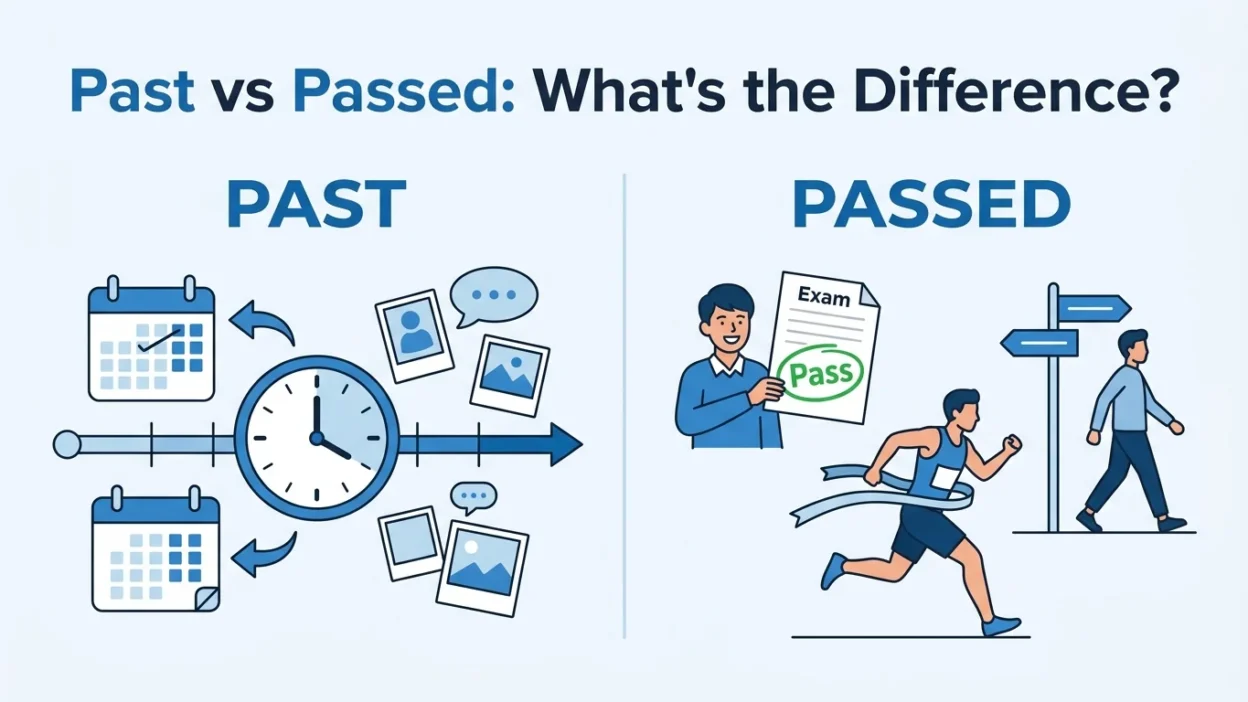
- Past usually refers to time, position, or movement beyond something. It can be a noun, adjective, adverb, or preposition.
- Passed is the past tense and past participle of the verb pass, meaning to move by, go beyond, succeed, approve, or hand something over.
Correct examples:
- We drove past the school.
- She passed the exam.
- The event happened in the past.
- He passed me on the highway.
A simple trick is this:
If you can replace the word with “went by” or “moved beyond,” use “passed.” Otherwise, you probably need “past.”
What Does “Past” Mean?
The word past generally refers to a time that has already happened or a position beyond a particular point.
Depending on the sentence, it can function as different parts of speech.
Past as a Noun
When used as a noun, past means a period of time that has already occurred.
Examples:
- We should learn from the past.
- Her past helped shape who she is today.
- Let’s leave the past behind.
Past as an Adjective
As an adjective, past describes something that has already happened.
Examples:
- During the past year, sales increased.
- The past month has been challenging.
- We discussed past experiences.
Past as a Preposition
As a preposition, past indicates movement beyond a place or point.
Examples:
- Walk past the library and turn left.
- The runner sprinted past the finish line.
- We drove past several villages.
Past as an Adverb
As an adverb, past means beyond or by.
Examples:
- The car sped past.
- Several people walked past without noticing.
- Time seemed to fly past.
What Does “Passed” Mean?
Passed is the past tense and past participle of the verb pass.
It describes an action that has already happened.
Common Meanings of Passed
1. Moved Beyond Something
- She passed the bus stop.
- We passed several restaurants on the way.
2. Succeeded in a Test or Examination
- He passed his driving test.
- They passed the final exam.
3. Handed Something to Someone
- Sarah passed the salt across the table.
- The teacher passed out worksheets.
4. Approved Something
- The committee passed the proposal.
- Parliament passed a new law.
5. Died (A Polite Expression)
- His grandfather passed away peacefully.
- She passed last year.
Past vs Passed: Key Difference
The easiest way to distinguish these words is to remember that passed is always a verb, while past usually refers to time, location, or position.
| Feature | Past | Passed |
|---|---|---|
| Part of Speech | Noun, adjective, adverb, preposition | Verb |
| Meaning | Earlier time or beyond a point | Completed action of passing |
| Refers to Action? | Usually no | Yes |
| Example | The past cannot be changed. | She passed the exam. |
| Example | Walk past the store. | We passed the store yesterday. |
How to Remember the Difference
A helpful memory trick is to focus on the letter “e” in passed.
The word passed comes from the verb pass. Since it is an action word, it keeps the spelling related to the verb.
Ask yourself:
Is there an action happening?
If yes, use passed.
Examples:
- He passed the ball.
- She passed the test.
- We passed the building.
If no action is involved, use past.
Examples:
- The past is important.
- Walk past the gate.
- The meeting is now in the past.
Examples of Past in Sentences
Here are additional examples showing correct usage of past:
- The mistakes of the past taught valuable lessons.
- She looked back on her past achievements.
- It is already ten minutes past noon.
- Continue past the bridge.
- We cannot change the past.
Examples of Passed in Sentences
Here are examples of passed used correctly:
- He passed the interview successfully.
- The train passed our station quickly.
- She passed me a note during class.
- The bill passed without opposition.
- They passed through the city yesterday.
Common Mistakes With Past and Passed
Many writers accidentally use one word when the other is needed.
Incorrect: I passed the grocery store.
If you mean you moved beyond the store, this sentence is actually correct because passed is the action.
Incorrect: I drove passed the grocery store.
Correct: I drove past the grocery store.
Here, past acts as a preposition showing position or direction.
Incorrect: She past the exam.
Correct: She passed the exam.
Passing an exam is an action, so the verb passed is required.
Incorrect: The event is in the passed.
Correct: The event is in the past.
The sentence refers to an earlier time period, making past the correct choice.
American vs British English Differences
There is virtually no difference between American and British English when it comes to past and passed.
Both varieties use the words in the same way and follow the same grammatical rules.
Examples in both American and British English:
- She passed the test.
- Walk past the station.
- We learned from the past.
The spellings and meanings remain consistent across both forms of English.
Why Do People Confuse Past and Passed?
There are several reasons these words are commonly confused:
- They sound identical.
- Both can relate to movement.
- Both frequently appear in everyday writing.
- English contains many similar homophones.
Because pronunciation does not help distinguish them, understanding their grammatical role is the best solution.
Simple Test to Choose the Right Word
When you’re unsure, ask yourself:
Can I replace the word with “went by” or “moved beyond”?
If yes, use passed.
- We passed the museum.
- He passed the finish line.
If not, use past.
- Leave the past behind.
- Walk past the entrance.
This quick check works in most situations.
Frequently Asked Questions
What is the difference between past and passed?
Past refers to a previous time or a position beyond something, while passed is the past tense of the verb pass and describes an action.
Is it drive past or drive passed?
The correct phrase is drive past when describing movement beyond a location.
Is it passed away or past away?
The correct expression is passed away because it comes from the verb pass.
Can past be used as a verb?
No. Past is not used as a verb in modern standard English.
Is passed always a verb?
Yes. Passed is always a form of the verb pass.
Which is correct: half past six or half passed six?
The correct phrase is half past six.
How do I remember past vs passed?
Remember that passed contains the verb pass. If the sentence describes an action, use passed. Otherwise, use past.
Why are past and passed pronounced the same?
They are homophones in English, meaning they have the same pronunciation but different meanings and spellings.
Summary
Understanding past vs passed becomes much easier once you know their grammatical roles. Past usually refers to time, location, or position, while passed is the past tense of the verb pass and always describes an action. Although they sound identical, they serve different purposes in a sentence.
Whenever you’re unsure, check whether the word expresses an action. If it does, choose passed. If it refers to an earlier time, a position beyond something, or a direction, choose past. With a little practice, you’ll use both words confidently and accurately in everyday writing.

Dani Morrison is a dedicated language writer and spelling expert at Spelword.com, where she focuses on helping readers understand common English spelling mistakes and confusing word pairs. With a passion for clear communication, Dani creates easy-to-follow guides that simplify complex grammar and spelling rules for everyday use.