If you’ve ever paused while writing and wondered whether to use either or neither, you’re not alone. These two words often confuse English learners because they both refer to choices involving two people or things. However, they express opposite meanings, and using the wrong one can completely change what you want to say.
The good news is that once you understand a few simple grammar rules, choosing between either and neither becomes easy. In this guide, you’ll learn the meanings, differences, examples, common mistakes, and practical tips for using both words correctly in everyday and professional English.
Quick Answer
The difference between either and neither is simple.
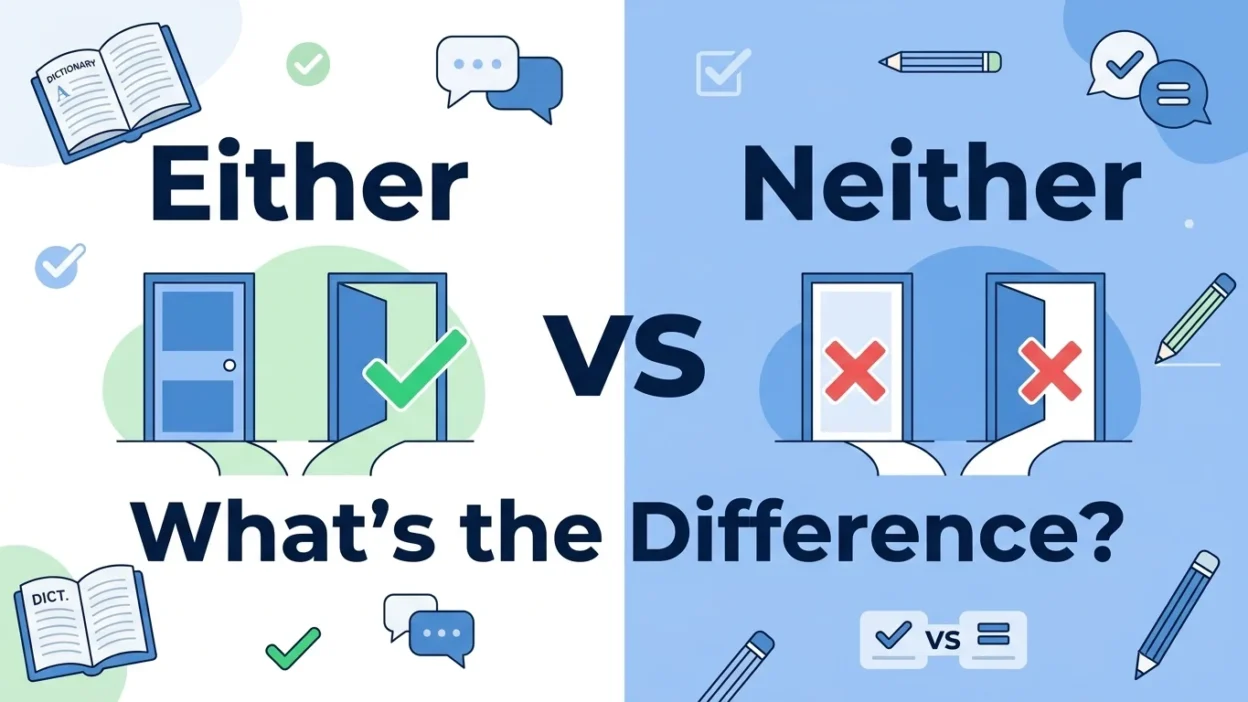
- Either means one or the other of two choices.
- Neither means not one and not the other.
- Either expresses a positive choice.
- Neither expresses a negative idea.
Although they are related, they have opposite meanings.
What Does “Either” Mean?
Either refers to one of two people, things, or options. It indicates that both choices are possible, but only one is selected.
It can function as:
- A determiner
- A pronoun
- An adverb
- A conjunction (in the phrase either…or)
Examples
- You may choose either book.
- Either answer is acceptable.
- We can travel on either day.
- I don’t like coffee, and my brother doesn’t either.
In every example, either refers to one of two options.
What Does “Neither” Mean?
Neither means not one and not the other. It indicates that both choices are rejected.
Like either, it can function as:
- A determiner
- A pronoun
- A conjunction (in the phrase neither…nor)
Examples
- Neither student passed the exam.
- I like neither option.
- Neither of the restaurants is open.
- She speaks neither French nor German.
Here, neither excludes both choices.
Either vs Neither: Key Differences
Although both words refer to two people or things, they have opposite meanings.
| Feature | Either | Neither |
|---|---|---|
| Meaning | One of two | Not one of the two |
| Positive or Negative | Positive | Negative |
| Number of Choices | Two | Two |
| Common Pair | Either…or | Neither…nor |
| Can Stand Alone | Yes | Yes |
The key is remembering that either accepts, while neither rejects.
When Should You Use Either?
Use either when one of two choices is acceptable.
Examples
- You can sit in either chair.
- Either solution will work.
- Choose either route.
- Either candidate would do a good job.
These examples express a positive choice between two options.
When Should You Use Neither?
Use neither when both choices are unacceptable or untrue.
Examples
- Neither answer is correct.
- Neither road leads to the village.
- I wanted neither option.
- Neither employee was available.
These sentences reject both alternatives.
Either…Or vs Neither…Nor
These are common paired conjunctions.
Either…Or
Use either…or to show a choice.
Examples:
- You can either stay home or come with us.
- We’ll meet on either Monday or Tuesday.
- She will either call or send an email.
Only one option is expected.
Neither…Nor
Use neither…nor to reject both choices.
Examples:
- Neither John nor Sarah attended.
- She likes neither tea nor coffee.
- Neither the manager nor the staff agreed.
Both options are excluded.
Either and Neither as Pronouns
Both words can replace nouns.
Either
- Which dress do you prefer?
- Either is fine.
Neither
- Which restaurant is open?
- Neither is open.
This avoids repeating the noun.
Either and Neither with “Of”
Both words are commonly followed by of.
Either Of
- Either of the books is useful.
- Either of my sisters can help.
- Either of these phones works well.
Neither Of
- Neither of the answers is correct.
- Neither of the players scored.
- Neither of the movies interested me.
In formal English, the verb is often singular, although plural verbs are common in informal conversation.
Common Mistakes to Avoid
These mistakes are among the most frequent.
1. Mixing Up Their Meanings
Incorrect:
- Either student failed the exam.
Correct:
- Neither student passed the exam.
If both failed, use neither.
2. Using Double Negatives
Incorrect:
- I don’t want neither option.
Correct:
- I want neither option.
Or:
- I don’t want either option.
Avoid combining don’t with neither, as this creates a double negative in standard English.
3. Confusing Either…Or with Neither…Nor
Incorrect:
- Either Tom nor Jack came.
Correct:
- Neither Tom nor Jack came.
Or:
- Either Tom or Jack will come.
Use the correct pairing.
Either vs Neither in Everyday English
Here are more practical examples.
Using Either
- You may choose either seat.
- I’ll accept either proposal.
- Either method is effective.
- We can leave at either time.
Using Neither
- Neither plan worked.
- Neither key opens the door.
- Neither explanation was convincing.
- I trust neither source.
These examples clearly show the opposite meanings.
American vs British English
There is very little difference between American and British English in using either and neither.
Both varieties:
- Use the same grammar rules.
- Use either…or and neither…nor in the same way.
- Accept either of and neither of.
One small difference is pronunciation.
American English
Some speakers pronounce either as:
- EE-ther
- EYE-ther
British English
British speakers also use both pronunciations, although regional preferences vary.
The meanings remain identical.
Tips for Remembering the Difference
These simple tricks can help.
- Either means one choice is available.
- Neither means no choice is available.
- Think of either as offering options.
- Think of neither as rejecting both.
- Remember the common pairs:
- Either…or
- Neither…nor
These memory aids make choosing the correct word much easier.
Quick Comparison Table
| Situation | Correct Word |
|---|---|
| One of two options | Either |
| Both options rejected | Neither |
| Positive choice | Either |
| Negative statement | Neither |
| Choose one | Either |
| Reject both | Neither |
| Either…or construction | Either |
| Neither…nor construction | Neither |
Frequently Asked Questions
What is the difference between either and neither?
Either means one of two choices, while neither means not one and not the other.
Can either and neither be used interchangeably?
No. They have opposite meanings and cannot usually replace one another.
Is “either of” grammatically correct?
Yes. Either of is a correct expression used to refer to one of two people or things.
Is “neither of” grammatically correct?
Yes. Neither of correctly refers to not one of two people or things.
Should I use either…or or neither…nor?
Use either…or when presenting two possible choices. Use neither…nor when rejecting both choices.
Do American and British English use either and neither differently?
No. Both varieties follow the same grammar rules, although pronunciation may differ slightly.
Is “I don’t want neither” correct?
No. This is considered a double negative in standard English. Say I don’t want either or I want neither instead.
Summary
Understanding either vs neither becomes easy once you remember that they express opposite ideas. Either refers to one of two possible choices and is used in positive contexts, while neither means not one and not the other, making it the correct choice for negative meanings. They are commonly used alone, with of, or in the paired expressions either…or and neither…nor.
Choosing the correct word helps make your English clearer and more accurate. Whether you’re writing an essay, having a conversation, or preparing a professional document, remembering these simple grammar rules will help you avoid common mistakes and communicate with confidence.

Dani Morrison is a dedicated language writer and spelling expert at Spelword.com, where she focuses on helping readers understand common English spelling mistakes and confusing word pairs. With a passion for clear communication, Dani creates easy-to-follow guides that simplify complex grammar and spelling rules for everyday use.