Have you ever paused while writing and wondered whether to use everyone or every one? You’re not alone. These two expressions look nearly identical, but they have different meanings and grammatical functions. Because of their similarity, they are often confused in emails, essays, business writing, and everyday communication.
The good news is that the distinction is simple once you understand the basic rule. In this guide, you’ll learn the difference between everyone vs every one, see practical examples, avoid common mistakes, and gain confidence in using the correct form every time.
Quick Answer
Everyone is an indefinite pronoun that means all people in a group.
Every one refers to each individual person or thing within a group and is often followed by of.
- ✅ Everyone enjoyed the concert.
- ✅ Every one of the tickets was sold.
A simple way to remember the difference is:
- Use everyone when referring to all people collectively.
- Use every one when emphasizing each individual member of a group.
What Does “Everyone” Mean?
Everyone is an indefinite pronoun that means all people or every person in a group.
It refers only to people and treats the group as a whole.
Examples of Everyone
- Everyone is welcome to attend the meeting.
- Everyone enjoyed the presentation.
- Everyone has their own opinion.
- Everyone in the office received the memo.
- Everyone was excited about the announcement.
In these examples, the focus is on the entire group rather than individual members.
What Does “Every One” Mean?
Every one is a phrase made up of two words. It means each individual member of a group and can refer to people, objects, or things.
It is commonly followed by of.
Examples of Every One
- Every one of the students passed the exam.
- Every one of the cookies was eaten.
- I checked every one of the documents.
- Every one of the chairs was occupied.
- She thanked every one of her supporters.
Here, the emphasis is on individual members rather than the group as a whole.
Everyone vs Every One: Key Difference
The primary difference is the focus.
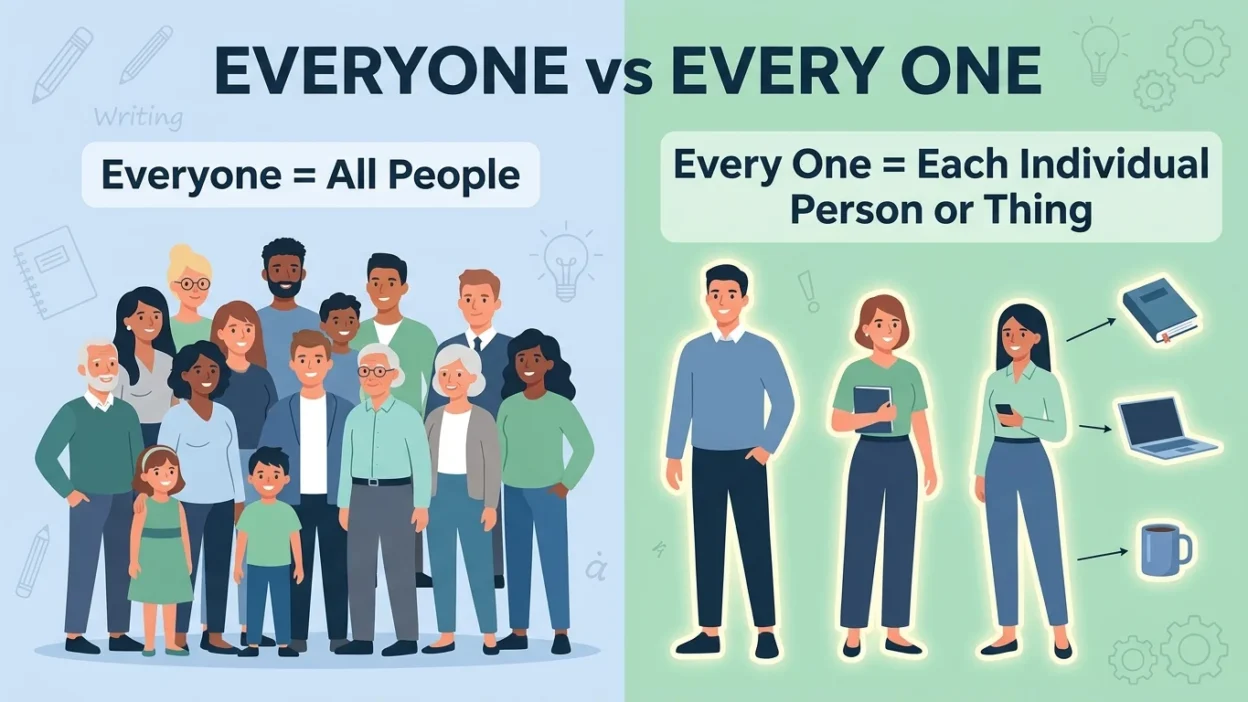
- Everyone = all people together.
- Every one = each individual person or thing.
Comparison Table
| Feature | Everyone | Every One |
|---|---|---|
| Part of Speech | Indefinite pronoun | Pronoun phrase |
| Meaning | All people collectively | Each individual member |
| Refers To | People only | People or things |
| Often Followed by “of” | No | Yes |
| Example | Everyone arrived early. | Every one of the guests arrived early. |
How to Use Everyone Correctly
Use everyone when discussing an entire group of people.
Correct Examples
- Everyone loves a good story.
- Everyone in the classroom listened carefully.
- Everyone deserves respect.
- Everyone received an invitation.
- Everyone agreed with the decision.
Notice that everyone acts as a singular pronoun, even though it refers to multiple people.
Singular Verb Usage
Because everyone is grammatically singular, it takes a singular verb.
Correct:
- Everyone is ready.
Incorrect:
- Everyone are ready.
This rule often surprises learners because the meaning includes many people.
How to Use Every One Correctly
Use every one when highlighting individual members of a group.
Correct Examples
- Every one of the books was returned.
- Every one of the employees completed the training.
- Every one of the flowers bloomed.
- I reviewed every one of the applications.
- Every one of the team members contributed.
The phrase draws attention to each separate item or person.
Why People Confuse Everyone and Every One
The confusion happens because both expressions sound exactly the same when spoken.
However, their meanings differ:
Everyone
Focuses on the group.
Example:
- Everyone cheered when the team won.
Every One
Focuses on individual members.
Example:
- Every one of the fans cheered loudly.
In everyday conversation, the distinction may not always be obvious, but in writing it matters.
Common Mistakes to Avoid
Mistake 1: Using Everyone Before “Of”
Incorrect:
- Everyone of the students passed.
Correct:
- Every one of the students passed.
The phrase everyone of is not grammatically correct.
Mistake 2: Using Every One for General Groups
Incorrect:
- Every one enjoyed the movie.
Correct:
- Everyone enjoyed the movie.
When referring to all people collectively, use everyone.
Mistake 3: Using Plural Verbs with Everyone
Incorrect:
- Everyone are happy.
Correct:
- Everyone is happy.
Remember that everyone takes a singular verb.
Mistake 4: Assuming Every One Refers Only to People
Many writers forget that every one can refer to objects as well.
Example:
- Every one of the boxes was labeled correctly.
Simple Memory Trick
A quick trick can help you choose the right form.
Use Everyone When:
- You mean all people.
- You could replace it with “everybody.”
Examples:
- Everyone attended.
- Everybody attended.
Both sentences mean the same thing.
Use Every One When:
- You can add of the after it.
- You want to emphasize individual members.
Examples:
- Every one of the players practiced.
- Every one of the files was reviewed.
If of the naturally follows, every one is usually correct.
Everyone vs Everybody
Many people also wonder about everyone and everybody.
In most situations, they mean exactly the same thing.
Examples:
- Everyone enjoyed the event.
- Everybody enjoyed the event.
Both are grammatically correct and interchangeable.
Some writers prefer everyone in formal writing because it can sound slightly more polished, but the difference is minimal.
Examples in Everyday Writing
Workplace Examples
- Everyone attended the weekly meeting.
- Every one of the reports was submitted on time.
School Examples
- Everyone participated in the discussion.
- Every one of the assignments received feedback.
Family Examples
- Everyone came to the reunion.
- Every one of the family photos tells a story.
Shopping Examples
- Everyone wanted the new product.
- Every one of the items sold quickly.
These examples show how context determines which form is appropriate.
American vs British English Differences
There is no significant difference between American and British English regarding everyone vs every one.
Both varieties follow the same grammatical rules:
- Everyone means all people collectively.
- Every one means each individual member of a group.
Whether you’re writing for an American or British audience, the distinction remains identical.
Frequently Asked Questions
Is everyone one word or two?
When referring to all people collectively, everyone is written as one word.
When should I use every one?
Use every one when referring to each individual member of a group, especially before of.
Can everyone be replaced with everybody?
Yes. In most cases, everyone and everybody have the same meaning and can be used interchangeably.
Is “everyone of them” correct?
No. The correct phrase is every one of them.
Does everyone take a singular or plural verb?
Everyone takes a singular verb because it is grammatically singular.
Can every one refer to objects?
Yes. Every one can refer to people, objects, items, documents, books, or any individual members of a group.
Which is more common in everyday writing?
Everyone is generally more common because people often refer to groups collectively.
How can I quickly tell which form is correct?
If you can naturally add of the after it, use every one. Otherwise, everyone is probably correct.
Summary
Understanding everyone vs every one is mainly about recognizing whether you’re referring to a group collectively or emphasizing individual members. Everyone means all people as a whole and functions as a singular pronoun. Every one highlights each individual person or thing and is often followed by of.
Although the two expressions sound identical, choosing the correct form makes your writing clearer and more professional. When you mean all people together, use everyone. When you want to focus on each member of a group individually, use every one.

William Harved is a passionate language enthusiast and digital writer specializing in English spelling, grammar clarity, and common writing mistakes. As the primary author of Spelword.com, he focuses on helping readers understand confusing word pairs, correct spelling errors, and improve everyday communication.