Have you ever wondered whether you should write “For all inquiries, contact us” or “For all queries, contact us”? At first glance, these words seem interchangeable because they both involve asking questions. However, there are subtle differences in meaning, usage, and regional preference that make choosing the right word important.
Understanding inquiries vs queries can improve your writing, whether you’re sending a business email, creating website content, writing customer support messages, or simply expanding your English vocabulary. This guide explains the meaning of each word, when to use them, examples, common mistakes, and the differences between American and British English.
Quick Answer
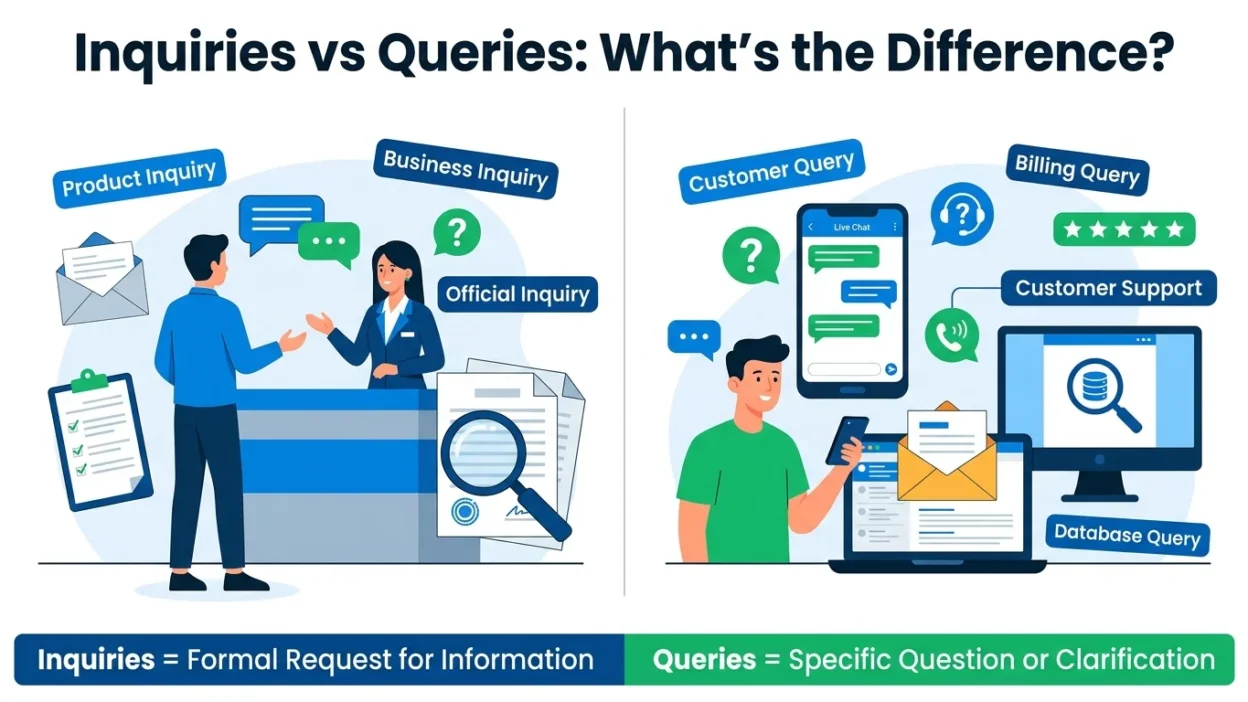
The difference between inquiries vs queries is mainly about purpose and context.
- Inquiry (or enquiry) usually refers to a request for information or a formal investigation.
- Query usually means a question, doubt, or request for clarification.
Examples:
- Please direct all customer inquiries to our support team. ✅
- If you have any queries, feel free to contact us. ✅
In everyday conversation, the two words often overlap, but inquiry is generally more formal, while query often refers to a specific question.
What Does “Inquiry” Mean?
An inquiry is a request for information, advice, or assistance. It can also refer to an official investigation into an event or issue.
The word is commonly used in business, education, government, customer service, and legal settings.
Examples
- I submitted an inquiry about the course.
- The company received several customer inquiries.
- Police launched an inquiry into the accident.
- Please send your inquiries by email.
- We appreciate your inquiry regarding our services.
In each example, the word refers to seeking information or conducting an investigation.
Common Uses of “Inquiry”
You will often see inquiry used in:
- Customer service
- Business communication
- Government reports
- Academic institutions
- Legal investigations
- Product information
- Service requests
- Official correspondence
It usually carries a formal tone.
What Does “Query” Mean?
A query is a question or expression of doubt that seeks clarification or additional information.
It is commonly used in everyday English, business communication, technology, and database management.
Examples
- I have a query about my bill.
- She answered every customer query politely.
- Please contact us if you have any queries.
- The editor raised a query about the report.
- He submitted a database query to retrieve the records.
Here, query refers to a specific question rather than a broad request.
Common Uses of “Query”
The word query frequently appears in:
- Customer support
- Technical documentation
- Business emails
- Database management
- Academic discussions
- Publishing
- Everyday communication
In computing, query has a specialized meaning related to retrieving information from a database.
Inquiries vs Queries: Comparison Table
| Feature | Inquiry | Query |
|---|---|---|
| Meaning | Request for information or formal investigation | A question or request for clarification |
| Tone | Usually more formal | Usually less formal and more conversational |
| Common Contexts | Business, legal, government, education | Customer service, technology, everyday communication |
| Can Mean Investigation? | Yes | No |
| Common Example | Product inquiry | Customer query |
When Should You Use “Inquiry”?
Use inquiry when you’re making a formal request for information or referring to an official investigation.
Examples
- We received your inquiry yesterday.
- The school responded to my admission inquiry.
- Parliament ordered an inquiry into the incident.
- Thank you for your business inquiry.
- The government opened a public inquiry.
In formal writing, inquiry often sounds more professional.
When Should You Use “Query”?
Use query when you’re referring to a specific question or asking for clarification.
Examples
- I have a query about my payment.
- Customers can submit their queries online.
- Her query was answered immediately.
- The manager responded to every employee query.
- Do you have any queries before the meeting ends?
In customer service, query is widely used because it emphasizes individual questions.
Real-Life Examples
Let’s compare both words in practical situations.
Business Email
Correct:
- Thank you for your inquiry regarding our services.
Correct:
- Please let us know if you have any further queries.
The first refers to the original request.
The second refers to additional questions.
Customer Support
Correct:
- Customer inquiries are handled within 24 hours.
Correct:
- Our team answers customer queries seven days a week.
Both are correct but emphasize slightly different aspects.
Government
Correct:
- A public inquiry was launched after the accident.
Incorrect:
- A public query was launched after the accident.
Investigations are called inquiries, not queries.
Common Mistakes People Make
Although the words are similar, they are not always interchangeable.
Here are common mistakes.
Incorrect
- The government opened a public query.
Correct:
- The government opened a public inquiry.
Incorrect
- I have an inquiry about today’s meeting agenda.
Correct:
- I have a query about today’s meeting agenda.
While inquiry is not technically wrong, query sounds more natural for a simple question.
Incorrect
- Please answer all customer inquiries individually.
Correct:
- Please answer all customer queries individually.
When referring to individual questions, queries is often the better choice.
Inquiry vs Enquiry
This is another common source of confusion.
In American English, the preferred spelling is:
- Inquiry
In British English, both spellings exist:
- Enquiry usually means a request for information.
- Inquiry often refers to a formal investigation.
However, many British organizations use the spellings interchangeably.
If you’re writing for an American audience, always use inquiry.
American vs British English Differences
There are noticeable regional preferences.
American English
- Inquiry = Standard spelling
- Query = Question or clarification
Examples:
- Customer inquiry
- Product inquiry
- Billing query
British English
- Enquiry often refers to asking for information.
- Inquiry frequently refers to official investigations.
- Query is commonly used for customer questions.
Despite these differences, readers generally understand all three words in both varieties of English.
Easy Way to Remember the Difference
Here’s a simple trick.
Think of inquiry as asking for information or conducting an investigation.
Think of query as asking a specific question.
Another memory tip:
- Inquiry = Bigger request
- Query = Smaller question
This simple distinction helps in most situations.
FAQs
What is the main difference between inquiries and queries?
An inquiry is generally a request for information or a formal investigation, while a query is a specific question or request for clarification.
Can inquiry and query be used interchangeably?
Sometimes, especially in customer service. However, inquiry is usually more formal, while query often refers to an individual question.
Is inquiry more formal than query?
Yes. Inquiry is commonly used in business, legal, and official communication.
What is a customer inquiry?
A customer inquiry is a request for information about a product, service, policy, or company.
What is a customer query?
A customer query is a specific question that requires clarification or an answer.
Is query used in technology?
Yes. In computing, a query is a request made to a database to retrieve information.
What is the difference between inquiry and enquiry?
In American English, inquiry is the standard spelling. In British English, enquiry often refers to information requests, while inquiry commonly refers to formal investigations.
Which word should I use in business writing?
Inquiry is generally preferred for formal business communication, while query is appropriate when referring to individual customer questions.
Summary
Understanding inquiries vs queries helps you choose the most appropriate word for different situations. Inquiry usually refers to a formal request for information or an official investigation, while query typically means a specific question or request for clarification. Although they sometimes overlap, each word has its own common usage and tone.
Whether you’re writing business emails, customer support content, academic papers, or everyday messages, using the correct term makes your communication clearer and more professional. By remembering that inquiries are generally broader and more formal, while queries are more specific and conversational, you’ll use both words with greater confidence.