Have you ever hesitated while writing waiting or awaiting? Although these words are closely related, they are not always used in the same way. Many English learners and even native speakers confuse them because both refer to expecting something to happen. However, their grammar, tone, and sentence structure differ.
The good news is that understanding waiting vs awaiting is straightforward once you know a few simple rules. This guide explains the meaning of each word, highlights their differences, provides practical examples, discusses common mistakes, and helps you choose the correct option with confidence.
Quick Answer
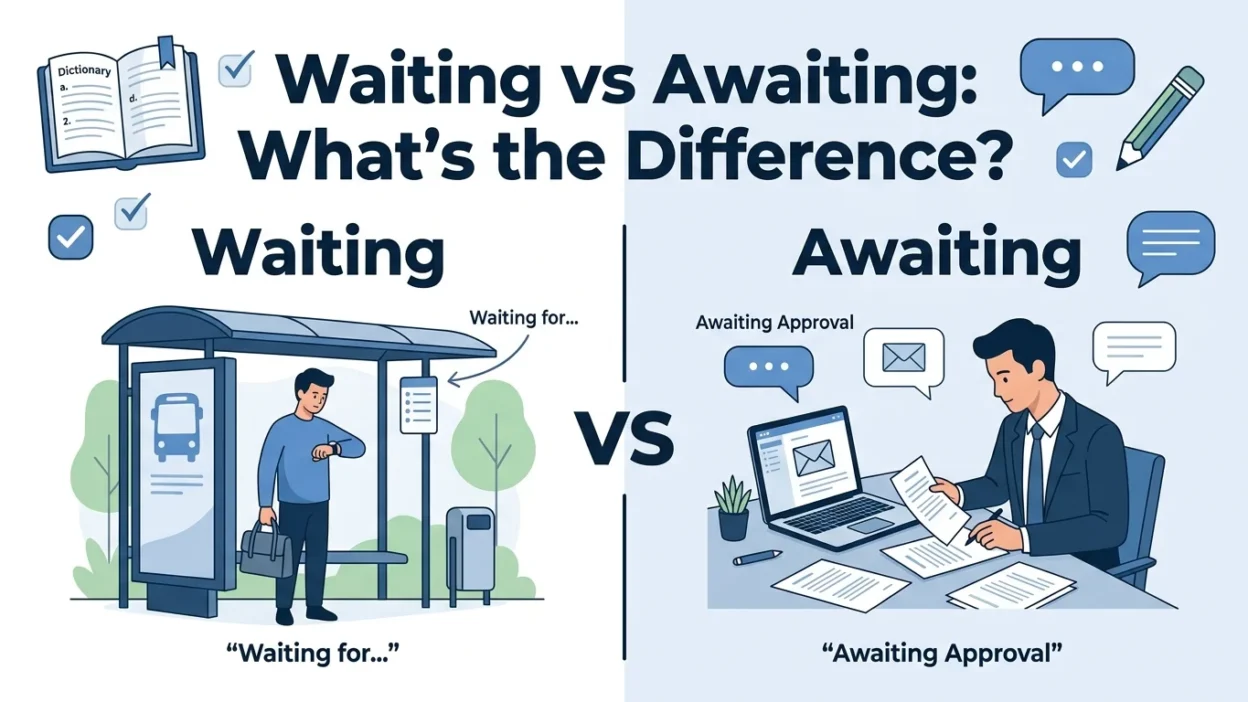
The difference between waiting and awaiting is mainly grammatical.
- Waiting usually requires the preposition for before the object.
- Awaiting does not use for and takes its object directly.
- Awaiting is generally more formal than waiting.
- Both words express the idea of expecting or looking forward to something.
What Does “Waiting” Mean?
Waiting is the present participle of the verb wait. It means staying in one place or delaying action until something happens or someone arrives.
The verb wait is usually followed by the preposition for before the object.
Examples
- I am waiting for the bus.
- She is waiting for her friend.
- We were waiting for the results.
- They are waiting for the meeting to begin.
Notice that for is required before the thing or person being waited for.
What Does “Awaiting” Mean?
Awaiting is the present participle of the verb await. It means expecting or waiting for something, but unlike wait, it does not require the preposition for.
It is commonly used in formal writing, business communication, legal documents, and official announcements.
Examples
- We are awaiting your response.
- The company is awaiting approval.
- She is awaiting the doctor’s report.
- They are awaiting further instructions.
Notice that the object comes immediately after awaiting.
Waiting vs Awaiting: Key Differences
Although both words express expectation, they differ in grammar and style.
| Feature | Waiting | Awaiting |
|---|---|---|
| Meaning | Expecting something | Expecting something |
| Preposition needed | Usually for | No |
| Formality | Neutral or informal | More formal |
| Common in speech | Very common | Less common |
| Common in business writing | Yes | Very common |
The biggest difference is sentence structure.
When Should You Use Waiting?
Use waiting when speaking casually or writing everyday English.
It is common in conversations, emails, stories, and daily communication.
Examples
- I’m waiting for my package.
- She’s waiting for the train.
- We’re waiting for good news.
- They were waiting for permission.
This is the most common form used in spoken English.
When Should You Use Awaiting?
Use awaiting in more formal situations where concise and professional language is preferred.
Common contexts include:
- Business emails
- Academic writing
- Legal documents
- Official notices
- Medical reports
- Government communication
Examples
- We are awaiting confirmation.
- The patient is awaiting surgery.
- The application is awaiting review.
- The committee is awaiting the final report.
These sentences sound polished and professional.
Grammar Rule: Waiting Requires “For”
This is one of the most important grammar rules.
Correct
- I’m waiting for the bus.
- She’s waiting for an email.
- We’re waiting for approval.
Incorrect
- I’m waiting the bus.
- She’s waiting your reply.
Always use for after waiting when introducing the object.
Grammar Rule: Awaiting Does Not Use “For”
Unlike wait, await takes a direct object.
Correct
- We are awaiting your reply.
- She is awaiting the decision.
- The team is awaiting instructions.
Incorrect
- We are awaiting for your reply.
- She is awaiting for approval.
Adding for after awaiting is a common grammatical mistake.
Waiting vs Awaiting in Professional Writing
Professional writing often favors awaiting because it sounds more formal.
Examples include:
- We are awaiting your confirmation.
- The project is awaiting approval.
- Your application is awaiting review.
- The shipment is awaiting customs clearance.
However, waiting for is still correct and acceptable in less formal business communication.
Waiting vs Awaiting in Everyday Conversation
In casual conversations, native speakers overwhelmingly prefer waiting for.
Examples:
- I’m waiting for my coffee.
- She’s waiting for the movie to start.
- We’re waiting for our friends.
- They’re waiting for the rain to stop.
Using awaiting in these situations may sound overly formal.
Common Mistakes to Avoid
Many learners make similar errors.
1. Using “Awaiting For”
Incorrect:
- We are awaiting for approval.
Correct:
- We are awaiting approval.
Never use for after awaiting.
2. Omitting “For” After Waiting
Incorrect:
- I’m waiting the train.
Correct:
- I’m waiting for the train.
Remember that wait normally requires for.
3. Assuming They Are Always Interchangeable
Although both express expectation, their grammar differs.
Correct:
- I’m waiting for the bus.
- I’m awaiting confirmation.
Choose the form that matches the sentence structure.
American vs British English
There is no significant grammatical difference between American and British English in the use of waiting and awaiting.
In both varieties:
- Waiting for is the standard everyday expression.
- Awaiting is considered more formal.
- The grammar rules are identical.
- Both forms are widely accepted.
British English may use awaiting slightly more often in official or legal writing, but the difference is minimal.
Tips for Remembering the Difference
These simple tricks can help.
- Waiting needs for.
- Awaiting never takes for.
- Casual conversation usually uses waiting for.
- Professional writing often uses awaiting.
- If you’re unsure, check whether for is present.
These memory tips make choosing the correct word much easier.
Quick Comparison Table
| Situation | Correct Choice |
|---|---|
| Waiting for a friend | Waiting |
| Waiting for a bus | Waiting |
| Waiting for an email | Waiting |
| Business confirmation | Awaiting |
| Legal approval | Awaiting |
| Medical report | Awaiting |
| Official notification | Awaiting |
| Casual conversation | Waiting |
Frequently Asked Questions
What is the difference between waiting and awaiting?
Waiting usually requires the preposition for, while awaiting takes a direct object without for and is generally more formal.
Is awaiting more formal than waiting?
Yes. Awaiting is commonly used in professional, legal, academic, and official writing, while waiting is more common in everyday speech.
Can I say “awaiting for your response”?
No. The correct expression is awaiting your response because await does not use the preposition for.
Is “waiting your reply” correct?
No. The correct phrase is waiting for your reply.
Which is more common in spoken English?
Waiting for is much more common in everyday conversation.
Do American and British English use these words differently?
No. Both varieties follow the same grammar rules, although awaiting may appear slightly more often in formal British writing.
How can I remember the difference?
Remember this simple rule: waiting needs for, but awaiting never does.
Summary
Understanding waiting vs awaiting is mainly about learning the grammar behind each word. Waiting is the more common and conversational choice, and it almost always requires the preposition for before the object. Awaiting, by contrast, is a more formal verb that takes its object directly without for. While both express the idea of expecting something, they are used in different sentence structures.
Choosing the correct form makes your English sound more natural and professional. Whether you’re writing a business email, speaking with friends, preparing an academic paper, or drafting an official document, remembering the simple grammar rule will help you avoid common mistakes and communicate with confidence.