
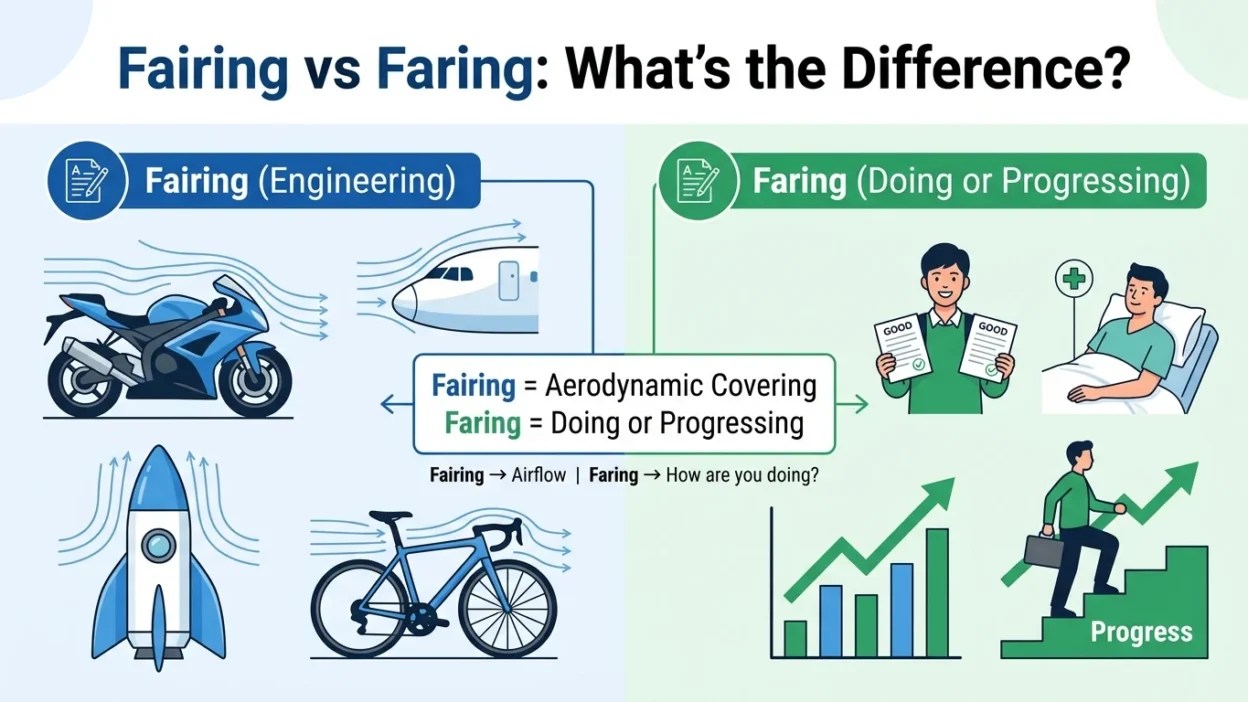
Have you ever written fairing when you actually meant faring, or wondered if the two words are interchangeable? You’re not alone. Because they sound exactly alike, fairing and faring are often confused in writing. However, they have completely different meanings and are used in entirely different contexts.
Understanding the difference between fairing vs faring can help you avoid embarrassing mistakes in emails, school assignments, technical writing, and everyday conversations. This guide explains each word in simple language, includes practical examples, highlights common errors, and helps you remember the correct usage with ease.
Quick Answer
Although fairing and faring are pronounced the same, they have different meanings.
- Fairing is a noun that refers to a smooth covering or structure designed to reduce air or water resistance, especially on vehicles, aircraft, boats, and motorcycles.
- Faring is the present participle of the verb fare, meaning to get along, perform, or progress in a particular way.
| Word | Part of Speech | Meaning |
|---|---|---|
| Fairing | Noun | A protective or aerodynamic covering |
| Faring | Verb (present participle) | Doing, progressing, or performing |
What Does Fairing Mean?
Fairing is a noun mainly used in engineering, aviation, automotive, cycling, and marine industries.
It refers to a specially designed covering that improves airflow or water flow around an object. Fairings reduce drag, improve fuel efficiency, and protect internal components.
You’ll often hear this word when discussing:
- Motorcycles
- Airplanes
- Racing cars
- Rockets
- Boats
- Bicycles
Examples of Fairing
- The motorcycle’s fairing reduced wind resistance.
- Engineers designed a lightweight fairing for the aircraft.
- The damaged fairing was replaced before the race.
- The rocket’s nose fairing protected the satellite during launch.
- A streamlined fairing improved the boat’s performance.
What Does Faring Mean?
Faring is the present participle of the verb fare.
It describes how someone or something is doing, performing, managing, or progressing.
You’ll commonly see it in questions such as:
- How are you faring?
- How is the business faring?
- The team is faring well this season.
Examples of Faring
- She is faring much better after the surgery.
- How are your studies faring?
- The company is faring well despite economic challenges.
- Our team is faring better than expected.
- Farmers are faring well after recent rainfall.
Fairing vs Faring: Side-by-Side Comparison
| Feature | Fairing | Faring |
|---|---|---|
| Part of speech | Noun | Verb form |
| Meaning | Aerodynamic covering | Progressing or doing |
| Common fields | Engineering, aviation, automotive | Everyday English |
| Refers to | Physical object | Condition or performance |
| Example | Motorcycle fairing | How are you faring? |
When Should You Use Fairing?
Use fairing whenever you’re referring to an object designed to improve aerodynamics or hydrodynamics.
Common Uses
- Motorcycle fairing
- Aircraft fairing
- Rocket fairing
- Boat fairing
- Bicycle fairing
Example Sentences
- The racing motorcycle has a carbon-fiber fairing.
- Mechanics repaired the front fairing after the accident.
- The aircraft fairing reduces air resistance.
- Engineers tested a new rocket fairing before launch.
When Should You Use Faring?
Use faring whenever you’re talking about someone’s progress, condition, or success.
It often answers questions such as:
- How are you doing?
- How is the project progressing?
- How is the company performing?
Example Sentences
- The students are faring well in their exams.
- How is your new job faring?
- Small businesses are faring better this year.
- The patient is faring much better after treatment.
- Our investment is faring well despite market changes.
Why Do People Confuse Fairing and Faring?
The confusion happens because the two words are homophones, meaning they sound exactly alike but have different meanings and spellings.
Reasons for confusion include:
- They have identical pronunciation.
- Both are relatively uncommon words.
- Spell-check tools may not detect the mistake because both words are correctly spelled.
- Context determines which word is appropriate.
For example:
❌ The company is fairing well.
✅ The company is faring well.
Likewise:
❌ The motorcycle has a damaged faring.
✅ The motorcycle has a damaged fairing.
Easy Trick to Remember the Difference
A simple memory trick can help.
Fairing = Fair + Air
Think of air inside fairing.
Since fairings improve airflow, the word fairing belongs in engineering and transportation.
Faring = Fare
Think of the expression:
“How are you faring?”
It simply means:
“How are you doing?”
This makes it easy to remember that faring relates to progress or performance.
Common Mistakes to Avoid
Here are some mistakes that frequently appear in writing.
Mistake 1: Using Fairing for Progress
❌ She is fairing well after surgery.
✅ She is faring well after surgery.
Mistake 2: Using Faring for Vehicle Parts
❌ The motorcycle’s faring needs replacement.
✅ The motorcycle’s fairing needs replacement.
Mistake 3: Assuming They Mean the Same Thing
Although they sound alike, these words are never interchangeable because they refer to completely different ideas.
Examples in Everyday Writing
Engineering
The aircraft’s fairing was redesigned to reduce drag.
Transportation
The motorcycle fairing protects the rider from strong wind.
Business
The company is faring better than analysts predicted.
Health
Patients are faring well after receiving the new treatment.
Education
Most students are faring well this semester.
Related Words
Understanding related vocabulary can make these words even easier to remember.
Words Related to Fairing
- Aerodynamics
- Streamlining
- Covering
- Shield
- Casing
- Housing
Words Related to Faring
- Progressing
- Performing
- Managing
- Succeeding
- Coping
- Doing
American vs British English
There is no spelling or meaning difference between American and British English.
Both varieties use:
- Fairing for aerodynamic coverings.
- Faring for describing progress or performance.
The pronunciation and meanings remain the same in both forms of English.
Quick Comparison Table
| Situation | Correct Word |
|---|---|
| Motorcycle body panel | Fairing |
| Rocket nose cone | Fairing |
| Aircraft covering | Fairing |
| How are you doing? | Faring |
| Business performance | Faring |
| Student progress | Faring |
Frequently Asked Questions
What is the difference between fairing and faring?
Fairing is a noun referring to an aerodynamic covering on vehicles or aircraft. Faring is the present participle of the verb fare, meaning to do or progress in a particular way.
Is fairing a real word?
Yes. Fairing is a standard English noun commonly used in engineering, aviation, automotive, and marine industries.
What does faring mean?
Faring means doing, progressing, managing, or performing in a certain way.
Which word should I use when asking how someone is doing?
Use faring.
Example:
“How are you faring?”
What is a motorcycle fairing?
A motorcycle fairing is a protective outer covering that improves aerodynamics, reduces wind resistance, and protects the rider and mechanical parts.
Are fairing and faring pronounced the same?
Yes. They are homophones, meaning they are pronounced the same but have different meanings and spellings.
Is there a difference between American and British English?
No. Both American and British English use fairing and faring with the same spellings and meanings.
Summary
Understanding fairing vs faring is easier once you know the context in which each word is used. Fairing refers to a physical aerodynamic covering found on motorcycles, aircraft, boats, rockets, and other vehicles. Faring, on the other hand, describes how someone or something is doing, progressing, or performing. Although the two words sound identical, they are not interchangeable.
Whether you’re writing about transportation, engineering, business, education, or everyday life, choosing the correct word improves clarity and professionalism. Remember that fairing relates to airflow and vehicle design, while faring answers the question, “How is someone or something doing?” Keeping this distinction in mind will help you avoid one of English’s most common homophone mistakes.

Dani Morrison is a dedicated language writer and spelling expert at Spelword.com, where she focuses on helping readers understand common English spelling mistakes and confusing word pairs. With a passion for clear communication, Dani creates easy-to-follow guides that simplify complex grammar and spelling rules for everyday use.