Have you ever typed renumeration in an email, resume, or job application only to see a red underline appear? You’re not alone. Many English learners and even native speakers confuse renumeration vs remuneration because the words look and sound similar.
The good news is that the difference is simple once you understand it. In this guide, you’ll learn which spelling is correct, what each word means, common mistakes to avoid, practical examples, and an easy way to remember the right spelling.
Quick Answer
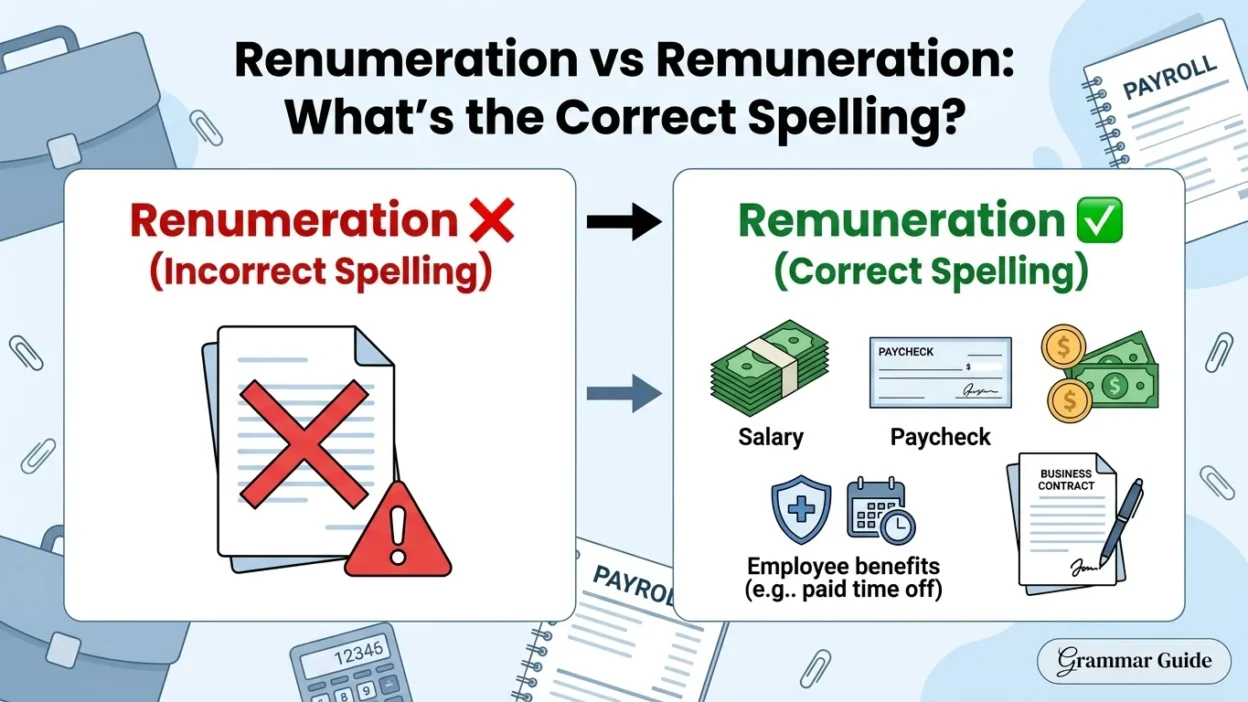
Remuneration is the correct English word. It refers to payment, salary, wages, compensation, or rewards received for work or services.
Renumeration is generally considered a misspelling of remuneration. It is not recognized as a standard English word in dictionaries and should be avoided in formal or professional writing.
| Word | Correct? | Meaning |
|---|---|---|
| Remuneration | ✅ Yes | Payment or compensation for work |
| Renumeration | ❌ No | Common misspelling of remuneration |
What Does Remuneration Mean?
Remuneration is a noun that means money or other benefits paid to someone for their work or services.
Remuneration includes much more than just a monthly salary. It may also cover:
- Base salary
- Bonuses
- Commissions
- Overtime pay
- Stock options
- Health insurance
- Retirement benefits
- Performance incentives
Employers often use the word remuneration in employment contracts, HR policies, recruitment advertisements, and legal documents.
Example Sentences
- The company offers competitive remuneration for experienced engineers.
- Her remuneration includes a yearly performance bonus.
- Employees discussed their remuneration package during the annual review.
- The consultant received remuneration after completing the project.
- Higher qualifications often lead to better remuneration.
Is Renumeration a Real Word?
No. Renumeration is not considered a standard English word.
It usually appears because people accidentally combine the words remuneration and enumeration or simply misspell the correct term.
Most dictionaries, grammar guides, and style manuals recognize remuneration as the only correct spelling.
Incorrect Examples
- ❌ The employee negotiated his renumeration.
- ❌ Please mention your expected renumeration.
Correct Versions
- ✅ The employee negotiated his remuneration.
- ✅ Please mention your expected remuneration.
Renumeration vs Remuneration: Side-by-Side Comparison
| Feature | Renumeration | Remuneration |
|---|---|---|
| Correct spelling | ❌ No | ✅ Yes |
| Dictionary word | No | Yes |
| Meaning | None (misspelling) | Payment for work |
| Suitable for formal writing | No | Yes |
| Used in contracts | No | Yes |
| Used in business English | No | Yes |
Why Do People Confuse Renumeration and Remuneration?
The confusion happens for several reasons.
Similar Pronunciation
When spoken quickly, remuneration may sound like “renumeration,” making the incorrect spelling seem believable.
Letter Order
The letters “mu” in remuneration are easy to swap with “nu”, especially while typing.
Familiar Pattern
Many English words begin with “re-“ followed by “nu”, causing people to write renumeration without realizing the mistake.
Auto-typing Errors
Fast typing and autocorrect mistakes often introduce the incorrect spelling.
Easy Trick to Remember the Correct Spelling
Think about the word money.
Both money and remuneration are related to payment.
Notice that remuneration contains “mu”, helping you connect it with money.
Another simple reminder is:
Remuneration = Reward for work.
If you’re discussing salary, compensation, wages, or employee benefits, remuneration is always the correct word.
Examples in Everyday English
Here are examples showing proper usage.
In a Job Advertisement
We offer an attractive remuneration package with health insurance and annual bonuses.
In a Business Email
Please provide details about your expected remuneration.
During Salary Negotiations
The candidate requested higher remuneration because of extensive experience.
In an Employment Contract
Remuneration will be paid on the final working day of each month.
In Human Resources
The HR department reviews employee remuneration annually.
Common Mistakes to Avoid
Many writers accidentally make these errors.
Using “Renumeration”
❌ The renumeration is competitive.
✅ The remuneration is competitive.
Confusing Remuneration with Salary
Salary is only one part of remuneration.
Remuneration can include:
- Salary
- Bonuses
- Incentives
- Benefits
- Insurance
- Pension contributions
- Paid leave
Misspelling in Professional Documents
Never write renumeration in:
- CVs
- Resumes
- Cover letters
- Employment contracts
- Business proposals
- Academic papers
Using the correct spelling creates a more professional impression.
Remuneration in Business and HR
The word remuneration is widely used in business, finance, and human resources.
Organizations often discuss:
- Executive remuneration
- Employee remuneration
- Total remuneration
- Annual remuneration
- Performance-based remuneration
- Fair remuneration policies
Companies use remuneration packages to attract and retain talented employees.
American vs British English
There is no spelling difference between American and British English.
Both varieties use:
✅ Remuneration
Neither American English nor British English accepts renumeration as the standard spelling.
The pronunciation is also nearly identical in both regions, with only slight differences in accent.
When Should You Use the Word Remuneration?
Use remuneration whenever you’re talking about compensation for work.
Examples include:
- Employment contracts
- Salary discussions
- HR documents
- Recruitment advertisements
- Legal agreements
- Government policies
- Corporate reports
- Academic writing
In casual conversation, people often say pay, salary, or wages instead, but remuneration remains common in professional contexts.
Quick Comparison with Similar Words
| Word | Meaning |
|---|---|
| Salary | Fixed regular payment |
| Wage | Payment based on hours worked |
| Compensation | Payment for work or loss |
| Income | Money received from all sources |
| Earnings | Total money earned |
| Remuneration | Complete payment and benefits for work |
Examples: Correct vs Incorrect
| Incorrect | Correct |
|---|---|
| Renumeration package | Remuneration package |
| Expected renumeration | Expected remuneration |
| Annual renumeration | Annual remuneration |
| Renumeration policy | Remuneration policy |
| Executive renumeration | Executive remuneration |
Using the correct spelling improves clarity and professionalism.
Frequently Asked Questions
Is renumeration a correct English word?
No. Renumeration is a common misspelling. The correct word is remuneration.
What does remuneration mean?
Remuneration means the payment or rewards someone receives for their work, including salary, bonuses, and employee benefits.
Why do people spell remuneration as renumeration?
People usually reverse the letters “mu” into “nu” because the pronunciation sounds similar and the spelling can be confusing.
Is remuneration the same as salary?
Not exactly. Salary is one part of remuneration. Remuneration may also include bonuses, commissions, insurance, retirement benefits, and other rewards.
Which spelling should I use in a resume?
Always use remuneration. Using renumeration may appear unprofessional and could leave a negative impression.
Is remuneration used in both American and British English?
Yes. Both American and British English use the spelling remuneration.
Can remuneration include non-cash benefits?
Yes. Remuneration can include health insurance, paid leave, retirement contributions, stock options, bonuses, and other employment benefits.
Summary
Understanding renumeration vs remuneration is easier than it first appears. Remuneration is the correct spelling and refers to the compensation, salary, wages, and benefits a person receives for their work. Renumeration, on the other hand, is simply a spelling mistake and should not be used in professional or academic writing.
Whether you’re writing a resume, negotiating a job offer, preparing an employment contract, or discussing employee benefits, choosing the correct spelling helps you communicate clearly and professionally. Remember that remuneration is the accepted form in both American and British English, making it the right choice in every context.

William Harved is a passionate language enthusiast and digital writer specializing in English spelling, grammar clarity, and common writing mistakes. As the primary author of Spelword.com, he focuses on helping readers understand confusing word pairs, correct spelling errors, and improve everyday communication.