Have you ever paused while writing because you couldn’t decide between flair and flare? You’re not alone. These two words sound exactly the same, but they have completely different meanings. Using the wrong one can confuse readers and make your writing appear less polished.
The good news is that the difference is easy to remember once you understand what each word means. In this guide, you’ll learn the meaning of flair vs flare, see practical examples, discover common mistakes, and gain simple memory tips so you can use both words confidently in everyday writing.
Quick Answer
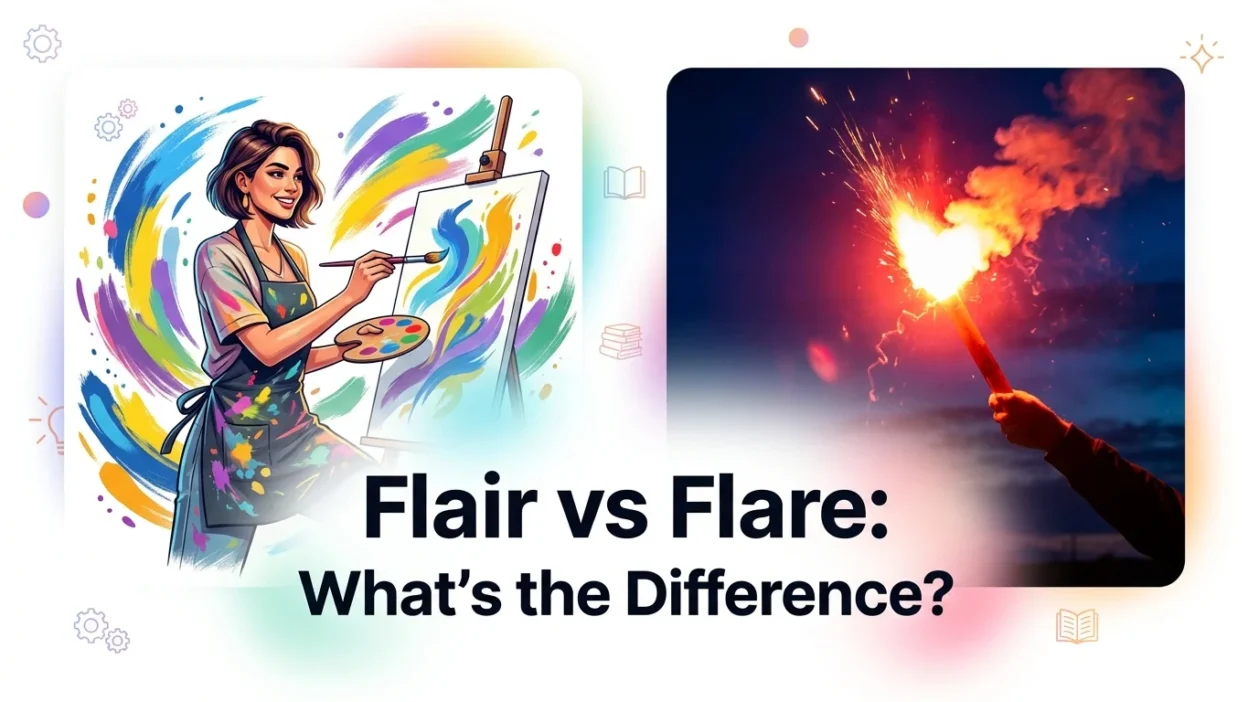
Flair refers to natural talent, style, or an impressive ability.
Flare refers to a sudden burst of light, fire, emotion, or a worsening of a condition. It can also be used as a verb meaning to spread outward or burn brightly.
- ✅ She has a flair for interior design.
- ✅ The campfire began to flare after more wood was added.
- ✅ His asthma had a flare-up during the winter.
What Does “Flair” Mean?
Flair is a noun that describes a natural ability, special talent, or distinctive style. When someone has a flair for something, they perform it with ease or creativity.
Examples of “Flair”
- She has a flair for writing engaging stories.
- Mark decorated the room with great flair.
- The chef’s dishes showed artistic flair.
- Emma has a flair for learning new languages.
- His presentation had style and flair.
Common Uses of “Flair”
- Flair for music
- Flair for fashion
- Flair for teaching
- Flair for business
- Creative flair
- Dramatic flair
In all of these examples, flair refers to talent, creativity, elegance, or personal style.
What Does “Flare” Mean?
Flare can be both a noun and a verb. It usually describes something that suddenly becomes brighter, larger, stronger, or more intense.
As a noun, it may refer to light, fire, emotion, or a medical condition becoming worse.
As a verb, it means to burn brightly, spread outward, or suddenly become stronger.
Examples of “Flare”
- The fire began to flare after the wind picked up.
- Tempers flared during the heated debate.
- Her allergies had a flare-up in the spring.
- A rescue flare helped the coast guard locate the boat.
- The candle flared before going out.
Common Uses of “Flare”
- Solar flare
- Flare-up
- Signal flare
- Tempers flare
- Flames flare
- Nostrils flare
These examples all involve something becoming more noticeable, intense, or expanded.
Flair vs Flare: Side-by-Side Comparison
| Feature | Flair | Flare |
|---|---|---|
| Part of speech | Noun | Noun and verb |
| Main meaning | Natural talent or style | Burst of light, fire, emotion, or worsening condition |
| Associated with | Creativity, ability, elegance | Light, heat, anger, illness, expansion |
| Example | She has a flair for painting. | The flames began to flare. |
| Memory tip | Think of talent and style. | Think of fire and sudden intensity. |
How to Remember the Difference
A simple trick can help you avoid confusion.
Flair = Talent
The word flair reminds you of personal style and unique ability.
Example:
She has a flair for photography.
Flare = Fire
The word flare is connected to flames, bright light, or sudden increases.
Example:
The fire started to flare after more fuel was added.
If you associate flair with talent and flare with fire, you’ll rarely mix them up.
Examples of Flair and Flare in Sentences
Here are more examples showing each word in context.
Flair
- The designer has a remarkable flair for color combinations.
- Olivia writes with creativity and flair.
- He showed a flair for solving difficult problems.
- The dancer performed with confidence and flair.
- Sarah has a flair for public speaking.
Flare
- The match caused the dry grass to flare.
- Political tensions flared overnight.
- His back pain flared after lifting heavy boxes.
- A bright flare lit up the night sky.
- The argument flared into a serious conflict.
Common Mistakes People Make
Because these words sound identical, many writers accidentally substitute one for the other.
Incorrect:
She has a flare for music.
Correct:
She has a flair for music.
Incorrect:
His asthma flair became worse.
Correct:
His asthma flare became worse.
Incorrect:
The flames showed great flair.
Correct:
The flames began to flare.
Reading your sentence carefully and asking whether you’re talking about talent or sudden intensity usually reveals the correct choice.
Is There Any Difference Between American and British English?
There is no significant difference between American English and British English when it comes to flair and flare.
Both varieties use these words with the same meanings and spellings.
For example:
American English
- She has a flair for marketing.
- The wildfire continued to flare.
British English
- She has a flair for marketing.
- The wildfire continued to flare.
Whether you’re writing for readers in the United States, the United Kingdom, Canada, Australia, or elsewhere, the rules remain exactly the same.
Why Do People Confuse Flair and Flare?
The confusion happens for several reasons.
- They are perfect homophones.
- Both are common in everyday English.
- Spell-checkers may not catch the mistake because both words are correctly spelled.
- Writers often rely on pronunciation instead of meaning.
Understanding the context is the easiest way to choose the correct spelling.
Quick Memory Tips
Keep these simple reminders in mind:
- Flair = Talent or Style
- Flare = Fire, Light, or Sudden Increase
- If you’re talking about someone’s ability, use flair.
- If something is burning, spreading, or becoming more intense, use flare.
- Always read your sentence for context before choosing.
Frequently Asked Questions
What is the difference between flair and flare?
Flair means natural talent, style, or creative ability. Flare refers to a sudden burst of light, fire, emotion, or the worsening of a condition.
Is it flair for something or flare for something?
The correct phrase is flair for something because it refers to having a natural talent or ability.
Can flare be used as a verb?
Yes. Flare can be a verb meaning to burn brightly, spread outward, or suddenly become stronger.
What does flair mean in writing?
In writing, flair refers to creativity, originality, style, or expressive skill that makes the writing engaging.
What is a flare-up?
A flare-up is a sudden worsening of a disease, medical condition, conflict, or emotional situation.
Why are flair and flare confusing?
They are confusing because they sound exactly alike but have different meanings and spellings.
Are flair and flare interchangeable?
No. They are never interchangeable because each word has a distinct meaning. Choosing the wrong one changes the meaning of the sentence.
How can I remember the difference between flair and flare?
Remember this simple rule: flair relates to talent and style, while flare relates to fire, light, or sudden intensity.
Summary
Although flair and flare are pronounced the same, they serve very different purposes in English. Flair is all about natural talent, creativity, style, or elegance. Flare, on the other hand, refers to something that suddenly burns brightly, spreads outward, becomes more intense, or worsens, such as a fire, emotion, or medical condition.
Whenever you’re unsure which word to use, think about the context. If you’re describing someone’s ability or unique style, choose flair. If you’re talking about flames, bright light, growing emotions, or a sudden increase in intensity, choose flare. Mastering this simple distinction will help you write more accurately and confidently.

Dani Morrison is a dedicated language writer and spelling expert at Spelword.com, where she focuses on helping readers understand common English spelling mistakes and confusing word pairs. With a passion for clear communication, Dani creates easy-to-follow guides that simplify complex grammar and spelling rules for everyday use.