English is full of words that look and sound similar but have completely different meanings. One pair that often causes confusion is discrete vs discreet. Since the two words differ by only one letter, many people accidentally use the wrong one in writing.
If you’ve ever wondered whether something should be described as discrete or discreet, you’re not alone. The good news is that once you understand the meanings of these words, choosing the correct one becomes much easier. This guide explains the difference, provides examples, highlights common mistakes, and offers simple memory tricks to help you use both words confidently.
Quick Answer
The difference between discrete and discreet is simple:
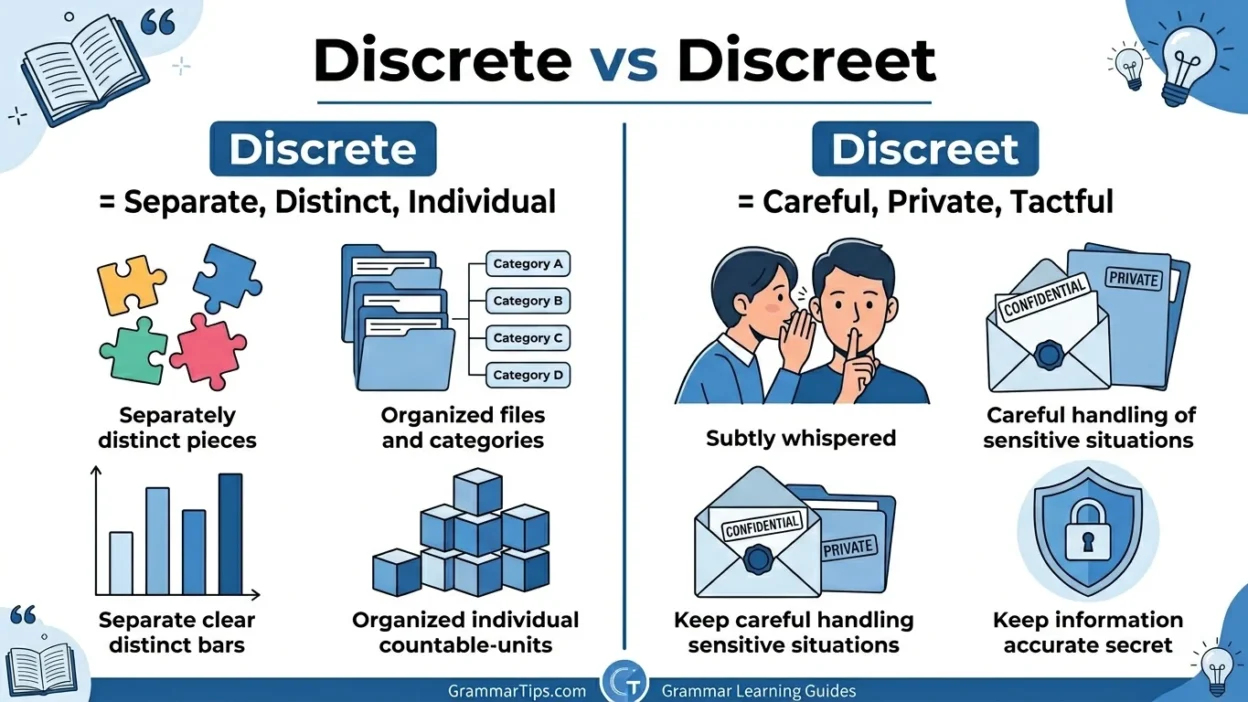
- Discrete means separate, distinct, or individual.
- Discreet means careful, tactful, or cautious about keeping something private.
Examples
- The project consists of several discrete stages.
- She was very discreet about the confidential information.
A quick way to remember:
- Discrete = Separate
- Discreet = Secret
What Does Discrete Mean?
Discrete is an adjective that describes things that are separate, distinct, or individually identifiable.
When something is discrete, it is not connected or blended with something else. Instead, it exists as its own independent unit.
Examples of Discrete
- The report is divided into three discrete sections.
- The company operates through several discrete business units.
- Each student completed a discrete assignment.
- Scientists analyzed the data as discrete categories.
- The software contains several discrete functions.
In all of these examples, the items are separate and distinct rather than combined into a single whole.
What Does Discreet Mean?
Discreet is an adjective used to describe someone who is careful, tactful, and able to keep information private.
A discreet person knows how to avoid drawing unnecessary attention and can handle sensitive situations wisely.
Examples of Discreet
- She was discreet when discussing her colleague’s personal issues.
- The hotel offers discreet service for celebrity guests.
- He made a discreet exit from the event.
- Please be discreet when handling confidential documents.
- The manager responded in a discreet and professional manner.
In these examples, the focus is on caution, privacy, and good judgment.
Discrete vs Discreet: Side-by-Side Comparison
| Feature | Discrete | Discreet |
|---|---|---|
| Meaning | Separate, distinct, individual | Careful, tactful, private |
| Common Use | Mathematics, business, science, organization | Personal behavior, communication, privacy |
| Refers To | Things or concepts | People, actions, behavior |
| Synonyms | Separate, distinct, independent | Careful, tactful, prudent |
| Example | The tasks were discrete. | She was discreet about the matter. |
Why Are Discrete and Discreet Confusing?
These words create confusion because they:
- Have nearly identical spellings
- Sound very similar when spoken
- Share a common linguistic origin
- Differ by only one letter
When reading quickly, many people don’t notice the difference between the endings.
As a result, even experienced writers occasionally mix them up.
How to Remember the Difference
A simple memory trick can help.
Discreet Has Two E’s
Think of the two e’s in discreet as representing the eyes of someone carefully watching what they say and do.
Discreet = Careful and Secretive
Discrete Has No Double E
Think of discrete as describing separate pieces.
Discrete = Distinct and Separate
These simple associations make it easier to remember which word belongs in a sentence.
Examples of Discrete in Sentences
Let’s look at more examples of discrete used correctly.
Business
- The corporation consists of several discrete departments.
- Each product line serves a discrete market segment.
Education
- Students completed discrete learning modules.
- The curriculum includes several discrete units.
Technology
- The computer uses a discrete graphics card.
- The application performs several discrete tasks.
Science
- Researchers identified discrete populations within the species.
- The experiment measured discrete variables.
In each case, the word refers to things that are separate and distinct.
Examples of Discreet in Sentences
Now let’s explore how discreet is used.
Personal Situations
- She remained discreet about her plans.
- He handled the issue in a discreet manner.
Workplace Communication
- Employees must be discreet when discussing company matters.
- The lawyer provided discreet legal advice.
Hospitality and Customer Service
- The staff offered discreet assistance.
- Guests appreciated the hotel’s discreet atmosphere.
Social Settings
- She gave him a discreet signal during the meeting.
- Their conversation was conducted in a discreet corner of the restaurant.
These examples emphasize privacy, tact, and sensitivity.
Common Mistakes With Discrete and Discreet
Many writers accidentally substitute one word for the other.
Mistake 1: Using Discreet for Separate Things
Incorrect:
- The report contains several discreet sections.
Correct:
- The report contains several discrete sections.
The sections are separate, not secretive.
Mistake 2: Using Discrete for Privacy
Incorrect:
- Please be discrete with this confidential information.
Correct:
- Please be discreet with this confidential information.
The sentence refers to careful handling of private information.
Mistake 3: Relying Only on Sound
Because both words sound similar, writers often choose the wrong spelling based solely on pronunciation.
Always consider the meaning before selecting the word.
Discrete in Mathematics
One of the most common uses of discrete appears in mathematics.
In mathematics, discrete refers to values that are separate and distinct rather than continuous.
Examples include:
- Whole numbers
- Countable objects
- Individual data points
A field known as Discrete Mathematics focuses on structures that can be counted individually.
Examples include:
- Graph theory
- Logic
- Combinatorics
- Algorithms
This specialized use reinforces the idea of separate units.
Discreet in Professional Communication
The word discreet is particularly important in professional environments.
Employers value discretion because it demonstrates:
- Trustworthiness
- Professionalism
- Good judgment
- Respect for privacy
For example:
- Human resources professionals must be discreet with employee records.
- Medical staff must be discreet when handling patient information.
- Financial advisors must remain discreet about client accounts.
In these situations, discretion helps maintain trust and confidentiality.
American vs British English
There is no significant difference between American and British English regarding discrete and discreet.
Both varieties of English use:
- Discrete for separate or distinct things
- Discreet for careful or private behavior
Examples accepted in both American and British English:
- The study examined discrete categories.
- She remained discreet throughout the discussion.
The meanings and spellings are the same on both sides of the Atlantic.
Frequently Asked Questions
What is the difference between discrete and discreet?
Discrete means separate or distinct, while discreet means careful, tactful, and respectful of privacy.
Is discrete the same as discreet?
No. Although they look and sound similar, they have different meanings and should not be used interchangeably.
How do I remember discrete vs discreet?
Remember that discreet has two “e’s,” which can remind you of someone carefully watching what they say and do.
Can discrete describe a person?
Generally, no. Discrete usually describes things, categories, units, or concepts rather than people.
Can discreet describe an object?
Sometimes. For example, a discreet entrance or discreet design can refer to something that avoids attracting attention.
Which word means separate?
Discrete means separate, distinct, or individual.
Which word means private?
Discreet means private, cautious, or tactful.
Are discrete and discreet pronounced differently?
Their pronunciations are very similar, which is one reason people often confuse them.
Summary
Understanding discrete vs discreet is essential for clear and accurate communication. While the words look nearly identical, their meanings are very different. Discrete refers to things that are separate, distinct, or independent, while discreet describes careful, tactful, and private behavior. Choosing the correct word helps prevent misunderstandings and improves the quality of your writing.
Fortunately, remembering the distinction is easier than it seems. Think of discrete as meaning separate pieces and discreet as relating to secrets and discretion. Whether you’re writing a business report, academic paper, professional email, or everyday message, using these words correctly will make your communication more polished and professional.

William Harved is a passionate language enthusiast and digital writer specializing in English spelling, grammar clarity, and common writing mistakes. As the primary author of Spelword.com, he focuses on helping readers understand confusing word pairs, correct spelling errors, and improve everyday communication.