Have you ever seen the phrase deep-seeded in an article, email, or social media post and wondered whether it was correct? You’re not alone. Many English speakers use deep-seeded and deep-seated interchangeably because they sound similar when spoken. However, only one of these expressions is traditionally considered correct in standard English.
Understanding the difference between deep-seeded vs deep-seated can help you write more accurately and avoid a common language mistake. In this guide, you’ll learn the meaning of each term, why people confuse them, examples of correct usage, and simple tips to remember the right phrase every time.
Quick Answer
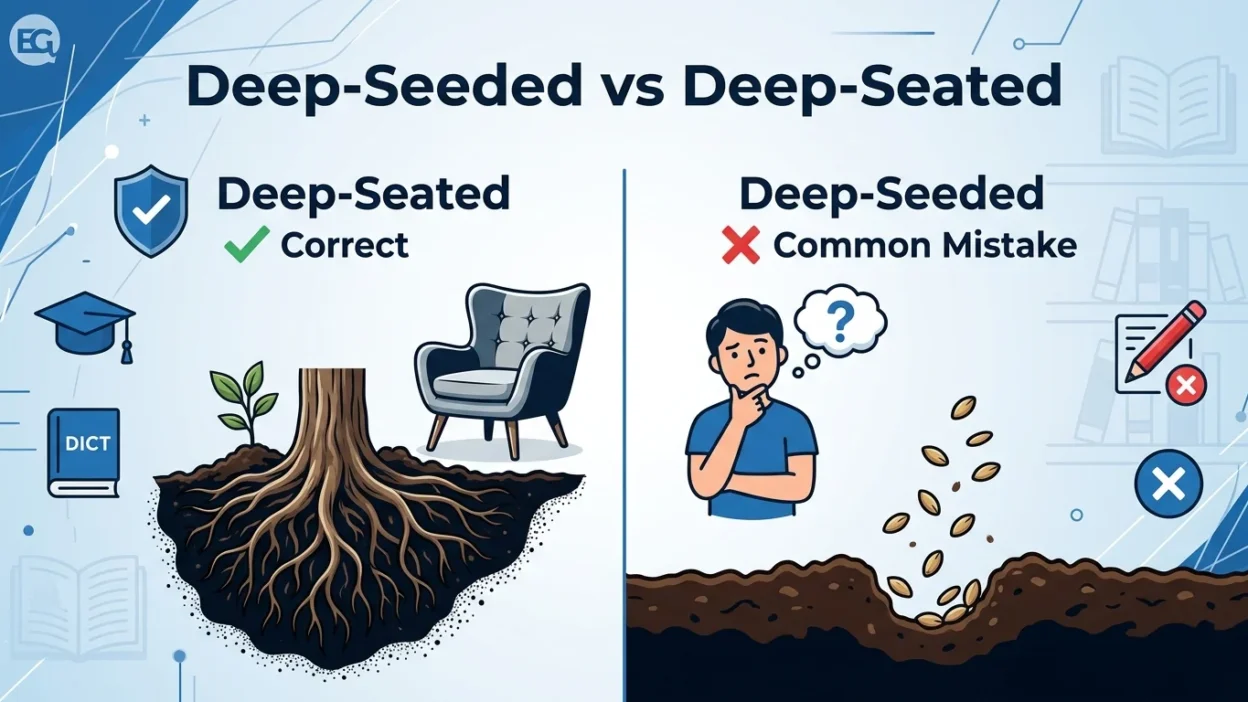
Deep-seated is the correct and standard English expression.
It means something is firmly established, strongly rooted, or difficult to change.
Deep-seeded is generally considered a mistaken version of deep-seated, although it has become increasingly common in informal writing because of the idea of something being “seeded” deeply.
Correct Example:
- She has a deep-seated fear of heights.
Incorrect Example:
- She has a deep-seeded fear of heights.
What Does Deep-Seated Mean?
The phrase deep-seated describes beliefs, emotions, attitudes, habits, or problems that are firmly established and deeply ingrained.
The word seated comes from the idea of something being fixed securely in a seat or position. Over time, the phrase evolved to describe ideas or feelings that are strongly embedded in someone’s mind or character.
Examples of Deep-Seated
- He has a deep-seated distrust of politicians.
- The company faced deep-seated organizational problems.
- Her deep-seated passion for music began in childhood.
- They struggled to overcome deep-seated cultural differences.
- The conflict stems from deep-seated historical tensions.
In each example, the issue or feeling is deeply rooted and not easily changed.
What Does Deep-Seeded Mean?
Deep-seeded is generally regarded as a nonstandard variant of deep-seated.
People often assume the phrase should involve “seeded” because seeds grow roots deep into the ground. As a result, the expression seems logical and meaningful.
For example:
- He has a deep-seeded belief that hard work pays off.
Although many readers understand the intended meaning, most grammar experts, dictionaries, editors, and style guides recommend using deep-seated instead.
Deep-Seated vs Deep-Seeded: Side-by-Side Comparison
| Feature | Deep-Seated | Deep-Seeded |
|---|---|---|
| Standard English | Yes | No |
| Accepted in formal writing | Yes | Usually No |
| Meaning | Firmly established or ingrained | Often used with same intended meaning |
| Dictionary recognition | Widely recognized | Generally treated as a variant or error |
| Recommended usage | Yes | Avoid in formal contexts |
Why Do People Say Deep-Seeded?
The confusion is understandable.
Many English speakers associate strong beliefs or emotions with roots and growth. Since seeds develop roots beneath the ground, deep-seeded sounds logical.
This is an example of what linguists sometimes call an eggcorn—a word or phrase that results from a mistaken interpretation but still seems meaningful.
Other common examples include:
- For all intensive purposes (instead of for all intents and purposes)
- One in the same (instead of one and the same)
- Nip it in the butt (instead of nip it in the bud)
Because deep-seeded makes intuitive sense, it continues to appear in everyday speech and online writing.
The Origin of Deep-Seated
The phrase deep-seated dates back several centuries.
Originally, it referred to something physically situated deep within a place or structure. Over time, the meaning expanded to describe emotions, opinions, habits, and conditions that were firmly established.
The image behind the phrase is not about seeds growing in soil. Instead, it is about something being deeply positioned or firmly seated within a particular location.
This historical origin explains why deep-seated remains the accepted form.
Examples of Deep-Seated in Everyday Writing
Here are some examples showing the phrase used correctly.
Personal Feelings
- She carried a deep-seated fear of failure.
- His deep-seated confidence helped him succeed.
Relationships
- Their disagreement revealed deep-seated trust issues.
- The family struggled with deep-seated resentment.
Business and Organizations
- The company faced deep-seated management problems.
- Deep-seated inefficiencies affected productivity.
Society and Culture
- The reform aimed to address deep-seated social inequalities.
- Deep-seated traditions influenced local customs.
Common Mistakes to Avoid
Many writers make similar mistakes when using this expression.
Using Deep-Seeded in Formal Writing
Incorrect:
- The report highlighted deep-seeded economic problems.
Correct:
- The report highlighted deep-seated economic problems.
Assuming Seeded Is the Original Form
Some people believe the phrase comes from planting seeds. While that interpretation sounds reasonable, it is not the historical source of the expression.
Switching Between Versions
Consistency matters. If you’re writing professionally, academically, or for publication, stick with deep-seated throughout the document.
How to Remember the Correct Phrase
A simple memory trick can help.
Think of the word seated as meaning “firmly positioned.
If something is deeply seated, it is fixed securely and difficult to move.
Examples:
- A deep-seated fear is firmly positioned in someone’s mind.
- A deep-seated habit is difficult to change.
- A deep-seated belief remains strong over time.
Remember:
Deep-seated = deeply established.
This connection makes the correct form easier to recall.
Is Deep-Seeded Ever Acceptable?
Language changes over time, and some dictionaries acknowledge that deep-seeded appears frequently in modern usage.
However, most editors and language professionals still consider deep-seated the preferred and standard expression.
In casual conversation, many people may not notice the difference. But in formal writing, business communication, academic work, journalism, and professional content, deep-seated is the safer and more widely accepted choice.
American vs British English
There is no significant difference between American and British English regarding this expression.
Both American and British style guides generally recommend deep-seated as the correct form.
Examples accepted in both varieties:
- A deep-seated fear of public speaking.
- Deep-seated political divisions.
- Deep-seated cultural beliefs.
While deep-seeded occasionally appears in both regions, it is generally viewed as a variant rather than the standard form.
When Should You Use Deep-Seated?
Use deep-seated when describing:
- Strong emotions
- Long-standing beliefs
- Persistent habits
- Entrenched attitudes
- Serious problems
- Historical conflicts
- Cultural traditions
Examples:
- Deep-seated anxiety
- Deep-seated prejudice
- Deep-seated concerns
- Deep-seated mistrust
- Deep-seated divisions
- Deep-seated values
These combinations are common in professional and everyday English.
Frequently Asked Questions
Is deep-seeded grammatically correct?
Deep-seeded is widely used, but most grammar experts and editors recommend using deep-seated as the standard form.
Which is correct: deep-seated or deep-seeded?
Deep-seated is the traditionally correct and preferred expression in standard English.
Why do people say deep-seeded?
People often associate strong beliefs and emotions with seeds growing roots, making deep-seeded sound logical even though it is not the original phrase.
What does deep-seated mean?
Deep-seated means firmly established, deeply ingrained, or difficult to change.
Is deep-seeded listed in dictionaries?
Some dictionaries acknowledge it as a common variant, but deep-seated remains the preferred form.
Is deep-seated used in American English?
Yes. American English generally recognizes deep-seated as the standard expression.
Is deep-seated used in British English?
Yes. British English also treats deep-seated as the accepted form.
Can I use deep-seeded in casual writing?
You can, and many readers will understand the meaning. However, deep-seated is usually the better choice for accuracy and professionalism.
Summary
The debate over deep-seeded vs deep-seated comes down to standard usage versus a common misunderstanding. While deep-seeded may sound logical because of its connection to seeds and roots, deep-seated is the historically correct and widely accepted expression. It describes beliefs, emotions, habits, or problems that are firmly established and difficult to change.
For professional, academic, and polished writing, choose deep-seated whenever possible. It is recognized by style guides, dictionaries, and editors in both American and British English. Understanding this distinction helps you communicate more clearly and avoid one of the most common phrase related mistakes in English.

Dani Morrison is a dedicated language writer and spelling expert at Spelword.com, where she focuses on helping readers understand common English spelling mistakes and confusing word pairs. With a passion for clear communication, Dani creates easy-to-follow guides that simplify complex grammar and spelling rules for everyday use.