English has many word pairs that sound similar but carry completely different meanings. One commonly confused pair is specs vs specks. Because these words are pronounced almost identically in many accents, writers and speakers sometimes mix them up.
If you’ve ever wondered whether you should write specs or specks, you’re in the right place. Although the words sound alike, they refer to entirely different things. Understanding the distinction will help you communicate more clearly and avoid embarrassing mistakes in both casual and professional writing.
Quick Answer
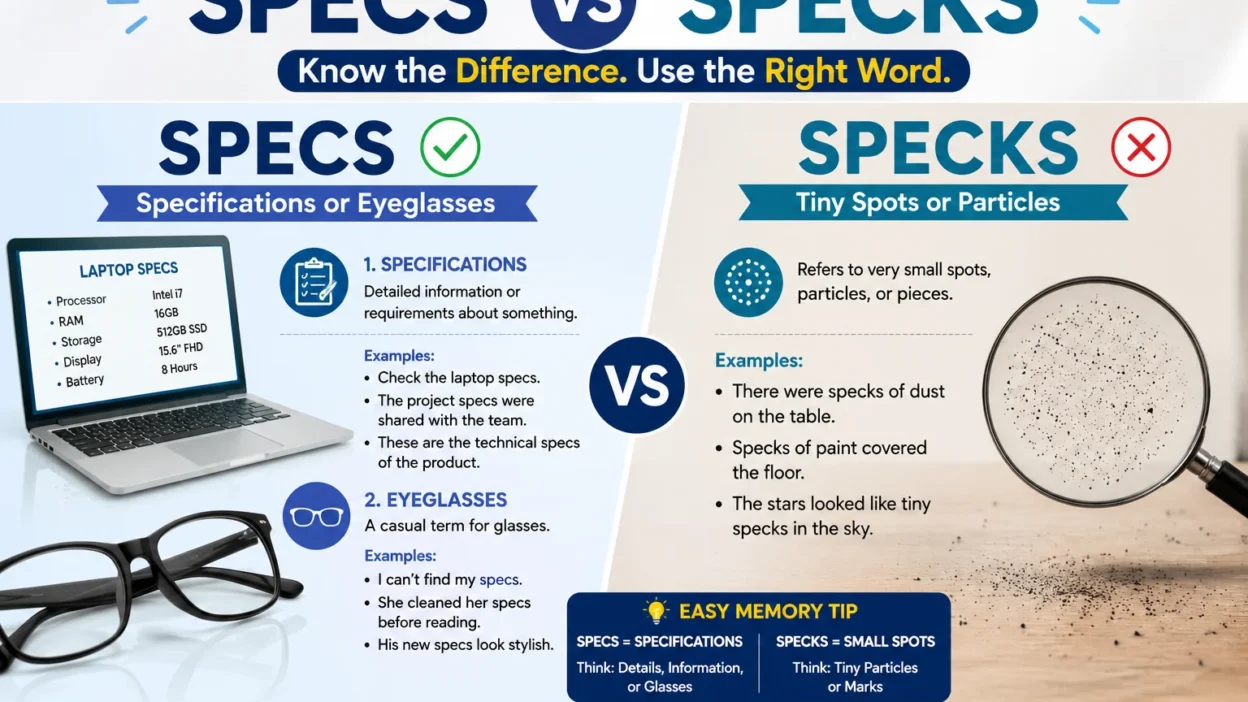
The difference between specs and specks is straightforward:
- Specs usually means specifications, details, requirements, or eyeglasses.
- Specks means tiny spots, particles, or small pieces of something.
Examples
- Check the product specs before buying a laptop.
- There were specks of dust on the table.
A simple memory trick:
- Specs = Specifications or glasses
- Specks = Small spots or particles
What Does Specs Mean?
Specs is the plural form of spec. Depending on the context, it can have two common meanings.
1. Specifications or Technical Details
In business, technology, engineering, and product descriptions, specs refers to specifications or detailed requirements.
Examples:
- The phone’s specs include 12GB of RAM.
- Read the project specs carefully.
- The architect reviewed the building specs.
- These computer specs are ideal for gaming.
2. Eyeglasses
In informal English, specs can also mean eyeglasses.
Examples:
- I can’t find my specs.
- She cleaned her specs before reading.
- His new specs look stylish.
This meaning is especially common in everyday British English.
What Does Specks Mean?
Specks is the plural form of speck, which means a very small spot, mark, particle, or piece of something.
A speck is usually tiny—often so small that it is barely noticeable.
Examples
- Tiny specks of dust covered the shelf.
- There were specks of paint on the floor.
- The sky contained a few distant specks that turned out to be birds.
- Small specks of dirt stained the fabric.
In every case, specks refers to tiny particles or marks.
Specs vs Specks: Side-by-Side Comparison
| Feature | Specs | Specks |
|---|---|---|
| Meaning | Specifications or eyeglasses | Tiny spots or particles |
| Part of Speech | Noun | Noun |
| Common Contexts | Technology, products, eyewear | Dust, dirt, paint, small marks |
| Example | Review the laptop specs. | Specks of dust covered the desk. |
| Refers To | Details or glasses | Tiny pieces or spots |
How to Use Specs Correctly
The meaning of specs depends on the situation.
Technology and Products
Examples:
- Compare the camera specs before purchasing.
- These laptop specs support advanced gaming.
- The manufacturer updated the product specs.
Business and Projects
Examples:
- The contractor followed the design specs.
- Project specs were shared with the development team.
- The client approved the final specs.
Eyeglasses
Examples:
- He left his specs on the kitchen table.
- My new specs arrived yesterday.
- She wears reading specs.
How to Use Specks Correctly
Use specks whenever you’re talking about tiny particles, spots, or marks.
Dust and Dirt
Examples:
- Specks of dust floated in the sunlight.
- The mirror had several specks of dirt.
Paint and Ink
Examples:
- Specks of paint covered the artist’s hands.
- Tiny specks of ink stained the page.
Distant Objects
Examples:
- The airplanes appeared as tiny specks in the sky.
- Boats looked like specks on the horizon.
Common Mistakes With Specs and Specks
Because the words sound alike, many people accidentally use the wrong one.
Mistake 1: Using Specks for Specifications
Incorrect:
- Check the phone’s specks before buying it.
Correct:
- Check the phone’s specs before buying it.
Mistake 2: Using Specs for Tiny Particles
Incorrect:
- There were specs of dust on the shelf.
Correct:
- There were specks of dust on the shelf.
Mistake 3: Confusing the Meanings
Incorrect:
- The sky was filled with flying specs.
Correct:
- The sky was filled with flying specks.
Always ask yourself whether you’re talking about details or tiny particles.
Easy Memory Tricks
Here are two simple ways to remember the difference.
Specs = Specifications
The word specs is short for specifications.
If you’re talking about requirements, technical details, or product features, use specs.
Specks = Small Spots
Notice that specks contains “eck.”
Think of specks as tiny flecks or little spots.
If you’re talking about dust, dirt, or particles, use specks.
Examples in Everyday Sentences
Specs
- The software specs were updated.
- Review the design specs before construction begins.
- Her specs make reading much easier.
- The gaming console’s specs are impressive.
- I misplaced my specs this morning.
Specks
- Specks of snow covered the window.
- The shirt had a few specks of mud.
- Tiny specks appeared under the microscope.
- The old photograph contained specks of damage.
- Specks of sand stuck to our shoes.
American vs British English
The meanings of specs and specks are the same in both American and British English.
However, there is one small difference.
Specs as Eyeglasses
In British English, specs is a very common informal term for eyeglasses.
Example:
- Have you seen my specs?
In American English, people are more likely to say:
- Glasses
- Eyeglasses
Nevertheless, Americans still understand the word specs.
The meaning of specks remains identical in both varieties of English.
Frequently Asked Questions
What is the difference between specs and specks?
Specs refers to specifications or eyeglasses, while specks means tiny spots, particles, or marks.
Is specs short for specifications?
Yes. Specs is commonly used as a shortened form of specifications.
What does specks mean?
Specks are very small spots, particles, or pieces of something.
Can specs mean glasses?
Yes. In informal English, specs often refers to eyeglasses.
Which word should I use for dust particles?
Use specks when referring to dust particles.
Are specs and specks pronounced the same?
In many accents, they are pronounced almost identically, which is why they are often confused.
Is specks ever used for technical details?
No. Technical details are called specs, not specks.
Do Americans and British people use these words differently?
The meanings are generally the same, though specs as a term for eyeglasses is more common in British English.
Summary
The difference between specs vs specks comes down to meaning and context. Specs refers to specifications, technical details, requirements, or eyeglasses, while specks refers to tiny spots, particles, or marks. Although the words sound similar, they describe completely different things.
Remember that specs relates to details and information, whereas specks relates to small visible particles. Understanding this distinction will help you write more accurately and avoid one of the most common homophone related mistakes in English.

Dani Morrison is a dedicated language writer and spelling expert at Spelword.com, where she focuses on helping readers understand common English spelling mistakes and confusing word pairs. With a passion for clear communication, Dani creates easy-to-follow guides that simplify complex grammar and spelling rules for everyday use.