Have you ever paused while writing and wondered whether to use foreword or forward? You’re not alone. These two words sound exactly alike, which makes them easy to confuse. However, despite their similar pronunciation, they have very different meanings and uses.
Understanding the difference between foreword vs forward can improve your writing and help you avoid a common mistake. Whether you’re reading a book, writing an email, or discussing future plans, knowing when to use each word ensures your message is clear and professional.
Quick Answer
The difference between foreword and forward is simple:
- Foreword is a noun that refers to an introductory section at the beginning of a book.
- Forward can be an adjective, adverb, verb, or noun that generally relates to movement, progress, or direction ahead.
Examples:
- The author asked a famous professor to write the foreword.
- We need to move forward with the project.
If you’re talking about a book introduction, use foreword. If you’re referring to progress, direction, or sending something onward, use forward.
What Does “Foreword” Mean?
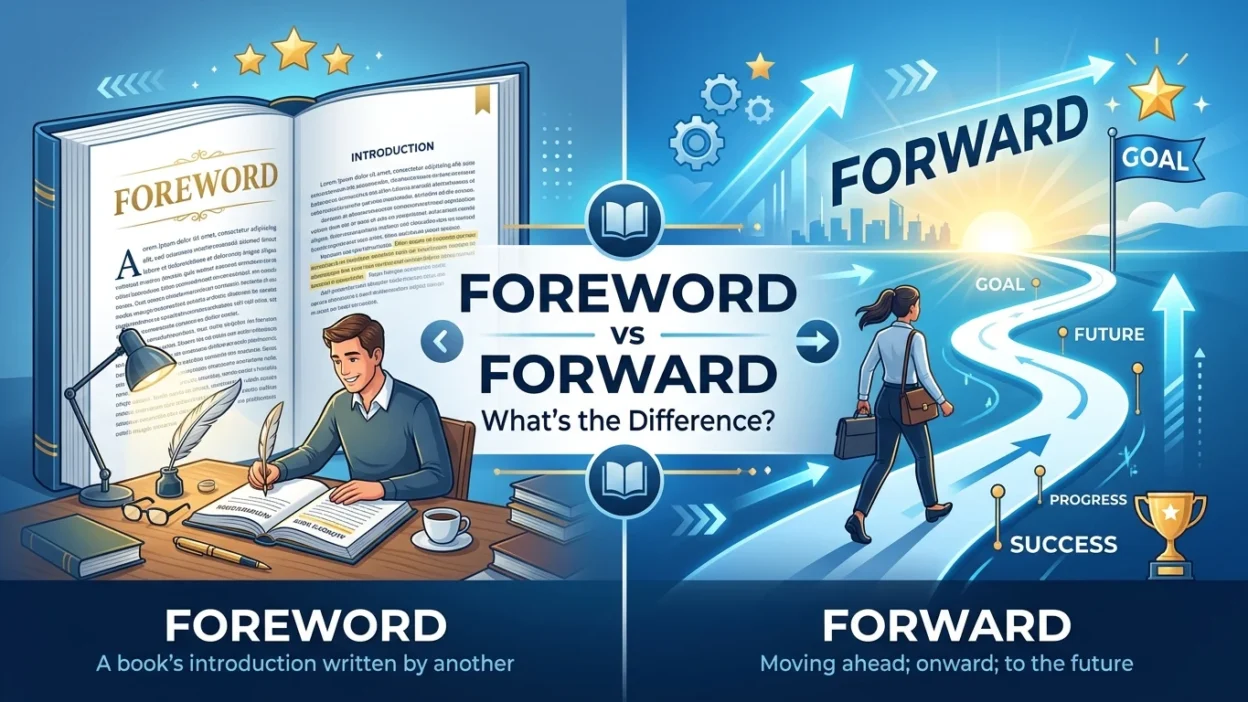
A foreword is a short introductory section found at the beginning of a book. It is often written by someone other than the author, such as an expert, colleague, or respected figure in the field.
The purpose of a foreword is to:
- Introduce the book
- Explain its importance
- Establish credibility
- Encourage readers to continue
Examples of Foreword in Sentences
- The publisher invited a historian to write the foreword.
- I enjoyed reading the foreword before starting the book.
- Her latest novel includes a foreword by a bestselling author.
- The foreword explains why the book remains relevant today.
Key Point About Foreword
A helpful way to remember this word is that foreword contains the word word. Since a foreword is written text that appears before the main content, the spelling makes sense.
What Does “Forward” Mean?
Forward is a much more versatile word. It generally refers to movement toward the front, progress, advancement, or sending something onward.
It can function as different parts of speech.
Forward as an Adverb
When used as an adverb, it describes movement ahead.
Examples:
- Please step forward.
- The crowd moved forward slowly.
- She leaned forward to hear better.
Forward as an Adjective
As an adjective, it describes something positioned toward the front or focused on progress.
Examples:
- The team adopted a forward strategy.
- He sat in the forward section of the plane.
- We need a forward plan for growth.
Forward as a Verb
As a verb, forward means to send something to another person or destination.
Examples:
- Please forward the email to me.
- She forwarded the document to her manager.
- Can you forward the invitation?
Forward as a Noun
In some contexts, forward can be a noun.
Examples:
- The coach selected a talented forward for the team.
- The forward scored the winning goal.
Foreword vs Forward: Main Differences
Although they sound the same, these words serve completely different purposes.
| Feature | Foreword | Forward |
|---|---|---|
| Part of Speech | Noun | Noun, adjective, adverb, verb |
| Meaning | Introduction to a book | Direction, progress, movement, sending onward |
| Related To | Publishing and books | Motion, advancement, communication |
| Example | Read the foreword first. | Move forward confidently. |
| Example | The foreword was inspiring. | Please forward the message. |
Why Are Foreword and Forward Confusing?
The confusion comes from the fact that they are homophones. Homophones are words that sound the same but have different meanings and spellings.
When speaking, listeners cannot tell which word is intended without context.
For example:
- “I enjoyed the foreword.”
- “Let’s move forward.”
Both words sound identical, but their meanings are completely unrelated.
Easy Trick to Remember the Difference
A simple memory tip can help you avoid mistakes.
Foreword = Before the Book
Think of:
Foreword = Front + Word
A foreword is made up of words that appear before the main text of a book.
Forward = Ahead
Think of:
Forward = Moving Ahead
Whenever the meaning involves direction, progress, advancement, or sending something on, choose forward.
Examples of Foreword in Everyday Writing
Here are some correct examples:
- The scientist wrote the foreword for the textbook.
- I always read the foreword before beginning a nonfiction book.
- The book’s foreword provided valuable context.
- Her mentor contributed a thoughtful foreword.
In each sentence, the word refers to introductory material in a publication.
Examples of Forward in Everyday Writing
Here are common uses of forward:
- Let’s move forward together.
- Please forward the report.
- The company is looking forward to future growth.
- He stepped forward to volunteer.
- The striker played as a forward.
Notice how all examples involve movement, progress, or transmission.
Common Mistakes With Foreword and Forward
Many writers accidentally swap these words because they sound alike.
Incorrect: The author wrote a forward for the book.
Correct: The author wrote a foreword for the book.
A book introduction is called a foreword.
Incorrect: We need to foreword this email.
Correct: We need to forward this email.
Sending an email onward requires the word forward.
Incorrect: I am looking foreword to meeting you.
Correct: I am looking forward to meeting you.
The common expression is “looking forward to.”
Incorrect: The foreword scored two goals.
Correct: The forward scored two goals.
In sports, a player position is called a forward.
Foreword vs Forward in Publishing
In publishing, these words have completely different meanings.
Foreword
A foreword:
- Appears before the main text
- Is usually written by someone other than the author
- Introduces the book’s value and purpose
Forward
The word forward is rarely used in publishing unless discussing future plans, progress, or communication.
Understanding this distinction is especially important for writers, editors, students, and authors.
American vs British English Differences
There is no significant difference between American and British English regarding foreword and forward.
Both varieties use the same spellings and meanings.
For example:
- The book includes a foreword.
- We are moving forward with the proposal.
These forms are accepted and standard in both American and British English.
When to Use Foreword
Use foreword when referring to:
- A book introduction
- Preliminary remarks in a publication
- Introductory commentary written by someone other than the author
Examples
- The editor requested a foreword.
- The foreword highlighted the author’s achievements.
- Readers often skip the foreword, but it can be insightful.
When to Use Forward
Use forward when discussing:
- Direction
- Movement
- Progress
- Advancement
- Sending information
- Sports positions
Examples
- Move forward carefully.
- Please forward the attachment.
- The company continues to move forward.
- She plays forward on the soccer team.
Frequently Asked Questions
What is the difference between foreword and forward?
A foreword is an introductory section of a book, while forward refers to movement, progress, direction, or sending something onward.
Is a foreword part of a book?
Yes. A foreword appears at the beginning of a book and usually introduces the work to readers.
Can foreword be used as a verb?
No. Foreword is only used as a noun.
Is it foreword an email or forward an email?
The correct phrase is forward an email because it means sending the message to someone else.
Why do foreword and forward sound the same?
They are homophones, meaning they share the same pronunciation but have different spellings and meanings.
Who usually writes a foreword?
A foreword is often written by an expert, colleague, mentor, or notable person rather than the book’s author.
Is looking foreword to correct?
No. The correct expression is looking forward to.
Are foreword and forward interchangeable?
No. They have different meanings and cannot be used interchangeably.
Summary
The distinction between foreword vs forward is straightforward once you understand their meanings. A foreword is a book’s introductory section, typically written by someone other than the author. In contrast, forward relates to movement, advancement, direction, or sending something onward.
Although the two words sound identical, remembering their different purposes will help you choose the correct spelling every time. When discussing books, use foreword. When talking about progress, movement, communication, or future direction, use forward. Mastering this difference can make your writing clearer, more accurate, and more professional.

Dani Morrison is a dedicated language writer and spelling expert at Spelword.com, where she focuses on helping readers understand common English spelling mistakes and confusing word pairs. With a passion for clear communication, Dani creates easy-to-follow guides that simplify complex grammar and spelling rules for everyday use.