When writing about someone’s death, choosing the correct words matters. One phrase that often creates confusion is passed away vs past away. Because the words passed and past sound similar in many accents, people sometimes use the wrong spelling without realizing it.
If you’ve ever wondered whether the correct phrase is passed away or past away, you’re not alone. This is a common grammar and spelling mistake in English. Understanding the difference can help you write more accurately and respectfully, especially when discussing a sensitive topic. In this guide, you’ll learn the meanings, proper usage, examples, common errors, and simple tricks to remember the correct form.
Quick Answer
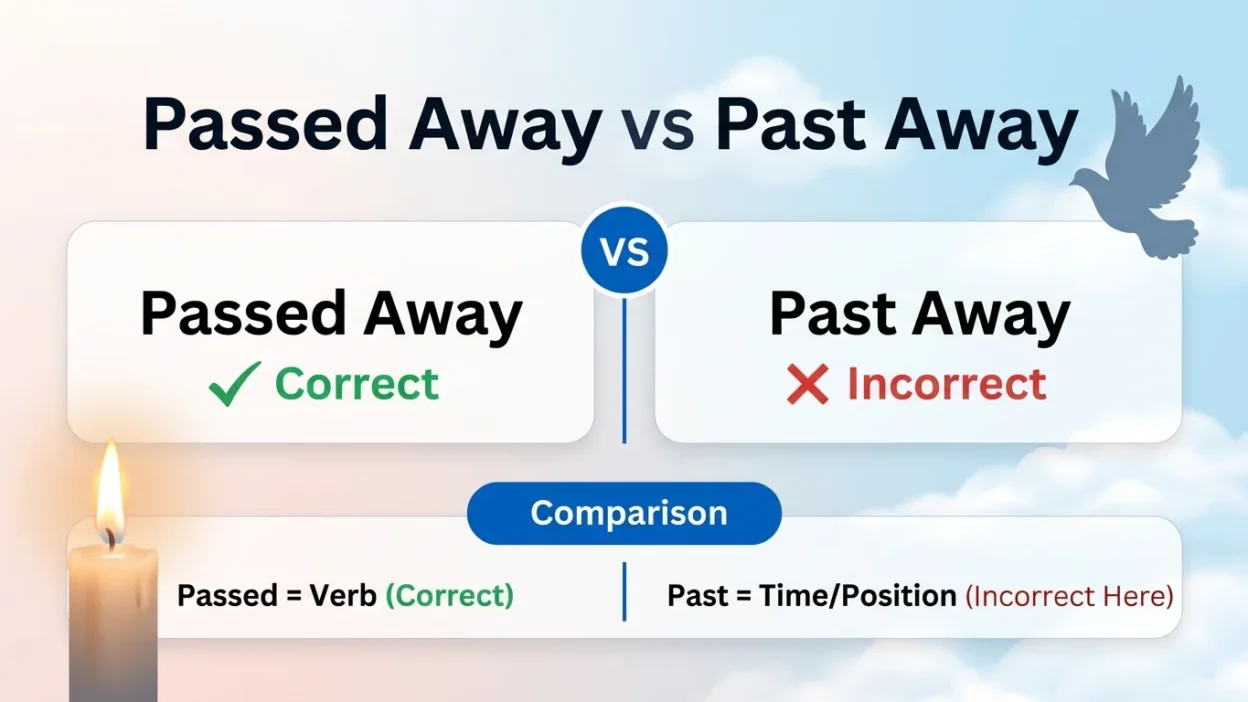
Passed away is the correct phrase.
It is a polite and widely accepted expression meaning that someone has died.
Past away is incorrect and is not recognized as a standard English expression.
Correct Example
- Her grandfather passed away peacefully last year.
Incorrect Example
- Her grandfather past away peacefully last year.
If you are referring to someone’s death, always use passed away.
What Does Passed Away Mean?
Passed away is a gentle and respectful euphemism for death. Instead of directly saying that someone died, people often use passed away to express the same idea in a softer and more compassionate way.
The phrase has been used for centuries and remains common in conversations, obituaries, memorial messages, and formal announcements.
Examples of Passed Away
- My neighbor passed away after a long illness.
- She passed away surrounded by her family.
- The beloved actor passed away at the age of 82.
- His father passed away several years ago.
- We were saddened to learn that our teacher passed away.
In each example, the phrase refers respectfully to a person’s death.
What Does Past Away Mean?
Past away is not a standard English phrase.
People usually write past away by mistake because they confuse the words past and passed. While past is a real English word, it does not work in this expression.
For example:
Incorrect:
- My aunt past away last month.
Correct:
- My aunt passed away last month.
If you see past away, it is almost always a spelling error.
Passed Away vs Past Away: Side-by-Side Comparison
| Feature | Passed Away | Past Away |
|---|---|---|
| Standard English | Yes | No |
| Meaning | Died | No accepted meaning |
| Grammatically Correct | Yes | No |
| Used in Formal Writing | Yes | No |
| Common Usage | Very common | Considered an error |
The comparison clearly shows that passed away is the only correct choice.
Why Is Passed Away Correct?
To understand why passed away is correct, let’s examine the word passed.
Passed is the past tense of the verb pass.
Examples:
- He passed the test.
- The years passed quickly.
- She passed through the city.
In the phrase passed away, the verb pass takes on a special meaning related to leaving life or moving from this world.
Because it functions as a verb phrase, passed is required.
Why Is Past Away Incorrect?
The word past is usually a noun, adjective, adverb, or preposition.
Examples:
- We talked about the past.
- The past year was difficult.
- Walk past the building.
Notice that past is not a verb.
Since the phrase requires a verb, past away does not make grammatical sense.
That’s why English speakers and style guides consider it incorrect.
Understanding Passed vs Past
The confusion often comes from the words passed and past themselves.
Passed
Passed is a verb.
Examples:
- She passed the exam.
- Time passed quickly.
- He passed the ball.
Past
Past usually refers to time, position, or movement beyond something.
Examples:
- Let’s forget the past.
- We walked past the store.
- The past month was busy.
A helpful rule is:
If you need an action word, use passed.
Since passed away describes an action, it requires the verb form.
Examples of Passed Away in Sentences
Here are additional examples of the correct phrase.
Personal Situations
- My grandmother passed away peacefully in her sleep.
- His uncle passed away unexpectedly.
News and Announcements
- The former mayor passed away at age ninety.
- The organization announced that its founder had passed away.
Sympathy Messages
- I am sorry to hear that your father passed away.
- Our thoughts are with the family during this difficult time after their loved one passed away.
Historical References
- The famous scientist passed away in the early twentieth century.
- The author passed away shortly after publishing her final book.
These examples demonstrate how commonly the phrase appears in both formal and informal contexts.
Common Mistakes to Avoid
Writing Past Away Instead of Passed Away
Incorrect:
- The singer past away last year.
Correct:
- The singer passed away last year.
Confusing Passed and Past
Incorrect:
- He past the ball to his teammate.
Correct:
- He passed the ball to his teammate.
Assuming Sound Determines Spelling
Because passed and past often sound similar in everyday speech, many people choose the wrong spelling. Always focus on the meaning and grammatical role of the word.
Is Passed Away Too Informal?
No. Passed away is accepted in both formal and informal English.
It commonly appears in:
- Obituaries
- Funeral notices
- Sympathy cards
- News reports
- Family conversations
- Memorial tributes
However, some contexts may require more direct language, such as medical reports or legal documents, where the word died is often preferred.
Alternative Expressions
English offers several ways to refer to death respectfully.
Examples include:
- Passed away
- Died
- Departed
- Lost their life
- No longer with us
- Left this world
Among these options, passed away remains one of the most widely used and gentle expressions.
American vs British English
There is no significant difference between American and British English regarding passed away.
Both varieties of English use:
- Passed away ✓
- Past away ✗
Examples accepted in both American and British English:
- Her mother passed away last year.
- The respected professor passed away peacefully.
The phrase is recognized and understood across the English-speaking world.
Easy Memory Trick
A simple trick can help you remember the correct spelling.
Ask yourself:
Is this describing an action?
If yes, you need the verb passed.
Remember:
- Passed = action
- Past = time or position
Since someone “passes away,” the correct phrase must contain the verb passed.
Frequently Asked Questions
Is it passed away or past away?
Passed away is correct. Past away is a spelling mistake.
Why is past away incorrect?
Past is not a verb, and the phrase requires a verb. Therefore, passed away is the correct form.
What does passed away mean?
Passed away is a polite and respectful way of saying that someone died.
Is passed away formal English?
Yes. It is widely accepted in both formal and informal communication.
Can I use passed away in an obituary?
Yes. Passed away is one of the most common phrases used in obituaries and memorial notices.
Is past away ever correct?
No. Standard English does not recognize past away as a correct expression.
What is the difference between passed and past?
Passed is the past tense of the verb pass, while past refers to time, position, or movement beyond something.
Do Americans and British people both use passed away?
Yes. Both American and British English use passed away in the same way.
Summary
Understanding passed away vs past away is relatively simple once you know the role of each word. Passed away is the correct and widely accepted phrase used to refer respectfully to someone’s death. The word passed functions as a verb, making the expression grammatically correct and meaningful.
On the other hand, past away is an error caused by confusion between the words past and passed. While the two words may sound similar, they serve different grammatical purposes. Whenever you’re referring to a person’s death, always use passed away to ensure your writing is accurate, respectful, and professional.

Dani Morrison is a dedicated language writer and spelling expert at Spelword.com, where she focuses on helping readers understand common English spelling mistakes and confusing word pairs. With a passion for clear communication, Dani creates easy-to-follow guides that simplify complex grammar and spelling rules for everyday use.