
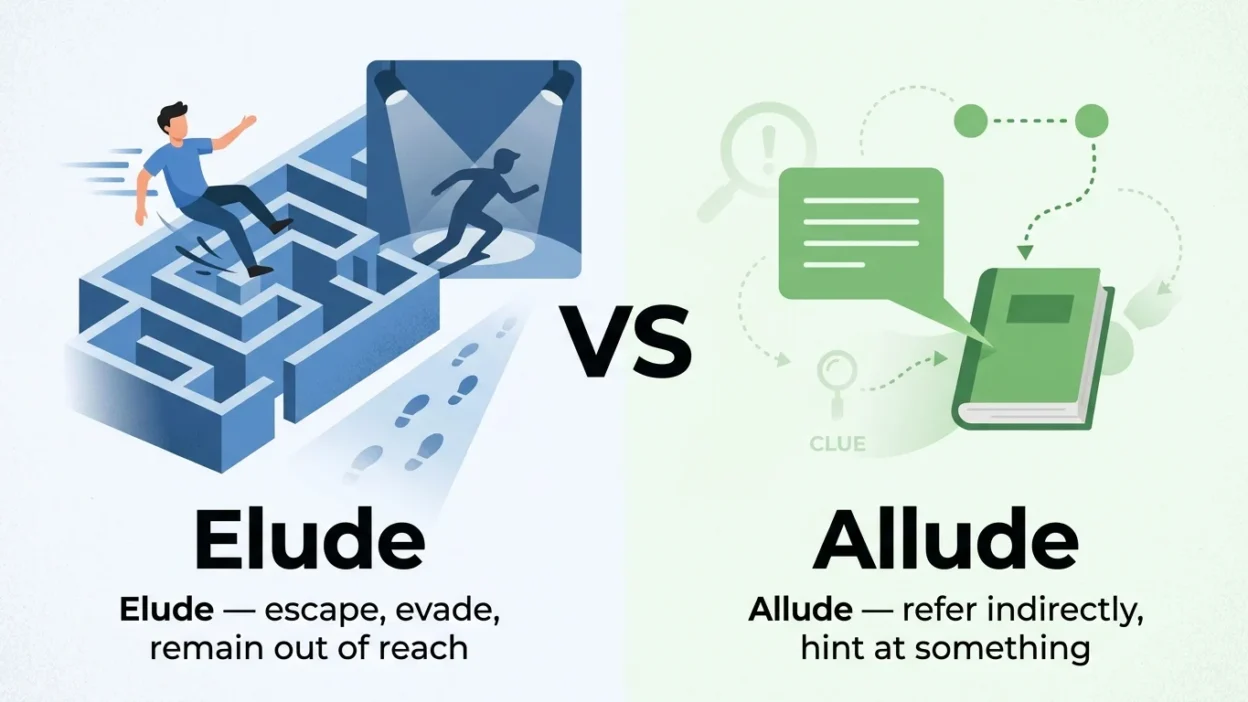
English is full of words that sound similar but have completely different meanings. One pair that often causes confusion is elude vs allude. Because these words rhyme and look somewhat alike, many writers accidentally use one when they mean the other.
If you’ve ever paused while writing and wondered whether to choose elude or allude, you’re not alone. Understanding the difference is easier than it seems. Once you learn their meanings and see them in context, you’ll be able to use both words confidently in everyday conversations, professional writing, and academic work.
Quick Answer
Elude means to escape, avoid, or remain difficult to understand or achieve.
Allude means to refer to something indirectly without mentioning it explicitly.
Examples:
- The suspect managed to elude the police.
- The speaker alluded to recent events during her presentation.
A simple way to remember the difference is:
- Elude = Escape
- Allude = Indirectly Refer
What Does Elude Mean?
The verb elude means to escape from someone, avoid capture, evade understanding, or remain out of reach.
It is commonly used when someone or something cannot be caught, found, understood, or achieved.
Examples of Elude
- The thief managed to elude security guards.
- Success continued to elude the struggling company.
- The answer seemed to elude me during the exam.
- The animal quickly eluded its hunters.
In each example, the idea is that something escapes or remains unattainable.
What Does Allude Mean?
The verb allude means to make an indirect reference to something without directly stating it.
Writers, speakers, and public figures often allude to events, people, books, or ideas when they expect the audience to understand the reference.
Examples of Allude
- The author alluded to a famous historical event.
- During the meeting, she alluded to possible changes in management.
- His joke alluded to a popular movie.
- The article alludes to problems within the organization.
In each case, the speaker or writer refers to something indirectly rather than naming it directly.
Elude vs Allude: Side-by-Side Comparison
| Feature | Elude | Allude |
|---|---|---|
| Meaning | Escape, evade, avoid | Refer indirectly |
| Context | Avoidance or difficulty | Communication or reference |
| Part of Speech | Verb | Verb |
| Main Idea | Something remains out of reach | Something is hinted at |
| Example | The solution eluded me | She alluded to the solution |
When Should You Use Elude?
Use elude when talking about something that:
- Escapes capture
- Avoids detection
- Remains difficult to understand
- Cannot be achieved easily
Correct Examples
- The criminal continued to elude authorities.
- The exact cause of the problem has eluded researchers.
- Victory seemed to elude the team all season.
- The meaning of the poem initially eluded the students.
In all these examples, something remains beyond reach.
When Should You Use Allude?
Use allude when referring to something indirectly.
This word often appears in:
- Speeches
- Literature
- Journalism
- Academic writing
- Everyday conversations
Correct Examples
- The professor alluded to a famous scientific theory.
- The politician alluded to previous policy failures.
- The novel alludes to ancient mythology.
- She briefly alluded to her childhood experiences.
In each sentence, the reference is implied rather than stated directly.
Common Mistakes with Elude and Allude
Because these words sound similar, they are frequently confused.
Mistake 1: Using Allude When You Mean Escape
❌ The suspect alluded the police for weeks.
✅ The suspect eluded the police for weeks.
Why? The suspect escaped capture rather than making an indirect reference.
Mistake 2: Using Elude When You Mean Refer Indirectly
❌ The speaker eluded to recent events.
✅ The speaker alluded to recent events.
Why? The speaker referred to something indirectly.
Mistake 3: Assuming They Have Related Meanings
Although they sound alike, elude and allude have completely different meanings.
One involves escaping.
The other involves indirect references.
Easy Memory Tricks
A simple memory trick can help you remember the difference.
Remember Elude
Think of the letter E in elude as standing for escape.
- Elude = Escape
- Elude = Evade
Remember Allude
Think of the word allude as related to making an allusion, which is an indirect reference.
- Allude = Refer
- Allude = Hint
These associations make it easier to choose the correct word while writing.
Elude and Allude in Literature
Both words appear frequently in books and articles.
Elude in Literature
Authors often use elude when describing:
- Mystery
- Unanswered questions
- Unattainable goals
- Escaping danger
Example:
- The truth continued to elude the detective.
Allude in Literature
Authors use allude to create deeper meaning by referencing other works, historical events, or cultural ideas.
Example:
- The novel alludes to several Greek myths.
Recognizing these references can enrich the reading experience.
American vs British English Differences
There is virtually no difference between American and British English regarding elude and allude.
Both varieties of English:
- Define the words the same way.
- Use them in the same contexts.
- Follow the same grammatical rules.
Whether you’re writing for an American or British audience, the distinction remains:
- Elude means escape or evade.
- Allude means refer indirectly.
Real-Life Examples
Business Writing
- The reason for declining sales continues to elude analysts.
- The CEO alluded to upcoming changes during the conference.
Academic Writing
- The solution to the equation initially eluded students.
- The research paper alludes to previous studies.
Everyday Conversation
- Sleep seemed to elude me last night.
- He alluded to a surprise without giving details.
News Reporting
- Authorities say the suspect continues to elude capture.
- Officials alluded to future reforms during the press briefing.
These examples demonstrate how differently the two words function despite their similar pronunciation.
Why Understanding the Difference Matters
Choosing the correct word improves clarity and professionalism.
Consider these sentences:
- The answer eluded me.
- The author alluded to the answer.
The first means the answer was difficult to understand or obtain.
The second means the author indirectly referred to the answer.
Using the wrong word can completely change the meaning of a sentence.
For students, professionals, writers, and content creators, mastering this distinction helps prevent misunderstandings and strengthens communication.
Frequently Asked Questions
What is the difference between elude and allude?
Elude means to escape, evade, or remain difficult to achieve. Allude means to refer to something indirectly.
Is elude related to escaping?
Yes. Elude commonly describes escaping capture, avoiding detection, or remaining out of reach.
What does allude mean in writing?
Allude means to hint at or indirectly mention a person, event, idea, or work without explicitly naming it.
Can elude and allude be used interchangeably?
No. They have completely different meanings and should not be substituted for one another.
How can I remember the difference between elude and allude?
Think of elude as escape and allude as allusion or indirect reference.
Is there a British and American English difference?
No. Both American and British English use these words with the same meanings.
What is an example of allude in a sentence?
“The speaker alluded to recent events without mentioning them directly.”
What is an example of elude in a sentence?
“The solution continued to elude researchers for years.”
Summary
Understanding elude vs allude becomes simple once you focus on their core meanings. Elude means to escape, evade, or remain difficult to obtain, while allude means to refer to something indirectly. Although the words sound similar, they serve entirely different purposes in communication.
Using the correct word helps make your writing clearer, more accurate, and more professional. Whenever you’re unsure, remember that elude relates to escaping or avoiding, while allude relates to hinting or making an indirect reference. Keeping this distinction in mind will help you avoid one of the most commonly confused word pairs in English.

William Harved is a passionate language enthusiast and digital writer specializing in English spelling, grammar clarity, and common writing mistakes. As the primary author of Spelword.com, he focuses on helping readers understand confusing word pairs, correct spelling errors, and improve everyday communication.